Rank #1 in Resistance Bands & Suspension Trainers
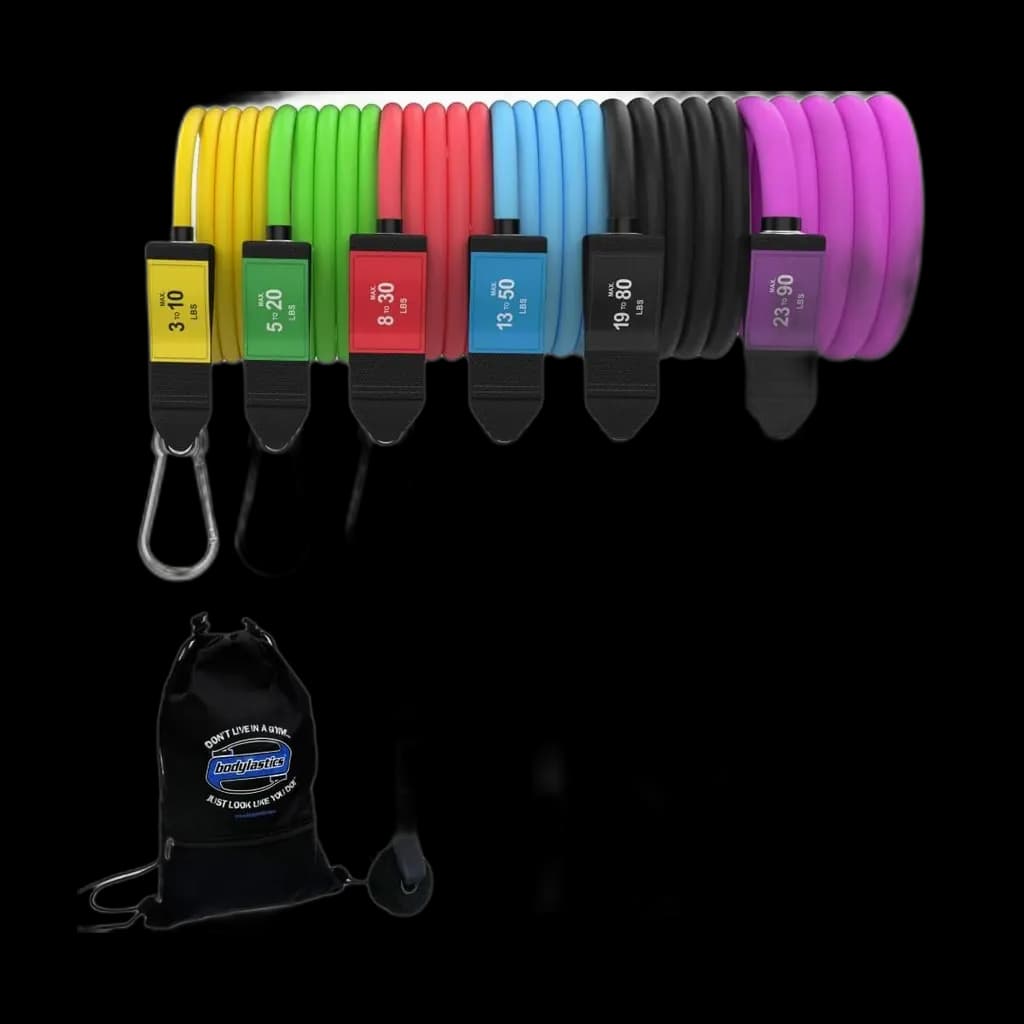
Bodylastics Stackable Resistance Bands Set
by Bodylastics
Score
The stackable tube band benchmark. Snap-guard inner cord, named carabiners, and component replacement parts available — the system you'll still be using in 10 years.
- Travelers, apartment lifters, and rehab users who want a serious band system with safety-first construction and the option to scale resistance over years.
- You already lift heavy free weights, you need true bilateral pressing at over 200 lb, or you dislike clipping and unclipping carabiners between sets.
Nothing dedicated. A door anchor needs a solid door; ground-based work needs about a 6 by 6 ft clear patch of floor.
easy — Out of the bag in under five minutes. The bands clip directly to the handles and ankle straps via named carabiners; no assembly tools required.
Tube band systems are accessory tier. Buy them after free weight foundations or as a travel and recovery layer to an existing rack and bench setup.
Strengths
- ↑Snap-guard anti-whip inner cord
- ↑Stackable up to 96+ lb (XT goes 300+)
- ↑Replaceable parts
- ↑Quality handles + ankle straps
- ↑Door anchor included
Weaknesses
- ↓Tube bands wear faster than fabric
- ↓Carabiner clipping takes practice
- ↓Max stack tension still below heavy free weights
What owners actually complain about
Synthesized from owner reviews and community threads. Paraphrased, not quoted.
- Carabiner clipping takes practice and can pinch fingers on first uses
- Tube bands stretch slightly over the first 30 days and need re-rating
- Door anchor placement matters more than the manual suggests; bad placement causes the foam to slip
- Stack of 5 bands can tangle when stored loose in the supplied bag
- Replacement parts are available but the website is the only good source
Buyer sentiment
Based on 2,239 user mentionsBuyers praise quality, workout performance, durability and construction.
Verdict: The safest serious tube-band system — ideal for travelers, apartments, and rehab, with a snap-guard cord that keeps a failed band from whipping.
Specs that matter
| Spec | Value |
|---|---|
| Bands | 5 tubes: 3, 8, 13, 19, 23 lb |
| Max stacked resistance | 96 lb (all five on one carabiner) |
| Safety design | Nylon snap-guard cord rated longer than the latex |
| Carabiners | Forged steel, screw-lock, replaceable |
What you get
- Safety — inner cord catches the ends if latex fails
- Portability — packs into a backpack pocket, near-silent
- Replaceable parts — long runway; clinic and military-list staple
What you give up
- Strength ceiling — 96 lb tops out rows/curls within a year for serious lifters
- Carry bag — weak, tears within a year
Buy it if you value portability, joint-friendly resistance, and rehab use. Skip it if you need to replace a rack and bench for heavy lifting.
Reviewers note the load-bearing cord inside each tube is why it shows up repeatedly in PT clinics and on deployment gear lists.
Full specs
- Resistance
- Up to 96 lb (Stackable XT: 300+ lb)
- Bands
- 5 tube bands, color-coded
- Includes
- Door anchor, handles, ankle straps, bag
- Warranty
- Lifetime on snap-guard
Common questions
Can the bands really replace free weights?
For most general fitness goals up to a moderate strength level, yes. The 96 lb stack covers the working range for pressing, rowing, and accessory work. Heavy compound lifts like a 300 lb squat or 200 lb bench will eventually need real iron because the strength curve and stabilization demand differ.
What is the snap-guard cord and does it work?
An inner nylon cord runs the length of each tube. If the latex tears, the cord holds the broken ends together so nothing whips back. Independent reviews and the product warranty both confirm the design works as described in normal use.
How long do the bands last?
Daily users report two to four years on the original bands before the latex shows surface cracks. Storage out of sunlight and avoiding leaving bands stretched while not in use roughly doubles that life.
Is the door anchor safe?
Yes on a solid, latched door with the anchor placed near the top hinge for downward pulls or near the bottom hinge for upward pulls. Hollow interior doors and sliding doors are not safe anchors for any band system.
Can I stack bands beyond 96 lb?
The standard set tops out at 96 lb. The Stackable XT line extends to roughly 300 lb using thicker bands and the same handles, and the parts are cross-compatible if you upgrade later.
Sources & references
- ManufacturerBodylastics Anti-Snap Technology Product Page
- ResearchResistance Band Safety and Care Guidelines
- ResearchCommon Resistance Band Injuries
- ResearchResistance Band Training Effectiveness Review
- Independent reviewTips to Stop Resistance Bands from Snapping
- CommunityHome Band Training Community Discussion
Full buying guide
Best Resistance Bands for Home Gyms in 2026: Bodylastics Wins
Read the full ranking →Related Resistance Bands & Suspension Trainers guides
Other resistance bands & suspension trainers we rate
Ranked alternatives from the same category, with our score and the current price.
The travel suspension trainer. Lighter than the TRX Pro, anchors to any door or tree, and brings a full-body workout to a hotel room. The brand that defined the category.
The Amazon best-seller for a reason — 200K+ reviews, 5-tier loop set, ships with instructional ebook. The 'starter set everyone owns'.
The default pull-up assist (and powerlifting accommodating resistance) bands. Layered latex, 41" continuous loop, four tensions that cover beginner to elite.
The flagship TRX. Heavier-duty fabric than the GO, padded foot cradles, and a 350 lb capacity — what trainers buy for clients.
ProsourceFit Loop Resistance Bands Set
Best-value mini-band set for glute work and warm-ups. Five colors, stitched (not glued) seams, costs less than a pair of cheap dumbbells.