Rank #1 in Saunas & Infrared
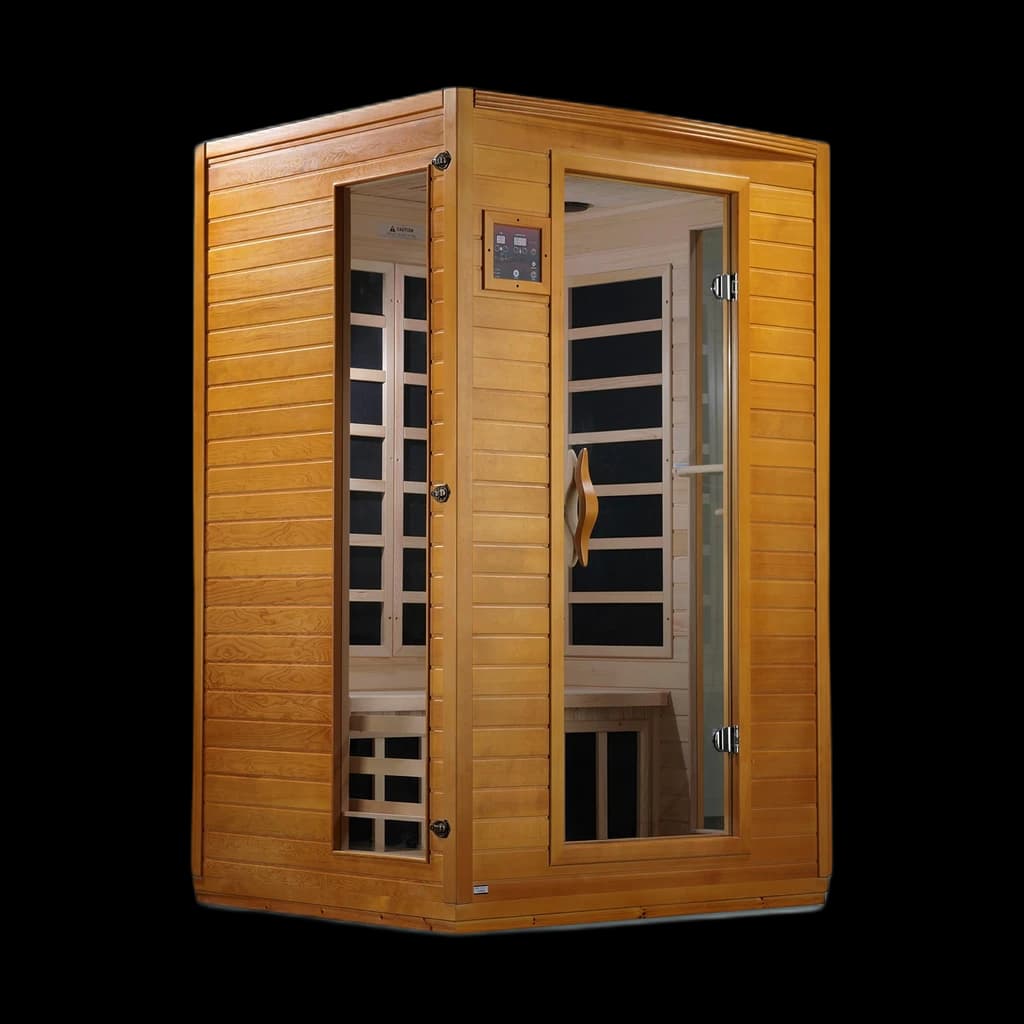
Dynamic Saunas Andora 2-Person
by Dynamic SaunasBuy later
Score
Two-person Canadian hemlock cabin with carbon-far-IR heaters. Mid-tier price for cabin construction, available on Amazon Prime. The compromise pick if Sun Home is out of budget.
- Buyers who want a true 2-person cabin sauna at under $2,500 with Amazon Prime delivery
- Home users prioritizing far-infrared protocol over near or mid-IR spectrum
- Garages and basements with 120V standard household circuits (no electrician required)
- Couples wanting shared session capacity without the $4,000+ Sun Home or Sunlighten price tag
- Buyers willing to accept lower-grade carbon panels in exchange for hemlock cabin construction
- You have cardiovascular disease, uncontrolled hypertension, or are pregnant , sauna use raises core body temperature and heart rate; consult your physician (Mayo Clinic, AHA guidance)
- You take medications that impair sweating (anticholinergics, some antihistamines, beta-blockers) , heat tolerance is reduced
- You want full-spectrum (near + mid + far) IR , this unit is far-IR only
- You need EMF below 1 mG , the lower-grade carbon panels typically test 2-4 mG at body distance
- You have a medical implant, pacemaker, or recent surgery , clear sauna use with your doctor first
Cabin footprint is approximately 47x40 inches (3.9 x 3.3 feet) with a height around 75 inches. Plan on at least 5x5 feet of floor space to allow door swing and 6 inches of clearance behind for ventilation. Hardwood, tile, or sealed concrete is fine; carpet is not , moisture from sweat will trap underneath. The unit ships with a 120V plug; no dedicated 240V circuit or electrician needed, but the circuit should ideally not be shared with high-draw appliances.
moderate — Two people for 90 minutes to 2 hours. The panels arrive pre-wired and interlock with a buckle system; no power tools required. The most common assembly mistake is rushing the panel alignment, which leaves visible gaps that leak heat. Read the manual fully before starting , sequence matters. Tighten buckles in two passes (snug, then final) to avoid stressing the hemlock joinery.
A home sauna is a destination purchase, not a foundation. Most buyers add it after the primary training equipment (rack, bench, cardio piece) is in place and they're chasing the next recovery upgrade. Buying a sauna before basic strength and cardio gear in place is almost always a misallocation of capital.
Strengths
- ↑True cabin build under $2,500
- ↑Amazon Prime eligible
- ↑Two-person capacity
- ↑Hemlock construction
Weaknesses
- ↓Far-IR only (no near/mid)
- ↓Lower-grade panels than premium tier
What owners actually complain about
Synthesized from owner reviews and community threads. Paraphrased, not quoted.
- Hemlock cabin develops faint pine-resin smell during first 5-10 sessions as wood cures
- Far-IR-only spectrum means longer sessions needed compared to full-spectrum competitors to reach the same therapeutic dose
- Carbon panels at this price tier test higher on EMF than premium-tier Sunlighten or Sun Home units
- Bench depth tighter than premium competitors , taller users (over 6'2") feel cramped at 2-person capacity
- 120V power means warmup to 130°F takes 30-45 minutes; 240V cabins reach temperature in 20-30
- Customer service response times slower than premium brands; warranty claims can take 2-3 weeks
Buyer sentiment
Based on 650 user mentionsBuyers praise assembly, quality, functionality and value for money. Mixed feedback on heating performance and heating time.
Verdict: The best real wood-cabin infrared sauna under $2,500 — a genuine compromise pick, not the best sauna outright.
Specs that matter
| Spec | Value |
|---|---|
| Construction | Canadian hemlock (grade-B) |
| Heating | Carbon far-infrared only |
| Power | 120V / 15A (~1,800W) |
| Temp ceiling | ~130–140°F |
| Capacity | 2-person |
What you get
- Real wood cabin — hemlock tolerates heat-cool cycling
- Plug-and-play — standard 120V outlet, no electrician
- Reliable heat — reaches setpoint in 30–45 min, holds it
What you give up
- Far-IR only — no near-IR/full-spectrum, EMF tests 2–4 mG
- Slower service — Amazon-channel warranty; temp can't hit Finnish 160–180°F
Buy it if you want a wood cabin under $2,500 for 3–5 sessions/week on a 120V outlet. Skip it if you need EMF certification, full-spectrum, or traditional Finnish heat.
The Finnish KIHD cohort (JAMA Internal Medicine 2015) found dose-response longevity benefit up to 7 sessions/week of 19+ minutes, with biggest gains between 4 and 7 sessions weekly.
Full specs
- Type
- 2-person cabin
- IR Spectrum
- Far only
- Power
- 120V
- Material
- Canadian hemlock
Common questions
Is far-infrared only enough, or do I need full-spectrum?
The published research on cardiovascular and longevity benefits of sauna use (Finnish KIHD cohort, JAMA reviews) was almost entirely conducted on traditional Finnish saunas, not infrared at any spectrum. Far-IR specifically penetrates 1.5 to 2 inches into tissue and is the spectrum tied to most consumer infrared marketing claims. Near-IR (red and near-IR light) has separate emerging evidence for skin and mitochondrial effects. If the goal is sweat, cardiovascular load, and the documented research benefits, far-IR alone at sufficient duration (30-45 minutes at 130-140°F) gets you there. Full-spectrum is a meaningful upgrade only if you also want the photobiomodulation effects of near-IR.
Should I be worried about EMF?
Mid-range carbon panels at this price tier typically test 2 to 4 milligauss at body distance, versus premium units (Sunlighten Signature, Sun Home Luminar) that test under 1 mG. The Swedish TCO standard for computer monitors is 2 mG at 30 cm; long-term low-frequency EMF research is mixed and ongoing. If EMF is a primary concern, the Andora is not the right unit and you should step up to a low-EMF certified premium model. If EMF is a secondary concern, the readings here are within the range of common household appliances.
Can I install this on a 120V circuit shared with my treadmill?
Not recommended. The sauna draws roughly 1,500 watts during heating and 800-1,200 watts maintaining temperature. A 15A 120V circuit can theoretically handle the combined load with a treadmill, but in practice you'll trip the breaker on simultaneous high-draw events. Run the sauna on its own dedicated 15A or 20A circuit, or alternate use times if sharing.
What's the realistic temperature ceiling at 120V?
The Andora's manufacturer-rated ceiling is 140°F. Real-world ceiling in a typical garage is 130-135°F after 45-60 minutes of warmup, with the temperature dropping 5-10°F when the door opens. 120V infrared cabins fundamentally cannot match the 160-180°F of a 240V Finnish-style sauna, which is fine for IR protocols but a real consideration if you want traditional sauna heat.
How long should each session be?
Research on the Finnish KIHD cohort showed maximum cardiovascular benefit at 4-7 sessions per week of 19-plus minutes each. For infrared protocols at 130-140°F, most users settle into 30-45 minute sessions starting from a cooler body temperature. New users should start at 15-20 minutes and build up over 2-3 weeks. Stop immediately for dizziness, nausea, or rapid heart rate; rehydrate with 16-20 oz water per session minimum.
Sources & references
- ResearchSauna Bathing and Cardiovascular Health , clinical review— Mayo Clinic Proceedings
- ResearchCardiovascular and Other Effects of Sauna Bathing (JAMA review)— NIH / NCBI PMC
- ResearchAHA Position on Sauna Use and Heart Health— American Heart Association
- Home Infrared Sauna Reviews , owner discussion— r/Sauna community consensus
- Infrared Sauna Buying Guide , spectrum and EMF— Garage Gym Reviews
Full buying guide
Best Infrared Sauna for Home Use in 2026: HigherDOSE Wins
Read the full ranking →Related Saunas & Infrared guides
Other saunas & infrared we rate
Ranked alternatives from the same category, with our score and the current price.
The 'budget portable' that sets the floor. Heated steam pod with chair seat, fits in a corner, $200. Build is what you'd expect at the price — useful, not premium. Beats nothing-at-all.
The one-person answer to the same question the Andora answers for two: a real Pacific-cedar cabin on a standard 120V outlet, with carbon far-IR panels and a red-light panel in the ceiling. It is not a full-spectrum $4,000 cabin, and we do not claim it is — it is the cabin you buy when a one-person footprint and a plug are the constraints.
Portable single-person cabin with full-spectrum IR (near + mid + far). Sets up in 5 minutes, folds for storage, runs on standard 120V. The sweet-spot product between blankets and full cabins.
The benchmark infrared blanket. Low-EMF, 158°F max, amethyst+tourmaline+charcoal layering claim is marketing fluff but the construction is real. Folds into a closet — most-replicated 'just works' choice in this category.
HigherDOSE alternative — Australian brand, similar low-EMF infrared blanket spec at slightly lower price. Strong build, real customer service. Pick this over HigherDOSE if you find it cheaper in stock.