 Best Budget
Rank #2 in Weight Benches
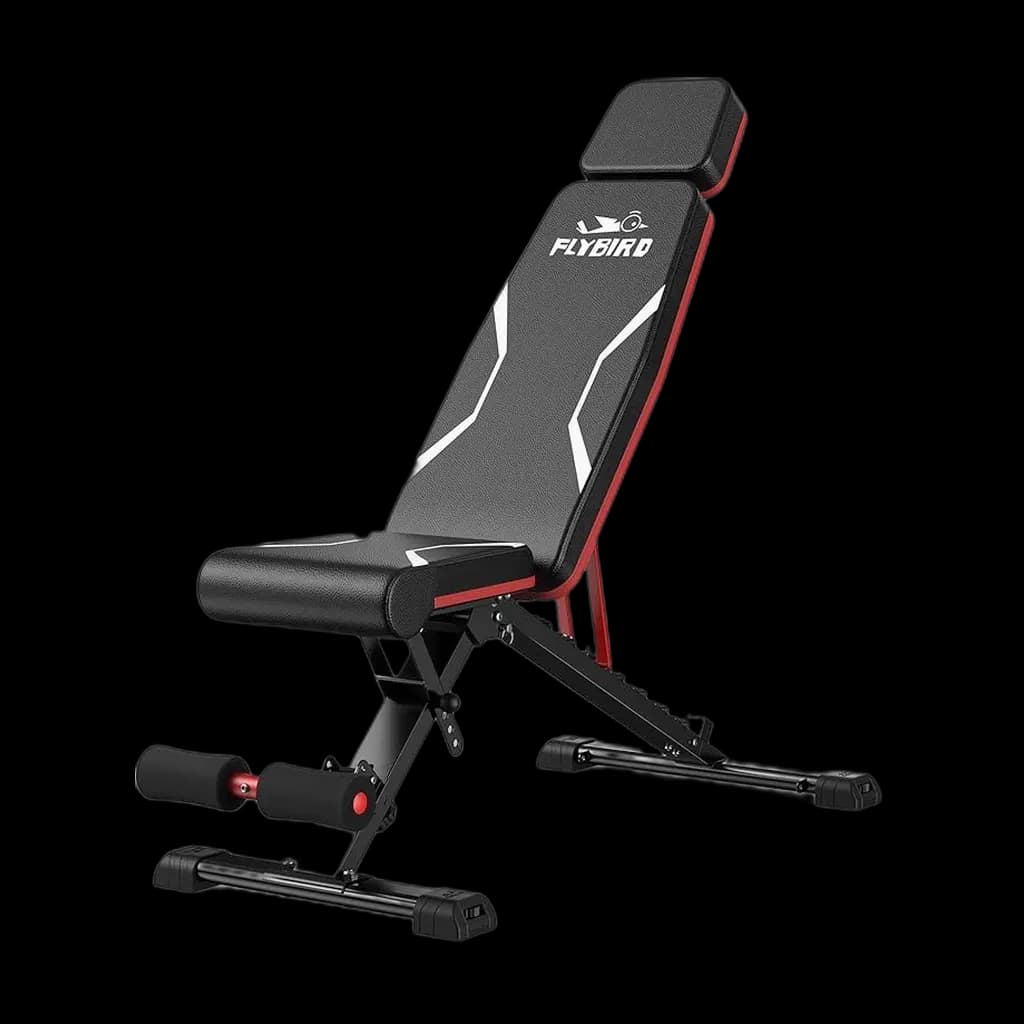
Flybird Adjustable Bench
by FlybirdBuy first
Score
The beginner bench. 6 adjustments, 620 lb capacity, folds for storage. Good enough for dumbbell work. Not a barbell bench.
- Dumbbell-only home gym under 200 lb per hand
- Beginner doing seated shoulder press and incline dumbbell work
- Apartment user who needs the bench to fold flat for closet storage
- Travel-friendly or guest-room setup that breaks down between sessions
- Anyone benching above 225 lb with a barbell
- Powerlifter who needs a stable, fixed flat platform
- Lifter who values lifetime durability over portability
- Buyer who wants ladder-style infinite incline adjustment
Folded: 8x14 in vertical against a wall; in use: 4x2 ft of floor plus 2 ft of clearance per side; 6 ft 6 in ceiling minimum for seated overhead press
easy — Most owners finish assembly in 15 to 25 minutes with the included multi-tool. Common gotcha on r/homegym is over-tightening the seat hinge before the back-pad bracket is squared, which causes a noticeable rock that gets blamed on the bench's design.
If you are starting a dumbbell-only build, the bench is the second purchase after the dumbbells themselves; the Flybird unlocks press and row variations from day one.
Strengths
- ↑Under $150
- ↑Folds flat for storage
- ↑Lightweight
Weaknesses
- ↓620 lb capacity (true limit closer to 300 under barbell)
- ↓Some wobble
- ↓Pop-pin adjustment (not ladder)
What owners actually complain about
Synthesized from owner reviews and community threads. Paraphrased, not quoted.
- Pop-pin adjustment system rattles under load and feels less premium than ladder-style benches
- 620 lb capacity is marketing math; practical limit is closer to lifter plus 200 lb dumbbell pair
- Rear support leg can shift on rubber mats during heavy seated press work
- Foam padding compresses noticeably within 12 to 18 months of regular use
- Color/finish chips on the frame are common after a few months of dumbbell handling
Buyer sentiment
Based on 980 user mentionsBuyers praise quality, sturdiness, value for money and assembly. Mixed feedback on stability and comfort.
Verdict: The under-$150 fold-flat bench for dumbbell-only training in storage-constrained rooms — not a barbell-press platform.
Specs that matter
| Spec | Value |
|---|---|
| Frame | 14-gauge steel |
| Adjustments | 7 back angles, 3 seat angles (pop-pin) |
| Pad | 10.5 in wide, ~1 in thick |
| Capacity | 620 lb advertised (~200 lb/hand practical) |
| Warranty | 1 year |
What you get
- Folds flat — genuinely useful in tight or shared rooms
- Fast pop-pin adjust — quicker between sets than ladder-style benches
- Right angles — hits flat, 30, 45, and 75-90 degrees for hypertrophy work
What you give up
- Stability — single-post support leg flexes and the pop-pin rattles under heavy load
- Longevity — foam compresses at 12-18 months; typically replaced at 2-3 years
Buy it if you do dumbbell programs and need storage. Skip it if you barbell-bench over 225 lb (upgrade to a ladder-style REP AB-3000).
Per Stronger By Science, the hypertrophy angles you need are flat, 30, and 45 degrees — all of which the Flybird hits cleanly inside its dumbbell-friendly load envelope.
Full specs
- Weight Capacity
- 620 lb
- Adjustment Positions
- 6
- Folds
- Yes
Common questions
Is the Flybird safe for barbell bench press inside a power rack?
Technically yes, but it is not the right tool. The bench is narrow (10.5 in pad), which is fine for dumbbell work but unstable for scapular retraction under a 250 lb barbell. Spend on a dedicated flat bench for barbell work and keep the Flybird for incline dumbbell.
How long does the foam padding last?
Owners on r/homegym report visible foam compression at 12 to 18 months of 3-to-4-day-per-week use. The foam does not fail, but it firms up and the original cushion is gone. Replacement pads are not sold by Flybird; the practical fix is a yoga mat layer or upgrading to a denser-foam bench.
Can I do Bulgarian split squats and step-ups on the Flybird?
Yes. The bench at the flat setting is rated and stable for unilateral leg work up to about 200 lb of added load. The rear leg can shift on rubber flooring, so position the bench against a wall or use a rough-textured mat under the rear foot.
Does the Flybird have a decline position?
Yes, one decline angle plus six positive angles and a flat. The decline is mild (about -10 degrees) and uses the seat as a foot brace rather than a roller pad, which limits true decline pressing range.
Will it fit a closet for storage?
Yes. The folded dimensions are roughly 14x8x36 in, which leans against the back wall of a coat closet or behind a bedroom door. The fold-flat design is the Flybird's biggest practical advantage over a fixed bench.
Sources & references
- Independent reviewFlybird Adjustable Bench Review— Garage Gym Reviews
- Independent reviewBest Weight Benches— Barbend
- Communityr/homegym community— Reddit
- Communityr/Fitness community— Reddit
- ResearchStronger By Science training articles— StrongerByScience
Full buying guide
Best Weight Benches for a Home Gym
Read the full ranking →Other weight benches we rate
Ranked alternatives from the same category, with our score and the current price.
The XMark XM-7472 is the dedicated adjustable bench upgrade — 11-gauge steel, 1500 lb capacity, 7 back-pad positions from full decline to military press, 3 seat angles. No uprights, no leg developer, just a bench that's stiffer and more adjustable than nearly anything in its class. Pad density is firm (this matters — soft pads compress unevenly under heavy bench loads, throwing off your arch). The downside: it's heavy (90+ lb) and not foldable, so it takes permanent floor space. For anyone serious about pressing volume, this is the kind of bench you buy and forget about.
The budget bench, and it still carries an ASTM certification — the thing actually worth checking on a cheap bench, because the failure mode is you under a loaded bar.
The bench with attachments — leg extension and preacher curl pad — which is what makes a single bench cover more of a full-body session when there is no room for separate stations.
The heavy end. YOLEO state an ASTM certification with a 2315 lb rating on 8-gauge steel, which is the specification to look for if you are pressing genuinely heavy weight at home.
REP's flagship adjustable bench — 11-gauge steel frame, 1,000 lb capacity, 21 total adjustments (7 back × 3 seat), vertical-storage stand included. Garage-gym standard for the "buy once, cry once" tier under $500. Notable for the ladder-style adjustment that doesn't lose position under load.