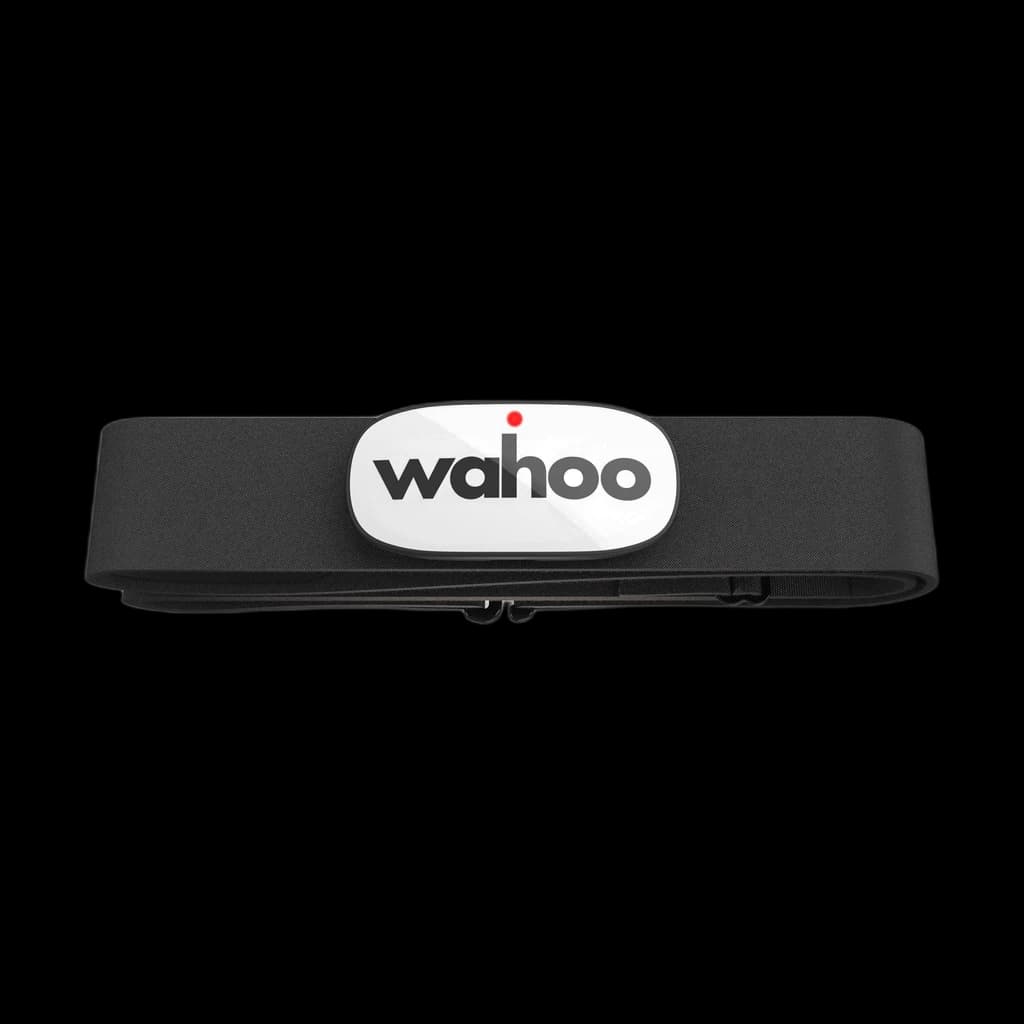
Wahoo Tickr X
The dual-band budget pick. ANT+ and BLE, onboard memory for indoor sessions, running cadence/dynamics included. Same accuracy as Polar H9 at a similar price.
Gym Score breakdown
Composite of build quality, durability, value, performance, and owner satisfaction. Calibrated per category.
- Budget-conscious athletes who want chest-strap accuracy without the Polar H10 price
- Runners interested in cadence, ground contact time, and vertical oscillation without buying a dedicated foot pod
- Lap swimmers and CrossFit athletes who train where phones cannot follow them
- Owners of older bike computers that still rely on ANT+ FE-C alongside BLE phones
- Riders pairing the strap to both a Garmin Edge and Zwift simultaneously
- You want a rechargeable battery and dislike buying CR2032 coin cells
- You expect the strap material to last beyond 18 to 24 months without replacement
- You rely on HRV measurements (the H10 is the better choice for HRV apps)
- You have had pairing issues with previous Wahoo devices and want the simplest possible setup
No floor space. Strap weighs about 48 grams and stores in any drawer.
none — Snap the Tickr X pod to the strap, moisten the electrode pads, and pair via the Wahoo app or directly with whatever HR-capable app the owner uses. Five minutes including app install.
Chest straps belong at the start of any heart-rate-driven training setup. The Tickr X is the cheaper way in for owners who do not need the H10's HRV-grade signal.
Strengths
- + ANT+ and BLE
- + Onboard memory for ~16 hours
- + Running dynamics
- + More affordable than H10
Weaknesses
- − Strap material wears faster than Polar
- − Battery replaceable, not rechargeable
- − Pairing occasionally finicky
What owners actually complain about
Synthesized from owner reviews and community threads. Paraphrased, not quoted.
- Strap material wears noticeably faster than Polar's, with chafing and slipping starting around the 12-month mark for daily users
- Battery is a replaceable CR2032, which annoys owners who expected USB charging on a 2024-priced device
- Pairing is occasionally finicky after firmware updates, with the strap appearing in app menus but failing to connect on the first try
- Running dynamics metrics (ground contact, vertical oscillation) are useful but require the Wahoo app, which buyers often do not realize
- ANT+ and BLE work together well but switching between paired phones requires a hard reset on some firmware versions
What the Wahoo Tickr X Actually Is
The Tickr X is Wahoo's mid-tier chest-strap heart rate monitor. It uses standard chest-wall ECG electrodes, broadcasts on ANT+ and BLE simultaneously, and adds three features the basic Tickr lacks: onboard memory for about 16 hours of workouts, running dynamics (cadence, ground contact time, vertical oscillation), and indoor cycling cadence sensing through chest motion detection. The pod is rated to 5 ATM, which covers swimming.
In DC Rainmaker's testing and the broader r/running and r/Wahoo discussion, the Tickr X is consistently ranked as the best dual-band alternative to the Polar H10 when budget is a factor. It does not match the H10's ECG-grade HRV stability, but for steady-state and interval training the difference is small.
Who It Is Built For
The Tickr X aims at the rider or runner who wants chest-strap accuracy but does not need research-grade signal cleanliness. The features that justify the X over the base Tickr are onboard memory (useful for swimming and CrossFit) and running dynamics (useful for runners working on form). For someone who only does steady road cycling and a bike computer is always paired, the base Tickr at a lower price covers the same job.
It also makes sense for athletes who already own a Wahoo head unit or bike computer. The Wahoo app handles pairing, firmware updates, and dynamics data display in one place, which is friendlier than juggling multiple ecosystems.
Where Owners Get Frustrated
The most consistent complaint in long-term threads is strap durability. Owners report the elastic strap material starting to slip or chafe noticeably around the 12 to 18 month mark with daily training use. Polar's strap material holds up longer in side-by-side reports, though Polar straps cost a few dollars more to replace. Wahoo sells replacement straps separately.
The battery is a CR2032 coin cell. Owners who came from rechargeable optical wrist monitors are sometimes surprised, but the coin cell lasts roughly 500 hours per Wahoo's spec, which translates to 12 to 18 months for typical training volumes. Replacements are inexpensive.
Pairing is mostly stable but has been a recurring r/Wahoo discussion point after firmware updates. The strap appears in app menus but fails to connect on the first try. The fix is usually unpairing from all devices, restarting the strap by pressing the connection points on the pod, and re-pairing fresh. Once paired, the strap stays reliable.
The running dynamics metrics require the Wahoo app to display in real time. Some buyers do not realize this and assume the strap streams cadence and ground contact time to any app, which is not the case. Third-party apps see HR only.
Setup and Daily Use
Unboxing is fast. Snap the pod to the strap, moisten the electrodes, fasten around the chest just below the pec line, and pair. The Wahoo app guides first-time pairing. After that, the strap shows up automatically in Zwift, Strava, Garmin Connect, TrainerRoad, and any other HR-capable app.
Day-to-day, the experience is identical to any other quality chest strap. The pod blinks blue when paired, the battery icon shows in the Wahoo app, and the strap rinses clean under tap water. The pod should detach from the strap before laundering.
The onboard memory feature deserves a callout. The strap holds about 16 hours of workout data internally and syncs to the Wahoo app the next time both are within Bluetooth range. This is genuinely useful for swimmers, CrossFit athletes whose phones live in a locker, and anyone whose watch dies mid-workout. The data is not lost; it just transfers later.
Running Dynamics in Practice
The running-dynamics features are the most-marketed differentiator versus the base Tickr, and they are useful in a narrow context. Cadence (steps per minute) is the most actionable metric: most coaches recommend 170 to 180 spm for efficient running form, and the Tickr X displays this in real time in the Wahoo app. Ground contact time and vertical oscillation are interesting trend metrics across weeks but rarely actionable on a single run.
Runners who already wear a Garmin or Coros watch with built-in running dynamics will find the Tickr X duplicates data they already have. Runners on Apple Watch or Polar watches without native running dynamics get the most value from the X over the base Tickr.
Worth It?
The Tickr X is the right answer for the buyer who wants chest-strap accuracy but is not willing to pay the H10 premium and does not need HRV-grade signal cleanliness. It is also the right answer for runners who want basic dynamics without buying a Stryd. For everyone else, the cheaper base Tickr or the more expensive H10 are both defensible picks. The middle ground the Tickr X occupies is real and well-supported. The decision usually comes down to two questions: does the rider or runner already own a watch that gives them running dynamics (if yes, base Tickr is enough), and do they care about HRV-quality signal (if yes, H10 is the better long-term buy).
Full specs
- Type
- Chest strap
- Connectivity
- ANT+, BLE
- Battery Life
- 500 hours
- Water Resistance
- 5 ATM
Common questions
Does the Wahoo Tickr X work with Apple Fitness?
Yes. Apple Fitness on Apple Watch can pair with an external BLE heart rate sensor, and the Tickr X is one of the supported strap profiles. The watch uses the strap signal in place of its wrist optical sensor during the workout.
What is the difference between Tickr and Tickr X?
The Tickr is a basic dual-band HR strap. The Tickr X adds onboard memory for about 16 hours of workouts, running dynamics (cadence, ground contact, vertical oscillation), and indoor cycling cadence sensing through chest motion.
How long does the Tickr X battery actually last?
Wahoo quotes 500 hours on a CR2032 coin cell. Owners doing five to seven hours of training per week report changing the battery roughly once every 12 to 18 months. The strap notifies through the Wahoo app when battery is low.
Can the Tickr X replace a Stryd or Garmin HRM-Pro for running?
Partially. The Tickr X captures cadence, ground contact time, and vertical oscillation but does not measure running power. Athletes specifically training by power need a dedicated foot pod like Stryd.
Why does the Tickr X strap loosen during long runs?
The elastic stretches with sweat over time. Owners report tightening the strap by one notch before long runs and rinsing the strap after each use. Replacement straps are sold separately for about $25.
Is the Tickr X accurate enough for HR-zone training?
Yes for steady-state training. Wahoo's accuracy is comparable to Polar H9 in independent testing. For HRV measurement and ECG-grade signal stability during rapid interval transitions, the H10 still leads.
Sources & references
- Wahoo Tickr X In-Depth Review— DC Rainmaker
- Tickr X Product Specifications— Wahoo Fitness
- Tickr X long-term wear thread— r/Wahoo
- ACSM Heart Rate Training Zone Guidelines— ACSM
- Chest Strap Recommendation Roundup— DC Rainmaker