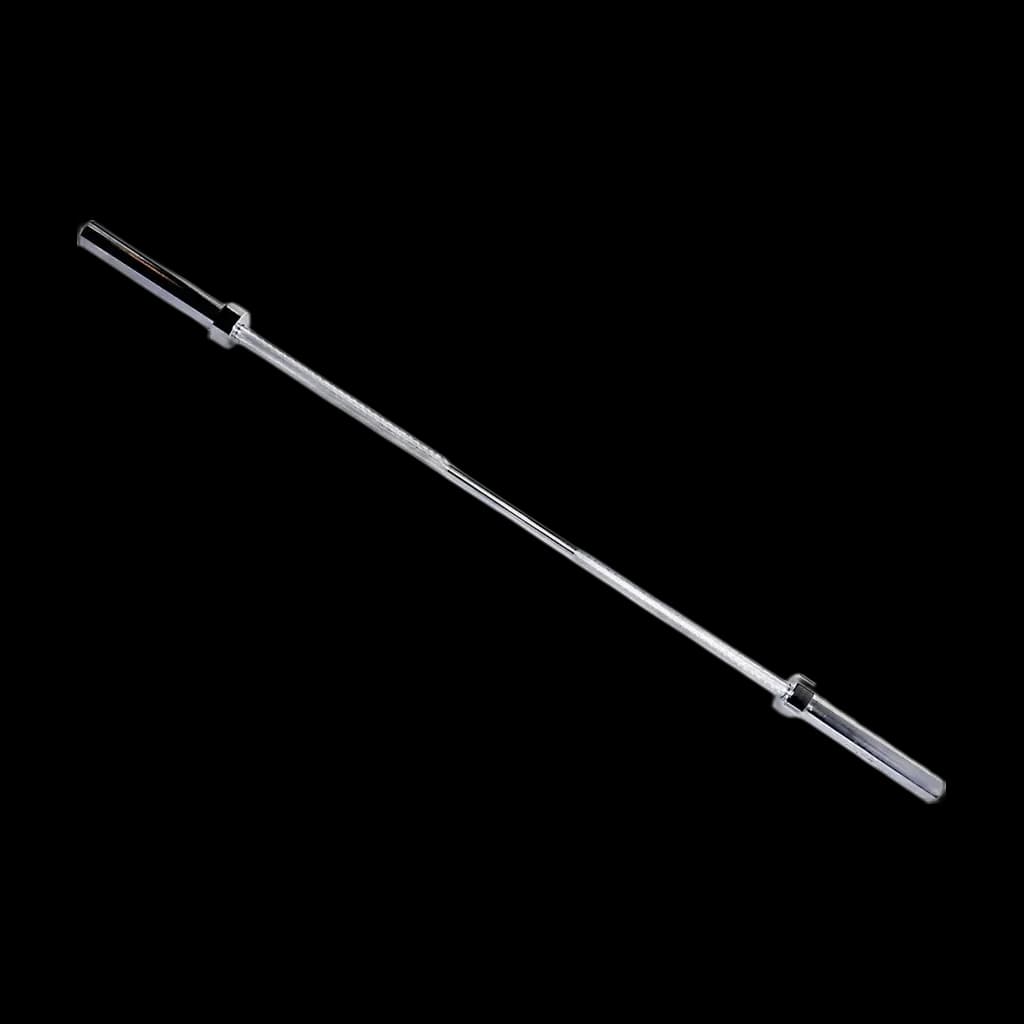
CAP Barbell Olympic 2-Inch Solid Chrome Bar
If you're under 200 lb in your working sets and want the cheapest 'real' Olympic bar, this is it. Solid (not hollow) construction, 7-foot length, 2-inch sleeves, chrome finish. The weakness is the spin (chrome bushings, not bearings) and the modest 600 lb capacity rating. The knurl is the lightest of any bar on this list — fine for benching, less great for deadlifts without straps. For a teen lifter, a couples gym setup, or a strict garage budget, this is the bar; just plan to upgrade in 1-2 years if you progress.
Gym Score breakdown
Composite of build quality, durability, value, performance, and owner satisfaction. Calibrated per category.
- Brand-new lifter buying their first real Olympic bar
- Sub-200 lb working weight in any compound lift
- Garage gym in humid climate (chrome holds up to humidity better than zinc)
- Budget under $150 with Amazon Prime delivery needed
- Lifter approaching or above 300 lb deadlifts (knurl will not grip clean without chalk)
- Anyone doing cleans or snatches with any regularity (sleeve spin is poor)
- Owner planning a 5-plus year ownership window (most lifters outgrow this bar at intermediate level)
- Buyer who values aggressive knurl and a stiff shaft
Bar is 7 ft tip to tip; rack inside-width clearance 49 in; floor space for deadlifts 7x4 ft minimum
easy — Bar ships fully assembled with a light protective oil; wipe the cosmoline with a microfiber before first load. New-owner gotcha is assuming the chrome finish is rust-proof; chrome resists corrosion but the bar still needs wiping after sweaty sessions in humid garages.
Entry-level bar that comes with the rack; expect to upgrade within 1 to 2 years as strength outgrows the spec.
Strengths
- + Under $150 frequently with Prime delivery
- + Solid steel construction (not hollow)
- + Chrome finish doesn't need maintenance
- + Good first bar for sub-200 lb working weights
Weaknesses
- − Light knurl, requires chalk for heavy deadlifts
- − Sleeve spin is poor — not suited for cleans/snatches
- − Outgrown quickly by serious lifters
What owners actually complain about
Synthesized from owner reviews and community threads. Paraphrased, not quoted.
- Knurl is too mild for grippy deadlifts above 225 lb without chalk
- Sleeve spin is poor, makes cleans and snatches awkward and slow
- Solid-steel construction makes the bar feel slightly heavier in hand than the spec suggests
- Chrome finish flakes at the sleeve-shaft junction after a year or two of heavy use
- Outgrown quickly by serious lifters, leading to a second bar purchase within 18 to 24 months
Who this is for
The CAP Olympic 2-inch Solid Chrome Bar is the bar you buy when you are new to barbell training and need the cheapest path to a real 7 ft Olympic bar. Based on owner reports on r/homegym and r/Fitness, the right buyer is squatting 95 lb to 185 lb, bench pressing 95 lb to 185 lb, and deadlifting under 300 lb. Inside that range, the bar handles its job without drama.
It is not the bar for an intermediate lifter. The knurl is too mild for grippy deadlifts above 225 lb without chalk, the sleeve spin is too slow for cleans, and the chrome finish flakes at the sleeve-shaft junction within a few years of heavy use. The Chrome bar is a starter bar with a known expiration date, not a long-term keeper.
Build quality
The spec sheet shows a 44 lb, 7 ft bar with 28 to 29 mm shaft diameter, light knurl, chrome finish, and a 600 lb advertised capacity. Construction is solid steel rather than hollow tube, which makes the bar feel slightly heavier and stiffer in hand than the 44 lb spec suggests. Sleeves are chrome with bushing-style rotation; spin is poor compared with even mid-tier bars.
Knurl depth is the central tradeoff. Premium bars run aggressive medium knurl that grips reliably up to 500-plus lb without chalk; the CAP Chrome runs mild knurl that requires chalk above 225 lb deadlifts. For a beginner this is fine because the lifter has not yet built grip strength to need aggressive knurl; for an intermediate it becomes the daily friction that drives the upgrade.
Real-world use
In a 1-year ownership window for a beginner, the Chrome bar delivers a clean experience: it loads plates correctly, it holds shape under sub-300 lb pulls, and the chrome finish requires only monthly maintenance. According to Garage Gym Reviews Best Budget Barbells, it is the right pick when total spend matters more than long-term keep value.
As lifters cross into intermediate territory (deadlift above 315, bench above 225), owner reports on r/homegym consistently describe the same arc: mild knurl forces chalk earlier than expected, sleeve spin makes any clean work feel wrong, and a second bar purchase enters the budget. The Chrome bar typically gets relegated to spare-bar status or sold on r/homegymsales at a meaningful discount.
The case against
The primary case against the Chrome bar is that it has a short useful life for any lifter who plans to keep training. The price savings against a CAP Beast (about $80 to $120) get spent twice when you buy the Chrome bar and then upgrade within 2 years. r/homegym threads consistently recommend skipping straight to the Beast if the budget supports it.
The second case against is the cleans-and-snatches limitation. If your training will ever include Olympic lifts even casually, the slow sleeve spin makes the Chrome bar wrong on day one. The T-Nation analysis of bushings versus bearings explains why even budget needle-bearing bars (Synergee Games) outperform the Chrome bar for any rotational work.
Bottom line
The CAP Chrome bar is the right answer to one specific question: what is the absolute cheapest real Olympic bar I can buy with Amazon Prime delivery. Garage Gym Reviews lists it as the budget option in the category, and Barbend's best-barbell guide places it in the entry-bar tier. If you have any plan to outgrow 300 lb deadlifts in the next 2 years, the Beast is the smarter spend. For everyone else starting from zero, the Chrome bar gets you under the bar today.
Programming notes
The Chrome bar's natural programming range is a beginner linear-progression template such as Starting Strength, StrongLifts 5x5, or any basic bench-squat-deadlift split where the load progression is slow and the working weights remain under 300 lb for 12 to 24 months. Across this window, the bar handles its job competently. Stronger By Science training articles consistently note that beginner programming is dominated by neuromuscular adaptation rather than equipment refinement; the Chrome bar's modest knurl and slow sleeve spin are functionally invisible at this training stage.
The bar becomes a programming limitation once linear progression stalls. At the deadlift threshold around 315 lb, the mild knurl requires chalk and the chrome finish offers less grip authority than premium bars; at the squat threshold around 225 lb, the absent center knurl makes setup slightly less stable than premium bars. For lifters following intermediate programming (Madcow 5x5, 5/3/1, Wendler templates), the Chrome bar typically transitions from primary bar to spare bar within the first 2 years.
Owner-reported maintenance
Chrome is the easiest barbell finish to maintain. The standard maintenance is a monthly sleeve wipe and shaft wipe with a microfiber; no oiling is required in temperate climates, and only light oiling in humid climates. Chrome flaking at the sleeve-shaft junction is the most-reported long-term issue on r/homegym; it is cosmetic only and does not compromise function. The solid-steel construction means there is no internal hollow for moisture intrusion, which is structurally favorable but adds to the bar's slightly hefty hand-feel.
Full specs
- Bar Weight
- 44 lb
- Diameter
- 28-29mm
- Length
- 7 ft
- Capacity
- 600 lb
- Sleeve Type
- Chrome bushing
- Knurl
- Light
Common questions
Is the CAP Chrome bar good enough as a first barbell?
Yes, with a known expiration date. For a brand-new lifter learning the squat, bench, and deadlift under 200 lb, the bar is competent and survives 1 to 2 years of regular use. By the time deadlift working weight reaches 300 lb, most lifters report the mild knurl and poor sleeve spin push them to upgrade.
How does the Chrome bar compare to the CAP Beast?
The Beast (OB-86PB) is a substantial step up: aggressive knurl, 110,000 PSI tensile rating, and snap-ring sleeves rated to 1,000 lb test load. The Chrome bar is the entry rung, the Beast is the multi-year keep-it bar. The price gap is about $80 to $120 and most r/homegym owners recommend skipping straight to the Beast if the budget allows.
Will the chrome finish rust?
Chrome resists rust better than black zinc and dramatically better than bare steel, but is not rust-proof. Sweat from heavy deadlift sessions, especially in humid climates, can pit chrome over a 2-year window. A monthly wipe with 3-in-1 oil substantially extends the finish life.
Can I clean and snatch on the Chrome bar?
Mechanically yes, but the sleeve spin is poor enough that cleans feel laborious and snatches are awkward at any weight. The bushing or bearing surfaces are slower than even budget specialty bars, and the bar transmits more sleeve friction into the wrist on the catch. For occasional cleans below 135 lb it works; for any volume Olympic work, skip to a Synergee Games or equivalent.
Why is the Chrome bar so cheap?
Three reasons: solid (not hollow) construction is actually cheaper than precision-machined hollow shafts; the knurl is rolled to a lower depth than premium bars; and the sleeve hardware is the simplest possible bushing setup with no needle bearings. None of these compromises matter for a beginner; all of them matter for an intermediate lifter.
Sources & references
- Best Budget Barbells— Garage Gym Reviews
- Best Barbells— Barbend
- Why I Prefer Bushings to Bearings— T-Nation
- r/homegym community— Reddit
- r/Fitness community— Reddit