Rank #2 in Barbells & Bumper Plates
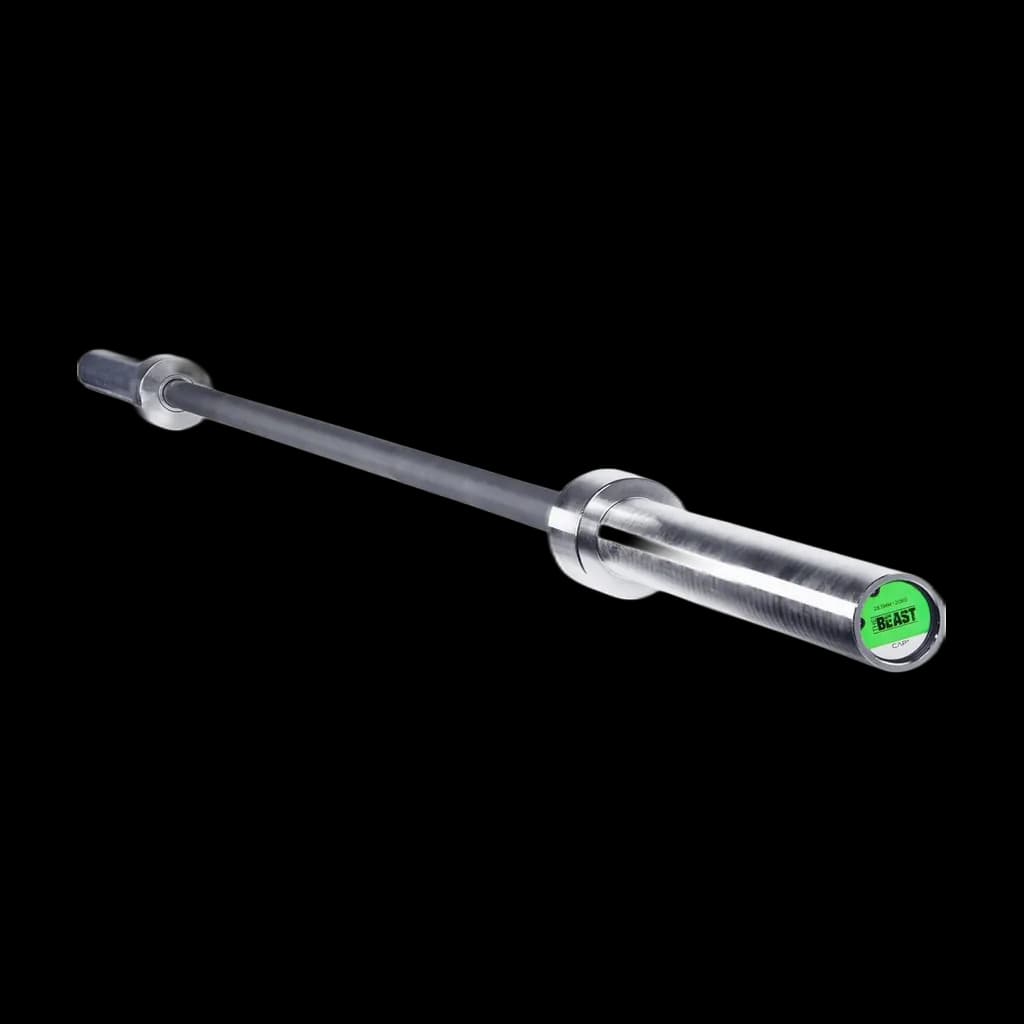
CAP Barbell The Beast Olympic Bar
by CAP BarbellBuy first
Score
The Beast is what most people actually buy as their first 'real' barbell, and it earns the love. 28.5mm shaft, no center knurl, snap-ring sleeve construction. The 1000 lb test rating is more than any home lifter will load in this lifetime. The knurl is milder than Rogue's — fine for high-rep work, less ideal for max deadlifts without chalk. Fit-and-finish loses to Rogue and Rep, but at less than half the price it's the bar that delivers 80% of the experience for under $200.
- First serious barbell for a lifter under 405 lb in any compound lift
- Multi-purpose home gym with no need for dedicated power or Olympic bars
- Garage gym owner who deadlifts on rubber flooring (no center knurl)
- Buyer prioritizing Amazon Prime delivery over the wait for premium brands
- Competitive powerlifter who wants 28.5 mm shaft with aggressive knurl and center knurl
- Olympic weightlifter doing volume cleans and snatches (no needle bearings)
- Lifter pulling 500-plus lb regularly (consider a Rogue Ohio Power Bar instead)
- Owner who hates re-oiling black zinc once a quarter
Bar is 86.6 in (7 ft 2 in) tip to tip; rack inside-width clearance must exceed 49 in; floor space for deadlifts 8x4 ft minimum
easy — The bar ships fully assembled; remove cosmoline shipping coating with a microfiber and 3-in-1 oil. Common new-owner gotcha is loading the bar with collars before wiping the cosmoline, which transfers oily residue to plates and the rack J-cups.
Bar comes immediately after the rack; you cannot meaningfully train without a real Olympic barbell, and the Beast handles the entire intermediate strength range.
Strengths
- ↑Less than half the price of premium bars
- ↑1000 lb test rating, 110K PSI tensile
- ↑Solid for any home lifter under 400 lb total loads
- ↑Available on Amazon Prime
Weaknesses
- ↓Knurl noticeably milder than premium bars
- ↓Sleeves use snap rings (less serviceable)
- ↓Black zinc finish wears in 2-3 years
What owners actually complain about
Synthesized from owner reviews and community threads. Paraphrased, not quoted.
- Black zinc finish develops surface rust spots if not oiled quarterly, especially in humid garages
- Knurl noticeably milder than premium bars, requires chalk for 405-plus lb deadlifts
- Snap-ring sleeve construction means bearings are not user-serviceable; if a sleeve fails, the bar is replaced not repaired
- Sleeve diameter runs a fraction tight; some thick-collar steel plates require a wiggle to seat
- Slight cosmetic burrs at the sleeve-shaft junction reported by owners on r/homegym (functional only, not structural)
Buyer sentiment
Based on 1,851 user mentionsBuyers praise quality, value for money, build quality and grip. Mixed feedback on durability and knurling.
Verdict: The budget bar that does too much for the money — the right pick for home lifters under 405 lb who want Prime shipping over a Rogue freight wait.
Specs that matter
| Spec | Value |
|---|---|
| Weight / shaft | 20 kg, 28.5 mm |
| Tensile strength | 110,000 PSI |
| Test rating | 1,000 lb |
| Sleeves | Snap-ring, chrome (non-serviceable) |
| Shaft finish | Black zinc |
What you get
- Strong value — top-ranked budget bar by Garage Gym Reviews and Barbend
- Handles mixed programming — rack work, deadlifts, occasional cleans up to ~400 lb
- Mild comfortable knurl — good for front squats and cleans
What you give up
- Non-serviceable sleeves — bearing failure means bar replacement
- Black zinc rusts in humidity — needs quarterly oil-and-wipe; rust within 6 months in damp garages
Buy it if you want the most barbell under $250 on your floor in days. Skip it if you've moved into competitive powerlifting or Olympic lifting (get the Rogue Ohio Power Bar or Kabuki).
Per Stronger By Science, shaft whip is only a programming variable at advanced loads — the Beast's 28.5mm hybrid whip is a non-issue under 400 lb.
Full specs
- Bar Weight
- 20 kg (44 lb)
- Diameter
- 28.5mm
- Tensile Strength
- 110,000 PSI
- Test Rating
- 1000 lb
- Sleeve Type
- Snap ring
- Center Knurl
- No
Common questions
Is the CAP Beast bar good for deadlifts?
Yes for sub-405 lb working sets. The knurl is mild, so chalk becomes necessary above 405 lb where premium bars (Rogue Ohio Power Bar, Texas Power Bar) would still grip clean. The shaft is 28.5 mm which gives slightly more whip than a true power bar but holds straight under repeated heavy loading.
What's the difference between snap-ring and bolt-on sleeves?
Snap-ring sleeves use a C-clip to hold the sleeve onto the shaft; bolt-on uses a threaded end cap. Snap-ring is cheaper and lighter but means the bushings cannot be replaced, so if a sleeve binds the bar is effectively a write-off. Bolt-on sleeves (Rogue, Rep, Kabuki) are serviceable. For a sub-$300 bar, snap-ring is the right cost compromise.
How does the Beast compare to a Rogue Ohio Bar?
The Rogue Ohio Bar has a 28.5 mm shaft, 200,000 PSI tensile strength, aggressive medium knurl with center knurl, and bushing sleeves; it costs about 2.5x the Beast. For a lifter under 405 lb working sets, the gap is real but not transformative. Above 500 lb the Rogue's stiffer shaft and aggressive knurl earn their premium.
Does the Beast need a center knurl?
Center knurl matters for high-bar squats above 315 lb (it grips the back) and for lifters who slide the bar off the rack during low-bar setup. Most lifters under 315 lb squat are unaffected. The Beast skips the center knurl, which makes it more comfortable for cleans and front squats and slightly less ideal for heavy back squats.
Will the Beast bend at 405 lb deadlifts?
Whip (elastic flex during the pull) yes, that is normal and useful. Permanent bend, no, not at 405 lb. The 110,000 PSI tensile and 1,000 lb test rating give substantial margin to the working ranges where the Beast is used. Permanent bends usually come from dropping a heavily-loaded bar onto safety pins, not from clean pulls.
Sources & references
- Independent reviewBest Budget Barbells— Garage Gym Reviews
- Independent reviewBest Barbells— Barbend
- ResearchWhy I Prefer Bushings to Bearings— T-Nation
- Communityr/homegym community— Reddit
- Communityr/powerlifting community— Reddit
Full buying guide
Best Barbell and Plates for Home Gyms 2026: Rogue Ohio Wins
Read the full ranking →Other barbells & bumper plates we rate
Ranked alternatives from the same category, with our score and the current price.
Synergee's Olympic bar is the CrossFit-leaning value pick — needle bearings instead of bushings give it noticeably more sleeve spin than the CAP Beast, which matters if you're cleaning and snatching. 190K PSI tensile is genuinely competitive with Rogue, and the 1000 lb capacity is plenty. Knurl is medium-aggression, no center knurl. Where it loses ground: long-term spin durability is hit-or-miss, with some owners reporting the bearings slowing within 2 years of high-volume Oly work.
The plate that pairs with the Synergee bar already ranked in this category, and the reason it earns a place is boring in the right way: solid rubber, a steel insert, a 2-inch collar opening, and a low bounce that keeps a dropped bar where you can predict it. Synergee sells it by the pair and by the set, so you buy the jumps you actually need rather than a fixed 160 lb package with two plates you will not use for a year. It is not a competition plate and Synergee does not sell it as one — the thickness is closer to a training bumper than an IWF disc, so a heavily loaded bar runs out of sleeve sooner.
Rogue's flagship 20 kg multi-purpose bar — 190K PSI tensile, dual knurl marks for Olympic + powerlifting, bronze bushings, 16.4" loadable sleeve, lifetime warranty against bending. The default home-gym barbell that gets recommended on r/homegym across roughly every "what bar do I buy" thread.
REP's V2 bumper redesign tightened weight tolerance from 3% to 2% and dropped dead-bounce noise by ~10% versus the original sport bumpers. IWF color-coded, with an orange 15 lb pair that fixes the 10-to-25 lb jump. Currently listed under "clearance" branding on REP's site as the line transitions.
Yes4All Olympic Bumper Plates
Yes4All's bumpers are the budget choice that doesn't feel cheap. The 2-inch hub fits any standard Olympic bar, the rubber is denser than recycled crumb (less bounce, longer life), and the steel insert is genuinely flush, so plates load tight without sliding. The catch: weight tolerance is ±3% rather than the IWF ±1%, which doesn't matter unless you're competing. Sold by individual plate or in pairs, which is rare and useful for filling specific gaps. The 230 lb set lands under $300 with Prime shipping — a quarter what Rep would cost delivered.