 Premium Pick
Rank #2 in Exercise Bikes
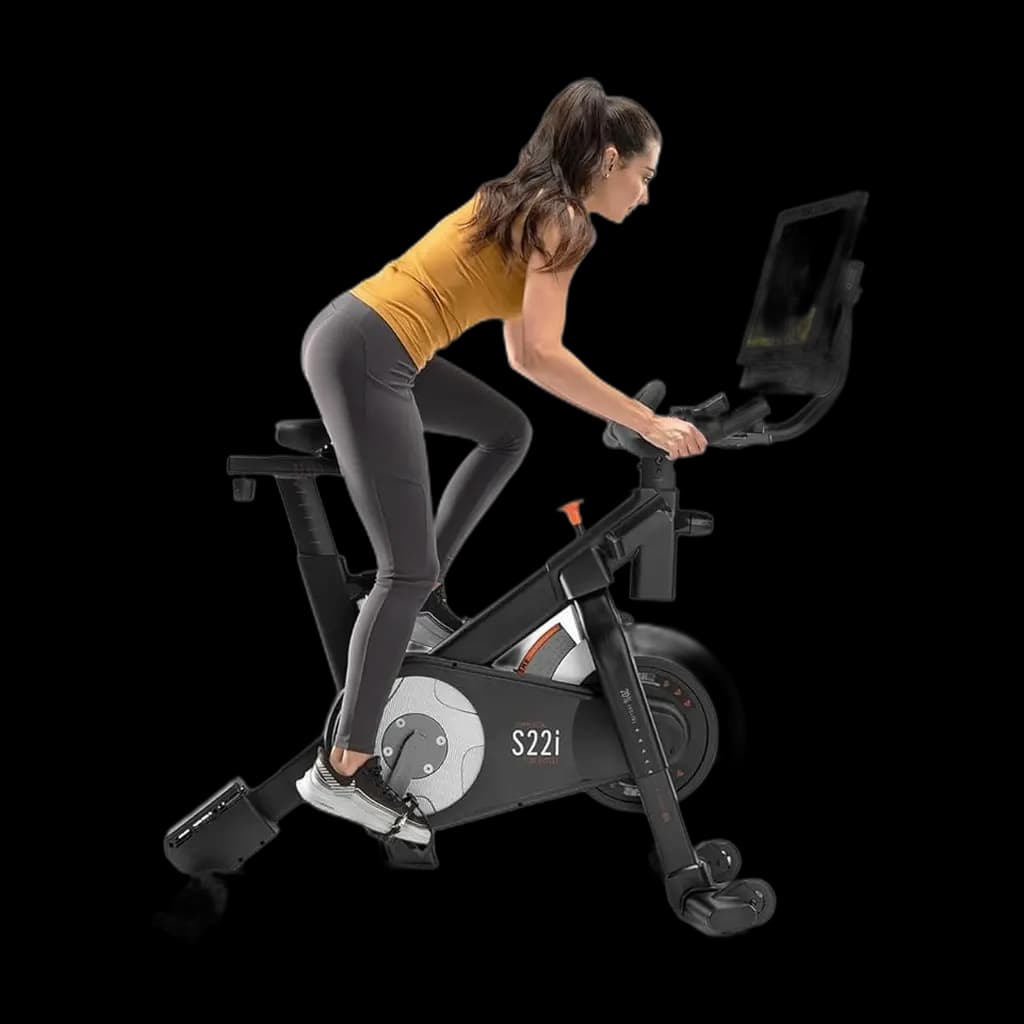
NordicTrack S22i
by NordicTrackBuy later
Score
The incline/decline spin bike. -10% to +20% tilt adjusts terrain mid-ride, auto via iFIT. Closest analog to an outdoor ride without leaving the basement.
- Riders training for outdoor climbs who want incline-and-decline simulation
- iFIT subscribers who want the full ecosystem on a bike rather than a treadmill
- Households where multiple riders want their own profile and class history
- Indoor cyclists who want the closest thing to outdoor terrain variation
- You refuse to pay iFIT's roughly $39 a month subscription
- Your floor cannot support a 185-pound bike on a small footprint
- You weigh more than 350 pounds, the rated user weight ceiling
- You want simple manual resistance with no software dependency
About 56 inches long by 22 inches wide. Plan for 8-foot ceiling for the upright riding position. Heavy at 185 pounds, so floor support and placement should be considered for upstairs rooms.
moderate — Plan 60 to 90 minutes with a helper. The console arm and touchscreen mount are the bulk of the work. The base, flywheel, and frame ship pre-assembled.
A premium spin bike is a software-dependent cardio commitment that should come after you have decided whether you will actually use the iFIT subscription long term, since the hardware value drops significantly without it.
Strengths
- ↑-10% to +20% incline range
- ↑Auto resistance + incline via iFIT
- ↑22" HD touchscreen
- ↑Fan for cooling
Weaknesses
- ↓iFIT subscription near-mandatory
- ↓Tilt can feel gimmicky
- ↓Heavy (185 lb)
What owners actually complain about
Synthesized from owner reviews and community threads. Paraphrased, not quoted.
- iFIT subscription lapse reduces the bike to a manual resistance machine with limited screen functions
- Tilt mechanism can feel gimmicky during seated steady-state rides where it adds little value
- Heavy at 185 pounds, requiring two people to move and consideration for upstairs floor loading
- Touchscreen freezes and firmware update glitches require occasional hard reboots
- Fan is loud at the highest setting and most riders use it at low or off
Buyer sentiment
Based on 3,576 user mentionsBuyers praise performance, workout and adjustability. Mixed feedback on assembly and stability. Some flag reliability.
Verdict: The most feature-rich indoor cycle made, and the only one with true tilt for climb/descent simulation — worth it for iFIT terrain trainers.
Specs that matter
| Spec | Value |
|---|---|
| Screen | 22" HD touchscreen |
| Tilt range | -10% to +20% |
| Flywheel | 30 lb magnetic, 24 levels |
| Weight | ~185 lb |
| Subscription | iFIT |
What you get
- True tilt — auto-syncs to iFIT terrain, real hill simulation
- Best screen — 22" HD, tilts/rotates for off-bike work
- Multi-profile — iFIT supports several riders
What you give up
- iFIT dependency — hardware value drops without subscription
- Heavy + polarizing tilt — 185 lb is hard to move; tilt feels gimmicky for steady-state
Buy it if you train outdoor-style climbs and will use the tilt. Skip it if you do mostly steady-state — a Schwinn IC4 plus Peloton app delivers studio classes at ~1/3 the all-in cost.
Over five years iFIT runs past $2,300 cumulatively on top of the $2,000+ hardware — the subscription dependency is the largest single objection.
Full specs
- Resistance
- Magnetic (24 levels)
- Display
- 22" HD touchscreen
- Incline
- -10% to +20%
- Flywheel
- 30 lb
Common questions
Can I use the S22i without iFIT?
Yes but with significant feature loss. Manual mode allows resistance and tilt adjustment from the console but the touchscreen becomes essentially a settings menu. The auto-adjusting resistance, tilt sync to outdoor-filmed rides, and trainer-led classes all require an active iFIT subscription.
How does the incline and decline feature compare to a real Peloton?
Peloton bikes do not tilt. The S22i tilts -10 to +20 percent, which sync to outdoor-filmed iFIT rides to simulate terrain. For riders training for outdoor climbs this is the largest single feature differentiator. Steady-state riders use the tilt less.
Is the 22-inch touchscreen worth the price premium?
For iFIT subscribers, yes. The screen is bright, responsive, and large enough to read instructor cues clearly. For non-subscribers it is over-built since manual mode does not utilize it.
Will it work with the Peloton app?
Limited integration. The S22i can broadcast some FTMS data to apps but Peloton specifically prefers its own hardware. Most S22i owners use iFIT and do not try to cross-platform.
How loud is the bike itself?
Magnetic resistance is quiet. The motor that controls tilt and resistance produces a soft hum. The included cooling fan is loud at maximum but most riders use it on low. Apartment use above neighbors is reasonable at moderate intensity.
Sources & references
- ResearchACSM cycling exercise prescription guidelines— ACSM
- CommunityNordicTrack S22i long-term owner discussion— r/homegym
- Independent reviewNordicTrack S22i review and durability assessment— Garage Gym Reviews
- Independent reviewWirecutter best indoor cycles coverage— Wirecutter
- ResearchNIH on cycling cadence and cardiovascular response— NIH
Full buying guide
Best Exercise Bikes for Home Gym Use
Read the full ranking →Related Exercise Bikes guides
Other exercise bikes we rate
Ranked alternatives from the same category, with our score and the current price.
The Peloton alternative. Bluetooth FTMS broadcasting, dual-sided SPD pedals, magnetic resistance — rides along with the Peloton app, and pairs with Zwift or any app that reads Bluetooth FTMS.
For cyclists training indoors. True road-bike fit, simulates gear shifts, drops into Zwift and TrainerRoad natively. Not a studio class bike.
The premium option. Auto-resistance, 23.8" HD rotating screen, the best-in-class class catalog. The question isn't quality — it's whether you'll use the $49.99/mo All-Access membership.