Rubber-Cal Eco-Sport Rolled Flooring
Commercial rolled rubber, 1/4" or 3/8" thickness, sold by linear foot. The 'just like a real gym' option — seamless coverage, professional finish. Most expensive route for full coverage.
Gym Score breakdown
Composite of build quality, durability, value, performance, and owner satisfaction. Calibrated per category.
- Permanent garage or basement gym builds where the floor isn't moving for years
- Strength athletes who drop loaded barbells and want commercial-grade impact attenuation
- Spaces over 200 sq ft where puzzle-tile seams would multiply into hundreds of joints
- Owners who want a Rogue-style monolithic look without flying out a commercial installer
- Buyers who will share install labor with a helper for the day
- You're a renter and need to remove the floor cleanly later
- You're working solo and can't get a second person for the install day
- Your room has a lot of jogs, alcoves, or stair returns that turn the roll into a tile-cutting exercise
- Budget under $4 per square foot all-in including freight
Rubber-Cal's recycled rubber rolls ship 4 ft wide in lengths like 10 ft and 25 ft. A single 4x10 roll covers 40 sq ft. Three 4x10 rolls cover 120 sq ft, the listed Amazon home gym configuration, enough for a single-rack platform plus a generous cardio zone. Plan for a 2 to 3 inch overlap allowance on cuts.
hard — Each 4x10 roll weighs roughly 60 to 80 lb depending on thickness and is awkward to maneuver into a final position alone. Plan on a helper, a sharp hooked-blade utility knife, double-sided seam tape or polyurethane adhesive, and a chalk line. Most owners regret not laying the rolls out 24 hours pre-cut to let the rubber relax before final placement.
Rolled rubber is the most labor-intensive surface to install around existing equipment, so it goes down before the rack, bench, sled, and any anchored fixtures.
Strengths
- + Commercial-grade
- + Seamless coverage
- + Recycled rubber composition
Weaknesses
- − Expensive ($4-6/sqft)
- − Hard to install solo
What owners actually complain about
Synthesized from owner reviews and community threads. Paraphrased, not quoted.
- Strong recycled-rubber smell that takes 1 to 4 weeks to fully fade depending on ventilation
- Rolls arrive curled at the ends and need 24 to 48 hours of weighted-down flattening before cuts hold true
- Freight delivery is curbside only on long rolls — moving 60 lb of rubber up a flight of stairs is a two-person job
- Seams gap over time if the subfloor isn't dead flat or if rolls weren't taped together at install
- Recycled tire content means visible flecks of every color and a non-uniform speckled appearance some owners didn't expect
When to Buy Rolled Rubber
Rolled rubber is the answer when the home gym has graduated from "I might move next year" to "this is the floor for the next ten years." Rubber-Cal's Eco-Sport rolls are the recycled-rubber, commercial-format choice that closes the visual and performance gap between a homemade garage gym and the kind of platform you'd see at a serious commercial facility. It is also, by a real margin, the most labor-intensive surface to put down.
The value pitch is straightforward: at $4 to $6 per square foot all-in, this is the cheapest way to get true vulcanized commercial rubber across a large room with minimal seams. Compared with stall mats, it looks better and stays put without trip-hazard gaps. Compared with interlocking tiles, the cost per square foot drops once you get above 200 sq ft. The tradeoff is freight, weight, and a single shot at the install.
Build and Materials
Eco-Sport rolls are recycled tire rubber bound with a polymer binder, the same stock used in commercial weight rooms and CrossFit boxes for the last two decades. Density is far higher than any EVA puzzle tile — the difference shows up the first time a 45 lb plate falls and the floor barely registers it. Thickness comes in 1/4 inch and 3/8 inch for the rolls, with the 3/8 inch being the default recommendation for any space hosting barbell work.
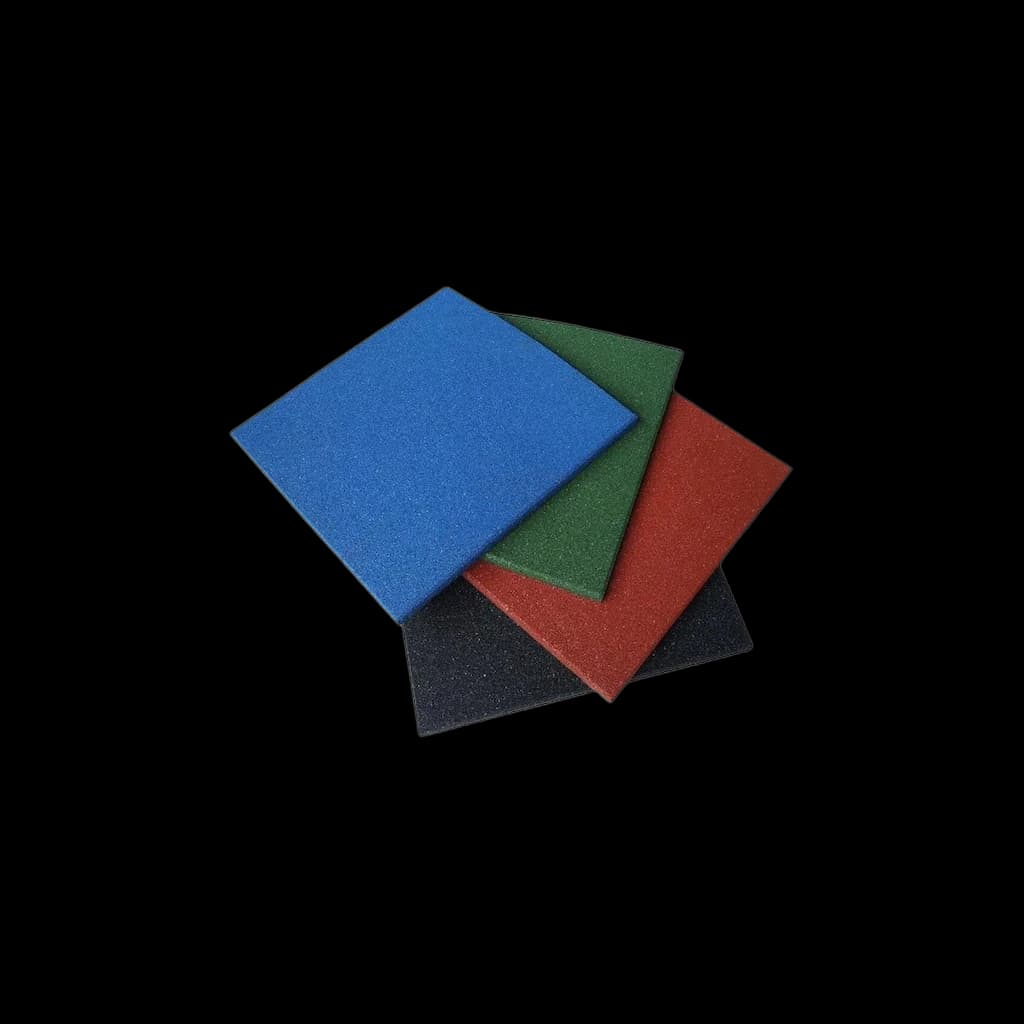
Visually, the recycled content shows. Speckles of black, gray, and occasional color from the source tires are visible across the surface. Owners expecting a uniform black slab sometimes flag this in reviews; it's a feature of the recycled material, not a quality miss.
Install Reality
This is where Rubber-Cal Eco-Sport demands the most patience of any product in the category. A 4x10 ft roll weighs 60 to 80 lb, ships curled, and arrives via freight carrier curbside. Step one is getting it into the room with a helper. Step two is unrolling it and weighting the corners with plates for 24 to 48 hours so the curl relaxes. Step three is cutting.
Cuts need a hooked-blade utility knife, a steel straightedge, and patience. Score deep on the first pass, bend the rubber back on the score, and finish from the underside. Trying to slice all the way through with a fresh straight blade dulls the blade in three feet and leaves a ragged seam.
Seam treatment is the other install decision. Owners under 200 sq ft typically get away with seam tape on the joints and gravity holding the field down. Above that, polyurethane adhesive perimeter glue-down is the right call, especially if the floor will see rolling racks or sled work. Renters skip the glue and rely on seam tape alone, accepting that they'll re-tape every year or two.
Where It Holds Up
Loaded barbell work, dropped dumbbells up to 100 lb, sled drags on the surface, and rolling caster racks: all comfortably in scope on 3/4 inch (the tile version) or stacked 3/8 inch (the roll version). Owners across The Garage Journal and Greatmats community threads report 5+ years of service with minimal visible wear when the install was done right.
The surface cleans easily. A damp mop with mild soap handles sweat and chalk; aggressive chemical cleaners can prematurely age the polymer binder, so stick with neutral pH cleaners.
Where It Doesn't
The two real failure modes are install regret and odor. Install regret is the bigger one: rushed cuts that don't line up, seams that gap after a season because the subfloor wasn't flat, and rolls that were trimmed before they'd relaxed from their shipping curl. None of these are product defects, but they're real complaints in owner reviews, and they're permanent because once you cut a roll, you can't un-cut it.
The smell is the other one. Recycled tire rubber off-gases harder than virgin EVA, and a fresh 120 sq ft of Eco-Sport in a closed basement will dominate the room for the first 1 to 2 weeks. Research on rubber flooring VOCs shows roughly 70 percent of emissions in the first 72 hours, with the long tail running 2 to 4 weeks. Ventilation, a box fan, and a wash on day 1 are the only real mitigations.
Versus the Alternatives
Versus stall mats: Eco-Sport wins on seam aesthetics and stays-put performance; stall mats win on dollars per square foot at the smallest scale. The crossover happens around 100 sq ft of coverage.
Versus IncStores or other vulcanized tiles: Eco-Sport wins on cost per square foot at large scale and on monolithic appearance; tiles win on solo install and ability to replace one damaged section without re-flooring the room.
Versus puzzle-style EVA blends: not a fair fight on density or durability for strength work. Eco-Sport is in a different performance tier and a different price tier.
Bottom Line
Buy Eco-Sport rolls when you've committed to the space, can recruit a helper for one afternoon, and want a true commercial floor under a serious lifting setup. Skip it if you're renting, working alone, or covering under 100 sq ft. Inside its lane, it's the floor that disappears under the rest of the gym for a decade.
Full specs
- Thickness
- 1/4" or 3/8"
- Format
- Roll (4 ft wide)
- Material
- Recycled rubber
Common questions
How long does the recycled rubber smell last on rolled flooring?
Plan on 2 to 4 weeks before the smell stops dominating the room, and a few months before it fully neutralizes. Recycled tire rubber off-gasses harder than virgin EVA blends because of the residual oils and synthetic additives. The first 72 hours release about 70 percent of the VOCs; ventilation, a fan, and a wash with mild soap and warm water on day 1 cut that meaningfully.
Will 3/8 inch rolled rubber protect a concrete slab from dropped barbells?
Yes for most strength training. The 3/8 inch thickness on dense recycled rubber is in the ballpark of a commercial gym floor and absorbs 225 lb deadlift drops without cracking the slab underneath. For competition deadlift singles above 405 lb, owners typically stack a second layer of stall mat in the drop zone — not because the Rubber-Cal fails, but because doubling protects the bar plates from the slab as much as the slab from the plates.
Do I need to glue rolled rubber down?
Not always. On a slab under 200 sq ft, gravity and seam tape on the joints are usually enough. Glue down with polyurethane adhesive if the room is above 200 sq ft, if you drag sleds, if there's a rolling rack, or if you've got a humid basement where the slab wicks moisture and creeps under the rubber. Renters skip the glue and use double-sided seam tape only.
How do I cut rolled rubber to fit the room?
Use a hooked-blade utility knife (the kind sold for linoleum), a steel straightedge, and a fresh blade. Score deep on the first pass — usually about a third of the way through — then bend the rubber on the score line and finish with the knife from the back. Trying to slice all the way through in one pass dulls the blade in three feet and leaves a ragged edge.
Is the install really a two-person job?
A 4x10 roll weighs 60 to 80 lb and lands in an inconvenient L shape after shipping. One person can unroll it, but two people are required to lift, align, and position once cuts start happening. Solo install is doable for one roll. For three or more, recruit help and budget half a day.
What's the practical difference between Eco-Sport rolls and Eco-Sport tiles?
Same recycled rubber, different geometry. Rolls give you a near-seamless commercial look and lower cost per square foot at high coverage, but require muscle and a helper. Tiles are heavier per square foot in shipping cost, easier to install alone, and trade some aesthetic uniformity for renter-friendliness. Both come from Rubber-Cal's same recycled tire stock.
Sources & references
- Rubber-Cal Recycled Rubber Home Gym Flooring (1/4 in rolls)— Amazon
- Rubber-Cal Eco-Sport Interlocking Rubber Flooring Tiles— Rubber-Cal
- What makes for good sport flooring— Rubber-Cal
- Rubber Flooring for Garage Gym — owner discussion— The Garage Journal Forum
- Rubber Flooring Rolls vs Rubber Floor Tiles— Greatmats
- Rubber Smell in New Gym Flooring: Off-Gassing, VOCs, and How to Clear— GrytFit