A Full-Body Dumbbell-Only Home Workout (One Pair)
One pair of adjustable dumbbells covers every major muscle group in this 3-day full-body home workout: the exact plan, sets and reps, and how to progress.
Yes — one pair of adjustable dumbbells trains your whole body. Run a 3-day full-body routine (eight movements: squat, hinge, lunge, press, row, overhead, curl, core), which hits each major muscle group at least twice a week and clears the CDC's 2-days-a-week strength guideline. Volume matters more than frequency, so do your sets; pick a pair that reaches at least 80 lb so your legs have room to grow.
How GymScored is paid: Amazon Associates commission plus brand-direct affiliate (Rogue / REP / Titan when approved). No sponsored placements, no paid reviews, no pay-to-rank. Picks are ranked by the Gym Score formula and nothing else. Read the full disclosure.
You do not need a rack to train your whole body. Run eight dumbbell movements through a 3-day full-body plan, hit each muscle twice a week, and progress on reps and tempo before adding weight. One pair that reaches 80 lb carries the routine for years.
The 8 movements that cover the whole body
One pair of dumbbells trains every major muscle group through five movement patterns plus arms and core. Rotate these across three full-body days.
| Pattern | Movement | Trains |
|---|---|---|
| Squat | Goblet squat | Quads, glutes |
| Hinge | Romanian deadlift | Hamstrings, glutes, back |
| Lunge | Reverse lunge | Quads, glutes, balance |
| Horizontal press | Floor or bench press | Chest, triceps |
| Horizontal pull | Bent-over row | Upper back, lats |
| Vertical press | Overhead press | Shoulders, triceps |
| Arms | Hammer or biceps curl | Biceps, forearms |
| Core | Suitcase carry / weighted sit-up | Trunk, anti-rotation |
The short version
You do not need a rack of equipment to train your whole body at home. One pair of adjustable dumbbells, run through a simple full-body routine three days a week, covers every major muscle group and hits the weekly volume that actually drives strength and size. This is the routine, the sets and reps, and how to keep progressing once 80 lb stops feeling heavy.
This is a usage guide, not a buyer's guide. If you are still deciding what to buy, start with the best adjustable dumbbells guide; if you are choosing between adjustable and fixed, read adjustable vs fixed dumbbells.
Key takeaways
- Full-body 3x a week beats a fancy split for dumbbell-only training. With one pair you cannot load every lift heavy, so frequency is how you reach real weekly volume. CDC guidance is 2+ days a week on all major muscle groups; three sessions clears it comfortably.
- Eight movements cover the whole body. Squat, hinge, lunge, press, row, overhead, curl, and a core piece. Everything else is a variation.
- Volume, not frequency, is the lever. A 2019 meta-analysis found that when weekly volume is equated, training frequency does not meaningfully change muscle growth. So you do not need a complicated 5-day plan — you need to do your sets.
- Progress when the top of the rep range gets easy. With a fixed weight ceiling, you progress on reps, tempo, and pauses long before you add plates.
The 8 movements that cover everything
Five patterns, eight lifts
A complete program needs a push, a pull, a squat pattern, a hinge pattern, and direct core work. With one pair of dumbbells, these eight lifts do all of it:
| Pattern | Movement | Trains |
|---|---|---|
| Squat | Goblet squat | Quads, glutes |
| Hinge | Romanian deadlift | Hamstrings, glutes, back |
| Lunge | Reverse lunge | Quads, glutes, balance |
| Horizontal press | Floor press or bench press | Chest, triceps |
| Horizontal pull | Bent-over row | Upper back, lats |
| Vertical press | Standing overhead press | Shoulders, triceps |
| Arms | Hammer or biceps curl | Biceps, forearms |
| Core | Suitcase carry or weighted sit-up | Trunk, anti-rotation |
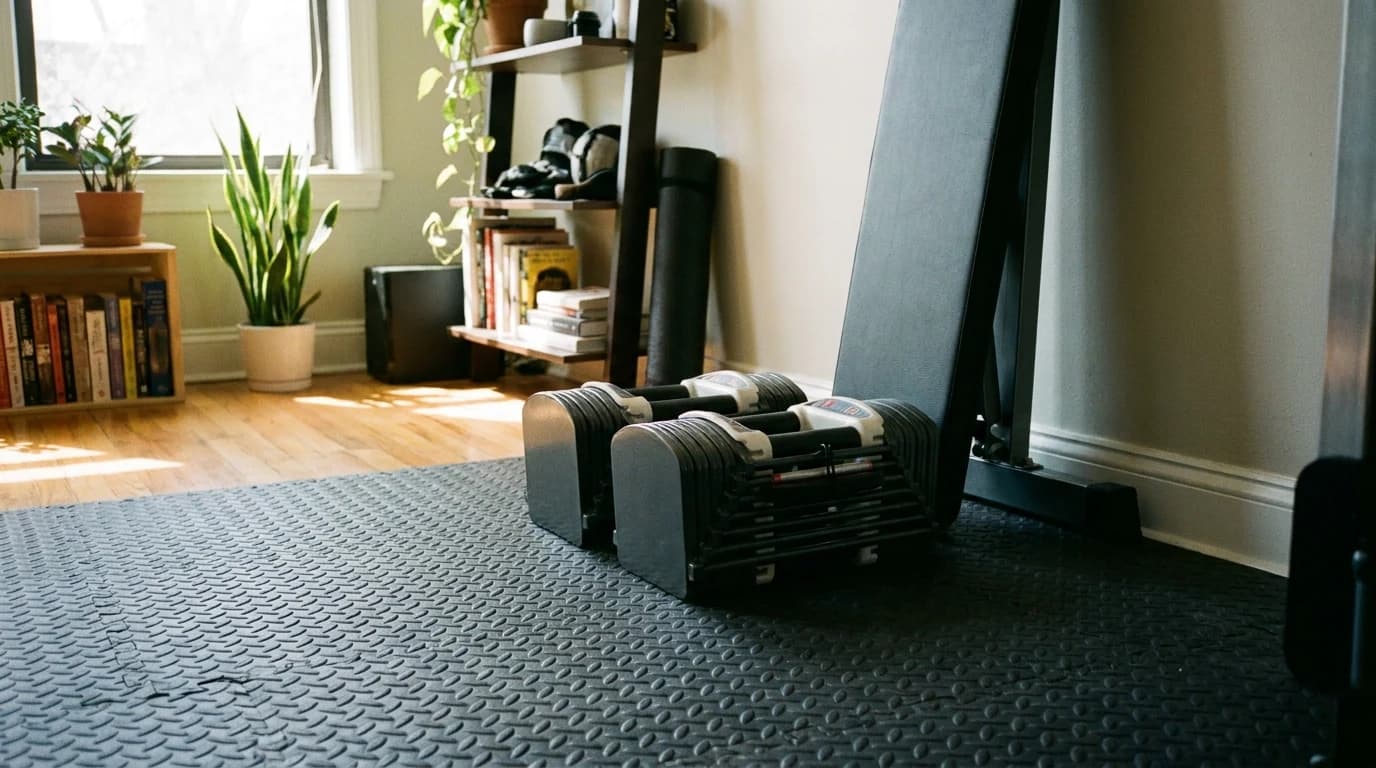
Rule of thumb: you do not do all eight every session. Rotate them across three full-body days so each pattern gets trained at least twice a week.
The 3-day full-body plan
Run this Monday / Wednesday / Friday, or any three non-consecutive days. Each session is 6 exercises, 3 sets each — about 45 minutes.
| Slot | Day A | Day B | Day C |
|---|---|---|---|
| Squat pattern | Goblet squat — 3 x 8-12 | Reverse lunge — 3 x 8-12 per leg | Goblet squat — 3 x 12-15 |
| Press | Floor press — 3 x 8-12 | Bench or floor press — 3 x 8-12 | Floor press — 3 x 12-15 |
| Pull | Bent-over row — 3 x 10-15 | Single-arm row — 3 x 10-15 per side | Bent-over row — 3 x 10-15 |
| Hinge | Romanian deadlift — 3 x 8-12 | Romanian deadlift — 3 x 10-15 | Single-leg RDL — 3 x 8-12 per leg |
| Overhead / arms | Overhead press — 3 x 8-12 | Hammer curl — 3 x 10-15 | Overhead press — 3 x 10-15 |
| Core | Suitcase carry — 3 x 30 sec per side | Weighted sit-up — 3 x 12-15 | Suitcase carry — 3 x 30 sec per side |
Why three days, not five
Each major muscle gets hit at least twice across the week. That is the point: a 2016 systematic review found higher training frequency produced more growth when it let lifters accumulate more weekly volume. Three full-body days is the simplest way to bank that volume with limited equipment.
What most people get wrong
The tool is not the limiter
The two mistakes:
- Treating dumbbell-only as a downgrade you tolerate until you can afford a barbell.
- Buying too light. The legs are the problem: most lifters out-grow a 50 lb dumbbell on goblet squats and RDLs fast.
What the evidence and the equipment say instead:
- When weekly volume is matched, a 2019 meta-analysis found frequency itself does not meaningfully change hypertrophy — a well-run dumbbell full-body plan that hits your sets is not inferior to a barbell split. The limiter is not the tool; it is whether you accumulate the volume.
- Buy a pair that climbs to 80-90 lb. The NUOBELL 80 tops out at 80 lb per hand and changes weight with a single dial twist, which keeps supersets fast. For more leg headroom, the PowerBlock Elite USA 90 lb reaches 90 lb per hand and has no mechanism to dial — you pull a pin. Either one carries this whole routine for years.
How to progress without a second pair
A fixed weight ceiling is not a wall — it just changes how you progress.
The ladder, in order
Move down this list before you ever add weight:
- Add reps. Work the top of the range (hit 12, then 15) before going heavier.
- Slow the eccentric. A 3-second lowering on every rep adds real difficulty at the same load.
- Add a pause. A 2-second pause at the bottom of a squat or press kills momentum and raises the demand.
- Cut rest. Shorter rest between sets increases density and metabolic stress.
- Then add weight. Once you own the top of the rep range with clean form, bump the dumbbell up one increment and start the cycle again.
Worth knowing: these are not consolation prizes. Tempo and pause work are legitimate intensity tools, and they let one pair of dumbbells stay challenging far longer than people expect.
Bottom line
A full-body routine three days a week, eight movements, one pair of adjustable dumbbells. It clears the CDC's strength guideline, hits each muscle twice weekly, and progresses on reps and tempo long before you need heavier weights. Pick a pair that reaches at least 80 lb so your legs have room to grow, then just show up and do the sets.
Sources
Frequently Asked Questions
Can you really build muscle with just one pair of dumbbells?+
Yes. Muscle growth is driven by training volume, not by how many machines you own. A 3-day full-body dumbbell routine that hits each muscle group at least twice a week accumulates plenty of weekly volume, and a 2019 meta-analysis found frequency itself does not meaningfully change hypertrophy when volume is equated.
How heavy do my dumbbells need to be?+
For most people, the legs set the ceiling. Goblet squats and Romanian deadlifts outgrow a 50 lb dumbbell quickly, so a pair that climbs to 80-90 lb per hand gives you years of headroom. Upper-body lifts rarely need that much, but you cannot under-buy and fix it later without a second pair.
Is full-body three days a week better than a split?+
For one-pair dumbbell training, usually yes. You cannot load every lift heavy, so frequency is how you reach real weekly volume. A full-body plan trains each muscle multiple times a week and is simpler to recover from than a complicated split when equipment is limited.
How do I keep progressing once the weight feels easy?+
Progress on reps first (work to the top of the range), then slow the lowering phase, then add a pause at the hardest point, then cut your rest periods. Only after you own the top of the rep range with clean form should you bump the dumbbell up an increment.
Sources & Research
- CDC — Physical Activity Basics: Adult Activity Guidelines (muscle-strengthening on 2 or more days per week, all major muscle groups)
- Schoenfeld et al. 2016 — Effects of Resistance Training Frequency on Measures of Muscle Hypertrophy: A Systematic Review and Meta-Analysis (Sports Medicine)
- Schoenfeld et al. 2019 — How many times per week should a muscle be trained to maximize hypertrophy? (Journal of Sports Sciences)
Your next step
One pair of adjustables covers this whole program.
Related reviews
Best Adjustable Dumbbells in 2026
Bowflex 1090 wins on its 10-90 lb range, NUOBELL 80 on feel, PowerBlock on durability. We scored 8 adjustable dumbbell sets on mechanism and build.
Adjustable vs Fixed Dumbbells for a Small Home Gym
One adjustable dumbbell pair replaces a whole fixed rack in a small home gym - but adjustables can't be dropped. When each type wins, and how to choose.
Progressive Overload at Home Without Adding Weight
Progressive overload without adding weight: progress with reps, sets, tempo, range, and rest when the next dumbbell jump is too big. The full method.
Hilly Shore Labs
Editorial teamThe independent product research team behind GymScored. Every recommendation is researched, never hands-on tested — rankings come from manufacturer specifications, published standards, and aggregated buyer sentiment.
163 products scored across 26 home gym categories, each on the same 5-dimension Gym Score formula.
See the scoring methodology and who we are.
Affiliate disclosure: GymScored is a participant in the Amazon Services LLC Associates Program. We earn from qualifying purchases at no extra cost to you. Full disclosure →