Progressive Overload at Home Without Adding Weight
Progressive overload without adding weight: progress with reps, sets, tempo, range, and rest when the next dumbbell jump is too big. The full method.
Progressive overload means giving your muscles a little more to handle over time, and weight is only one of the dials. At home, where dumbbells and bands jump in big steps, you progress by adding reps, then sets, then slowing the lowering phase, then using fuller range, then shortening rest. The cleanest system is double progression: add reps inside a range (say 8 to 12) at a fixed weight until you hit the top number for every set, then add weight and climb again. What actually drives the result is effort, each work set should end within one to three reps of failure, so more reps at an easy weight is not progress.
How GymScored is paid: Amazon Associates commission plus brand-direct affiliate (Rogue / REP / Titan when approved). No sponsored placements, no paid reviews, no pay-to-rank. Picks are ranked by the Gym Score formula and nothing else. Read the full disclosure.
Adding weight is the most obvious way to progress, but at home it is rarely the available one, because dumbbells and bands jump in big steps. Use double progression instead: add reps inside a set range until you own the top number across all sets, then slow the lowering, then add weight. Push each work set to within one to three reps of failure so it actually counts as overload, and train each muscle group about twice a week. Done this way, one dumbbell can drive months of steady progress.
Five ways to overload without adding weight
Pick the lowest-friction lever you have not used yet, and change only one at a time.
| Lever | How to apply it | Effort cost |
|---|---|---|
| More reps | Add 1 to 2 clean reps per set within your range | Low |
| More sets | Add a set (3 to 4) to the main movement | Low to moderate |
| Slower tempo | Lower the weight over 3 to 4 seconds | Moderate |
| Fuller range | Deeper squat, longer stretch, deficit | Moderate |
| Shorter rest | Trim 15 to 30 seconds between sets | High (conditioning) |
The short version
You do not need a heavier dumbbell to get stronger this week. Progressive overload means giving your muscles a little more to handle over time, and weight is only one of several dials you can turn. This matters at home more than anywhere else, because home setups jump in big steps. Many adjustable dumbbells go 25 to 30 to 35 pounds; fixed bands jump a whole resistance tier. When the next weight is too far away, you progress with reps, sets, tempo, range, and rest instead.
The NSCA defines progression as the systematic modification of a training program over time and notes it refers not only to intensity but also to frequency and increasing the difficulty of the work. In plain terms: there are many ways to make a workout harder. Adding plates is just the most obvious one.
Key takeaways
- Load is one lever, not the only lever. You can overload by doing more reps, more sets, slower reps, fuller range, or shorter rest, without touching the weight.
- Effort is what drives the adaptation. A set only counts as overload if it is genuinely hard relative to last time. More reps at an easy effort is not progress.
- At home, "double progression" is the cleanest method. Add reps within a range first, and only add weight once you hit the top of the range across all sets.
- What most people get wrong: they wait for a heavier weight and stall for weeks, when the same dumbbell could have driven months of progress through reps and tempo.
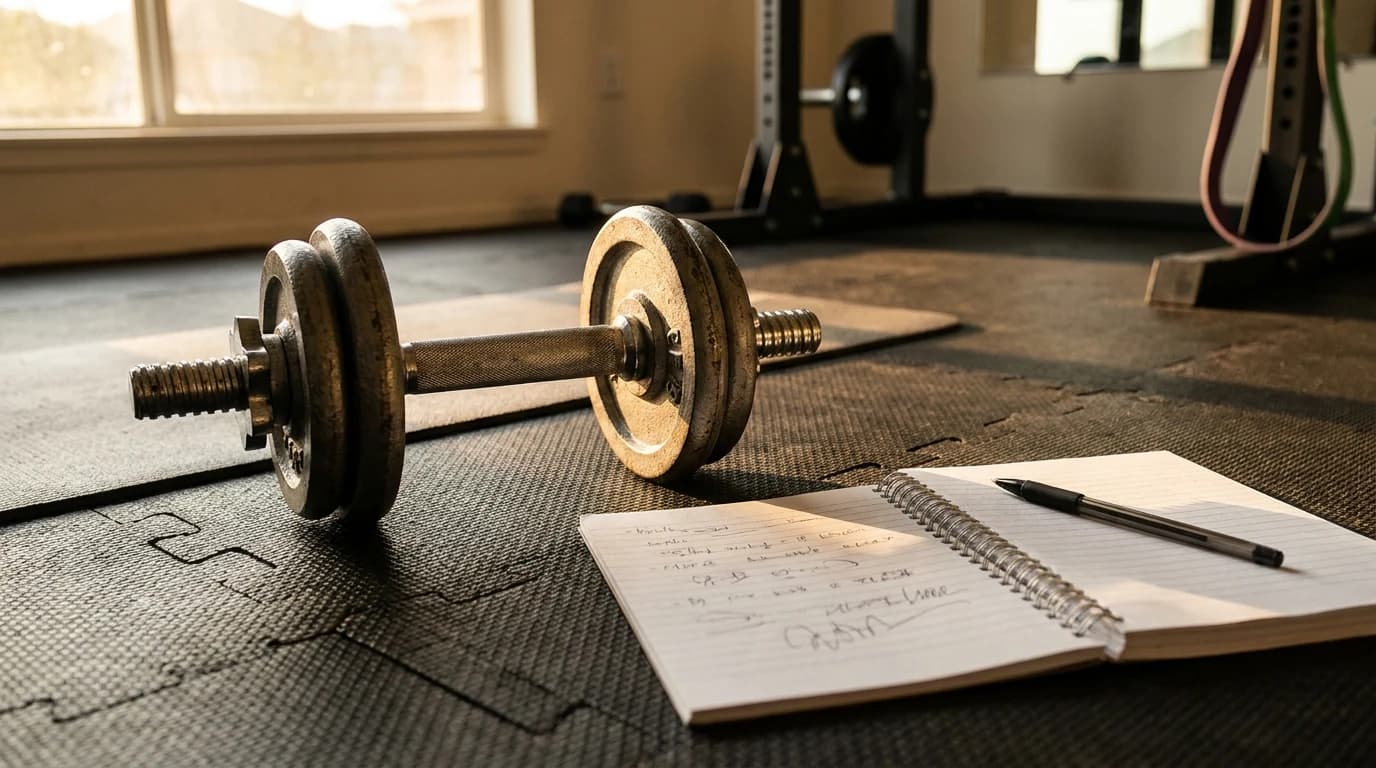
The five levers you can turn at home
From lowest friction to highest
When the next dumbbell or band is too big a jump, you still have room to make a workout harder. These are the dials, roughly from easiest to add to hardest.
| Lever | How to add overload | Best when |
|---|---|---|
| Reps | Do one or two more clean reps per set | The next weight is a big jump (adjustable dumbbells, bands) |
| Sets | Add a set to a movement (3 to 4) | You have time and recover well between sessions |
| Tempo | Slow the lowering phase to 3 to 4 seconds | You are stuck on reps and want more challenge at the same load |
| Range of motion | Use a fuller stretch (deficit, full squat depth) | Form is solid and you want more stimulus per rep |
| Rest | Shorten rest between sets by 15 to 30 seconds | You want a density and conditioning effect, not pure strength |
The order matters. Adding reps is the lowest-friction change and the one a returning lifter should reach for first. Slowing the tempo and increasing range of motion both raise the difficulty of the same weight, which is exactly what you want when the next dumbbell is 5 pounds away and 5 pounds is too much.
Rule of thumb: push one lever at a time. If you add reps, slow the tempo and cut rest in the same week, you will not know which change did the work when progress stalls.
Double progression: the home-gym default
Double progression is the simplest reliable system for adjustable dumbbells, resistance bands, or any setup with big weight gaps. You progress in two stages:
- Pick a rep range (for example, 8 to 12).
- Add reps inside that range session to session, keeping the same weight, until you can do the top number (12) for every set with good form.
- Only then add weight. When you do, your reps will drop back toward the bottom of the range (8), and you climb again.
What five weeks of it actually looks like
A worked example with a single dumbbell, training a goblet squat twice a week:
| Week | Weight | Sets x reps | What changed |
|---|---|---|---|
| 1 | 30 lb | 3 x 8 | Baseline |
| 2 | 30 lb | 3 x 10 | Added reps |
| 3 | 30 lb | 3 x 12 | Hit top of range, all sets |
| 4 | 35 lb | 3 x 8 | Added weight, reps reset |
| 5 | 35 lb | 3 x 9, slow lowering | Added reps + tempo |
Five weeks, one dumbbell, real progress every single session, and only one actual jump in load. That is the whole point: the weight on the rack is not the bottleneck, the system is.
The same logic works for bands. When the next band tier is too hard for a clean set, stay on the lighter band and add reps, slow the lowering, or add a set until the easier band feels easy across all your work sets. Then move up.
Why effort, not just numbers, is the real driver
Here is the line most people miss. Progressive overload only works if each session is genuinely demanding relative to the last one. Cranking out extra reps at a weight that never challenges you is just more easy volume; it is movement, not overload.
A set that counted as overload:
- Ended with roughly one to three reps left in the tank.
- Was harder than the same set was last session, on some dial.
- Kept clean form all the way to the last rep.
A set that was just volume:
- Ended with five or six reps still available.
- Added reps at a load that never felt demanding in the first place.
- Got easier by shortening range of motion rather than by getting stronger.
Light loads work if the effort is real
This is also why you do not need maximal weights to build muscle at home. A 2021 re-examination of the rep continuum by Schoenfeld and colleagues concluded that muscular adaptations can be obtained across a wide spectrum of loading zones, with hypertrophy in particular achievable with lighter loads taken to a similar level of effort, not only the classic 8 to 12 "moderate" range. For a home lifter with limited weight, that is liberating: a lighter dumbbell taken close to failure for 15 to 20 reps can grow muscle, so the lever you are short on (load) is not the lever you are stuck on.
How often to actually push
The practical weekly pattern
Overload needs frequency to add up, but more is not automatically better. The CDC recommends muscle-strengthening activity on at least 2 days a week, working all major muscle groups (legs, hips, back, abdomen, chest, shoulders, arms). That is the floor for general health. To keep progressing, the practical pattern is:
- Hit each muscle group about twice a week.
- Leave roughly 48 hours between hard sessions for the same area.
- Push one or two levers at a time so you can tell what is working.
- Treat three stalled sessions as a signal, not a failure: if you can no longer add reps, sets, tempo, range, or density for two or three sessions in a row, either add weight or take a lighter "deload" week and then restart the climb.
A genuine plateau is rare for a home lifter; running out of room on a single 5-pound jump is the far more common, and far more fixable, problem.
The bottom line
The next dumbbell up is not the unlock. The system is. Pick a rep range, add reps until you own the top of it across all sets, slow the lowering when reps stall, and only then add weight, whether you are working with adjustable dumbbells, bands, or a loaded barbell. Push each set close enough to failure that it actually counts, hit each muscle group about twice a week, and you can run months of steady progress on equipment you already own.
Frequently Asked Questions
Can you build muscle without ever adding weight?+
For a while, yes. If you keep adding reps, sets, tempo, or range while pushing each set close to failure, the same weight can drive real progress for weeks or months. Eventually you will own the top of every rep range at a given load and need to add weight to keep overloading, but the weight jump is the last lever to reach for, not the first.
What is double progression?+
Double progression means you progress in two stages. First you add reps within a set range (say 8 to 12) at a fixed weight, session by session, until you can hit the top number for every set with good form. Only then do you add weight, which drops your reps back toward the bottom of the range so you can climb again. It is the cleanest method for home setups with big weight gaps.
How do I progress when my dumbbells jump 5 pounds at a time?+
Treat reps and tempo as your in-between gears. Add reps at the lighter weight until the top of your range feels solid across all sets, then slow the lowering phase to make the same weight harder, then add weight. The 5-pound jump stops being a wall once you have several smaller levers bridging it.
How hard should each set be?+
Hard enough to count as overload. A useful target is finishing a work set with roughly one to three reps left in the tank. If you could have done five or six more, the set was too easy to count as progress no matter how many reps you logged. Effort relative to last time is what drives the adaptation, not the rep number on its own.
How often should I train each muscle to keep progressing?+
The CDC floor is muscle-strengthening on at least 2 days a week covering all major muscle groups. To keep progressing rather than just maintain, aim to train each muscle group about twice a week, leave roughly 48 hours between hard sessions for the same area, and change only one or two levers at a time so you can tell what is working.
Sources & Research
- Foundations of Fitness Programming — NSCA (progression defined as systematic modification of intensity, frequency, and difficulty over time)
- Loading Recommendations for Muscle Strength, Hypertrophy, and Local Endurance: A Re-Examination of the Repetition Continuum — Schoenfeld et al., Sports (Basel) 2021 (PMID 33671664)
- Physical Activity Guidelines for Adults — CDC (muscle-strengthening on 2+ days a week, all major muscle groups)
Your next step
When you do need more load, here's what to add.
Related reviews
How Often Should You Train Each Muscle at Home?
About twice a week per muscle, says the research - but once weekly volume is equal, frequency barely matters. How to set your volume and split at home.
Do Resistance Bands Actually Build Muscle? The Science
Yes - meta-analyses show resistance bands match free weights for strength in most lifters. The evidence, the mechanism, the hard ceiling, and how to train.
How to Build a Home Gym on Any Budget
Five complete home gym builds at $500, $1,500, $3,500, $7,500, and $15,000 - what to buy first, what to add later, and what to skip at every budget level.
Hilly Shore Labs
Editorial teamThe independent product research team behind GymScored. Every recommendation is researched, never hands-on tested — recommendations draw on manufacturer specifications and available published research. Category order is editorial; the Gym Score is a separate comparison aid.
170 listed products across 26 home gym categories. Scores use category criteria, value and owner-rating inputs; missing evidence limits what a score can tell you.
See the scoring methodology and who we are.
Affiliate disclosure: GymScored is a participant in the Amazon Services LLC Associates Program. We earn from qualifying purchases at no extra cost to you. Full disclosure →