Theragun Pro vs Hypervolt 2 Pro: Which Massage Gun Should You Buy?
Theragun Pro hits deeper with more amplitude; the Hypervolt 2 Pro has a quieter motor. We compare both massage guns on percussion depth, noise, battery.
How GymScored is paid: Amazon Associates commission plus brand-direct affiliate (Rogue / REP / Titan when approved). No sponsored placements, no paid reviews, no pay-to-rank. Picks are ranked by the Gym Score formula and nothing else. Read the full disclosure.
Theragun Pro for the deepest tissue penetration. Hypervolt 2 Pro for the quietest professional-grade percussion. Both are excellent — pick on amplitude vs noise priority.
| Product | Owner rating | Key specs | Pros | Cons | Price | Buy |
|---|---|---|---|---|---|---|
| Theragun Pro 16mm amplitude, 60 lbs stall force, rotating arm. Industry-leading depth. | Owner rating | Key specs
| Pros
| Cons
| $529.99 | Buy on Amazon |
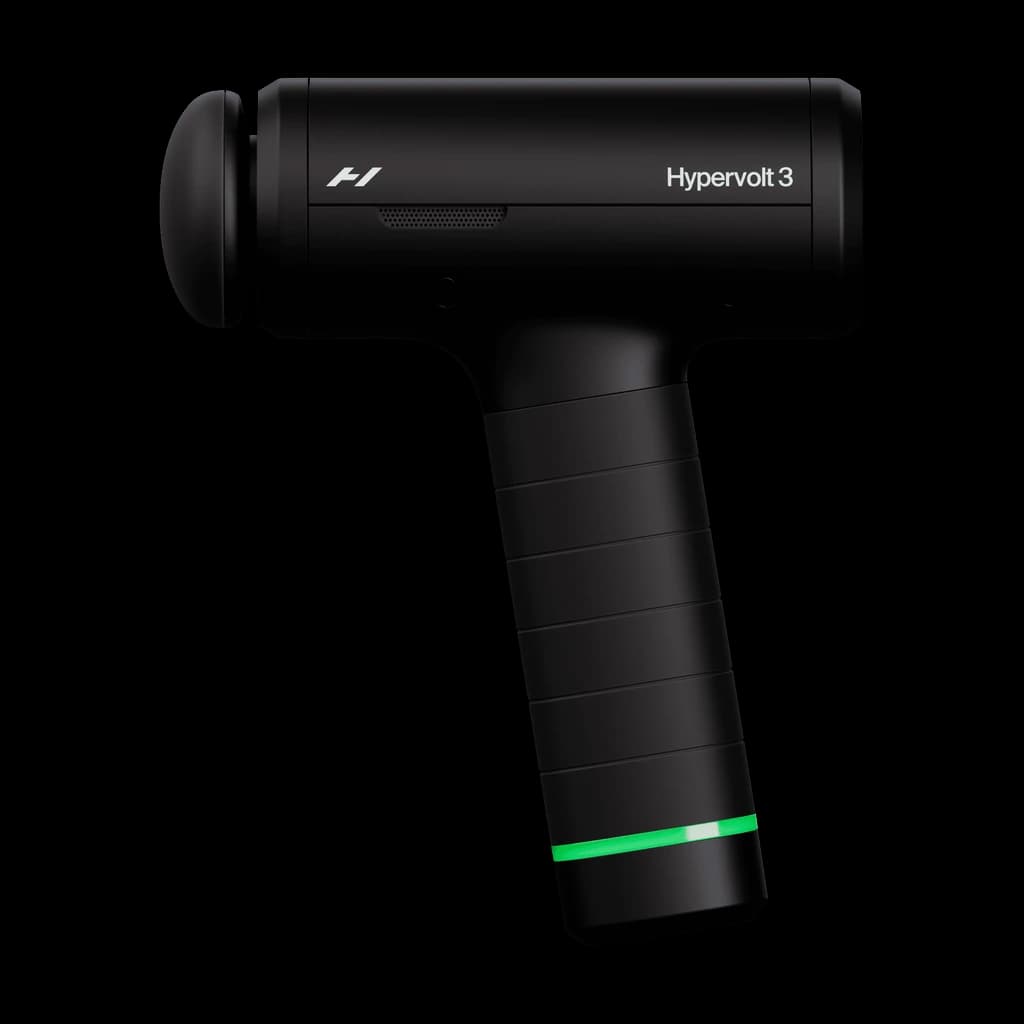 Hyperice's current quiet gun, launched March 2026 to replace the Hypervolt 2: rated at 48 dB, with a heated head and up to 4 hours of battery (Hyperice-stated). Reviews are still thin. | Owner rating Gym Score 73 | Key specs
| Pros
| Cons
| $249.00 | Buy on Amazon |
Amazon prices checked Oct 17, 2026. Amazon prices change often — the listing is authoritative.
Spec showdown: Theragun Pro vs Hypervolt 2 Pro
| Spec | Theragun Pro | Hypervolt 2 Pro |
|---|---|---|
| Amplitude (stroke depth) | 16mm | 14mm |
| Stall force | ~60 lb | ~55 lb |
| Speed range | 1750-2400 PPM (5 speeds) | 1700-2700 PPM (5 speeds) |
| Noise at top speed | ~65 dB | ~50 dB |
| Weight | 2.9 lb | 1.8 lb |
| Battery life | 2.5 hr (swappable) | 3 hr |
| Handle design | Triangular multi-grip + rotating arm | Pistol-grip barrel |
| App integration | Therabody (Bluetooth) | Hyperice (Bluetooth) |
Pick by need
Decide by your situation, not the generic ranking.
| If | You want | Pick |
|---|---|---|
| Deepest tissue, dense muscle | You want 16mm amplitude and 60 lb stall force for the strongest percussion | Theragun Pro |
| Quietest current Hyperice | You want professional-grade percussion quiet enough for shared spaces: Hyperice rates the Hypervolt 3 at 48 dB | Hyperice Hypervolt 3 |
| Hard-to-reach spots | The rotating arm reaches the back and traps a straight handle can't | Theragun Pro |
TL;DR
2026 update: Hyperice replaced the Hypervolt 2 line with the Hypervolt 3 in March 2026; the comparison below covers the 2 Pro as the sources we cite reviewed it, and the Hypervolt 3 is the current Hyperice model we rank.
- Hypervolt 2 Pro is the better pick for most users. Priced in the same bracket as the Theragun Prime, dramatically quieter motor, 3-hour battery, ergonomic barrel handle that suits self-treatment.
- Theragun Pro wins on raw amplitude (16mm vs 14mm) and rotating-arm reach. If you're an athlete with dense muscle tissue or you need to reach your own upper back, the Theragun's geometry matters.
- The peer-reviewed evidence base is real but narrow: percussive therapy reliably improves short-term range of motion and reduces perceived soreness. Performance recovery effects are mixed at best.
- Skip no-name guns that will not publish amplitude or stall force. If the spec sheet hides the two numbers that matter, assume they are low.
Spec showdown
| Spec | Theragun Pro | Hypervolt 2 Pro |
|---|---|---|
| Amplitude (stroke depth) | 16mm | 14mm |
| Stall force | ~60 lb | ~55 lb |
| Speeds | 5 (1750-2400 PPM) | 5 (1700-2700 PPM) |
| Noise (top speed) | ~65 dB | ~50 dB |
| Weight | 2.9 lb | 1.8 lb |
| Battery | 2.5 hr (swappable) | 3 hr |
| Handle geometry | Triangular multi-grip with rotating arm | Pistol-grip barrel |
| App | Therabody (Bluetooth) | Hyperice (Bluetooth) |
| Street price | $529.99 | $349.00 |
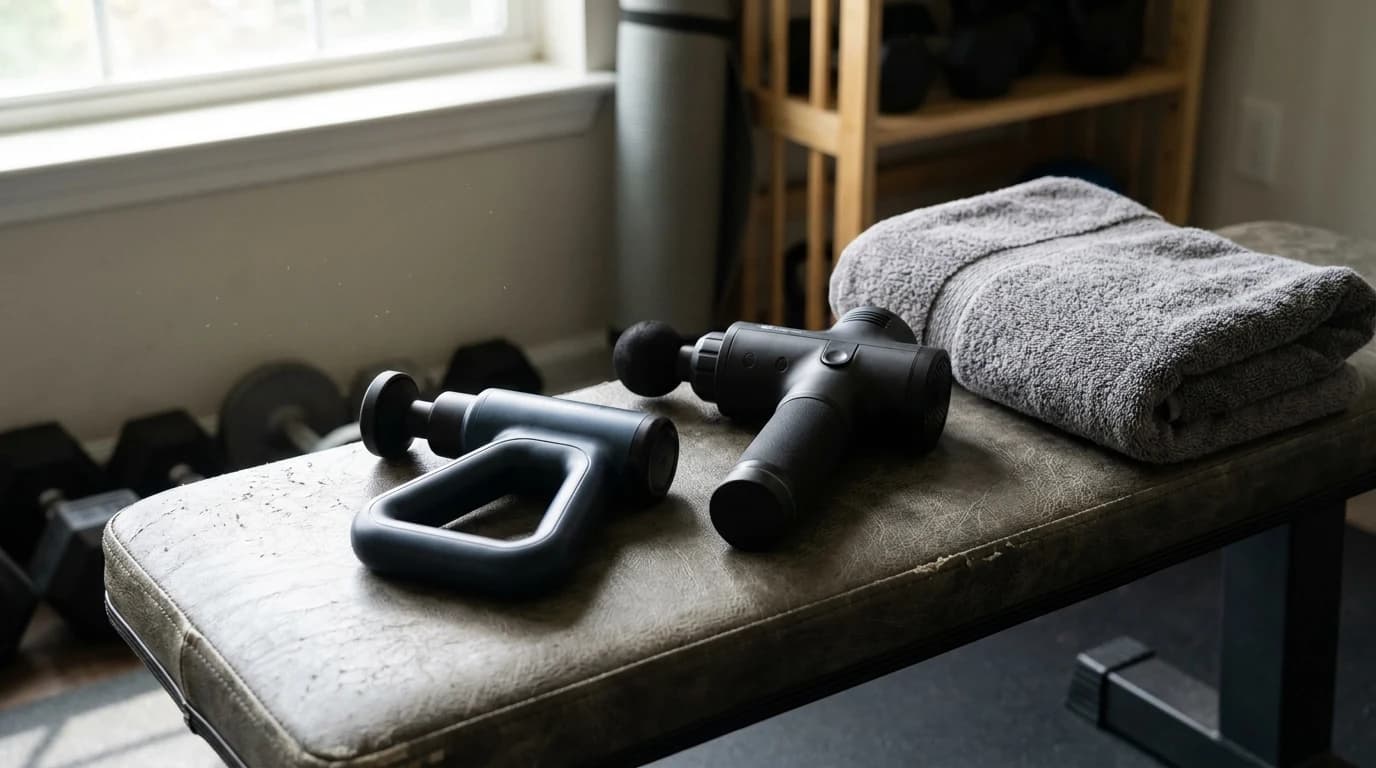
The spec that matters most is amplitude — how deep the head travels per stroke. A deeper stroke reaches further into dense muscle; how much deeper you actually need depends on what you treat.
Rule of thumb: both guns clear the 12mm bar, so the 2mm delta between them is real but smaller than most marketing makes it sound. Buy on noise, weight and reach before you buy on amplitude.
Where Theragun wins
Reach and depth
Amplitude — 16mm is the deepest mainstream offering. For users with dense or heavily-trained muscle, the extra 2mm reaches connective tissue that 14mm percussion glances over. Most users will not feel the difference; competitive athletes typically will.
The rotating arm reaches your own upper back and shoulders. The triangular handle has four grip positions and a head that swivels 30°. Hypervolt's barrel handle requires a partner or contortion to hit traps, rhomboids, and rear delts on yourself.
Stall force is higher. You can press harder before the motor bogs. 60 lb vs 55 lb is a 9% spec gap — perceptible if you do deep myofascial release on dense tissue, invisible otherwise.
All-day use and guided routines
Battery is swappable. Two batteries means the device runs continuously for a 5-hour treatment day (relevant for therapists, irrelevant for most home users).
App ecosystem includes guided routines. Therabody's app pairs over Bluetooth to walk through pre-set protocols by sport, body part, or recovery goal. The auto-adjust speed feature changes percussion frequency mid-routine. Useful for users who'd otherwise default to top-speed everywhere (a common mistake).
Where Hypervolt wins
Noise is the binding feature
Top speed measures ~50 dB — below normal conversation. The Theragun Pro at top speed sits around 65 dB — vacuum-cleaner range. If you'll use the gun while a baby sleeps, during a Zoom call, or in a shared apartment, the QuietGlide motor is the deciding spec.
Bluetooth pairing is reliable. The Hyperice app holds the connection through full sessions; firmware updates are routine. Some Therabody users report sporadic disconnects on the Pro at top speed — not a hardware fault, but a real friction point.
Comfort, runtime and price
Lighter and easier to hold. 1.8 lb vs 2.9 lb sounds small but matters across 10+ minute self-treatments — Theragun fatigues the holding hand. The pistol-grip barrel is also more intuitive for self-treatment of legs and arms; the Theragun's triangle requires more grip rotation between treatment zones.
Battery life is longer per charge. 3 hr vs 2.5 hr. For users who don't bother with the spare battery, Hypervolt simply runs longer — and it costs less than the Pro at list price.
Who should pick which
Pick Theragun if:
- You're an athlete with dense, heavily-trained muscle and you can feel the 2mm amplitude difference.
- You treat your own upper back and shoulders frequently — the rotating arm is uniquely useful.
- You're a fitness professional treating clients all day and the swappable battery matters.
- Noise is not a constraint (you live alone, you treat in a garage gym).
Pick Hypervolt if:
- You'll use the gun in shared living space — the noise floor difference is the entire game.
- You want a lighter, more comfortable device for longer self-treatment sessions.
- You're new to percussive therapy and want the lower price point.
- You already own Hyperice products and want the app cross-integration.
The current Hyperice model: Hypervolt 3
Hyperice launched the Hypervolt 3 in March 2026 to replace the Hypervolt 2 line, and it is the Hyperice gun we rank today. Hyperice lists five speeds across 1,500 to 2,500 RPM, a QuietGlide motor rated at 48 dB, a built-in pressure sensor, up to four hours of battery, a heated head attachment and a 2.0 lb weight. It publishes no amplitude or stall force, so the depth comparison above cannot be redone for it. It is also new: 4.3 stars from 56 Amazon ratings on 21 October 2026, too few to read much into. If quiet is why you were leaning Hyperice, it keeps that advantage.
If neither fits, compare every massage gun we rank in the live massage gun table.
What the research actually says
- Percussive massage therapy improves short-term range of motion. A systematic review of massage gun studies concluded they can help short-term range of motion, flexibility and recovery-related outcomes, but did not recommend them before strength or explosive work (Ferreira et al., 2023, PMID 37754971).
- A Hypervolt-device study found a large acute ROM gain in the calf with no change in strength after a single five-minute treatment (Konrad et al., 2020, PMID 33239942).
- Soreness relief is not reliable. In a controlled study of 65 active adults, five minutes of massage gun use after strenuous calf exercise had little effect on physical measures and slightly increased perceived soreness for up to four hours (Leabeater et al., 2024, PMID 37248364).
- Rhabdomyolysis from over-aggressive massage-gun use is documented in case reports (PMID 33156927). Don't use on bone, joints, kidneys, neck arteries, or recently strained tissue.
- Pre-exercise percussion did not harm jump performance and increased passive range of motion in a study of 26 recreationally active students (Alvarado et al., 2022, PMID 36161205).
What the research does NOT support: the claim that percussion guns accelerate performance recovery (next-day strength or power). Short-term ROM shows an effect; soreness and objective performance recovery do not reliably.
What to skip
- Massage guns without amplitude in the published specs. If the manufacturer hides amplitude, it's because the number is bad.
- Using percussion on neck, throat, kidneys, or directly over bone. Documented injury risk including rhabdomyolysis case reports.
- Daily aggressive percussion on the same muscle group. Soft tissue needs recovery between deep treatments. 2-3 sessions per week on a target zone is sufficient.
Sources
- Ferreira et al. 2023, systematic review of massage gun effects on performance and recovery — PMID 37754971
- Acute Hypervolt percussive treatment effects on plantar flexors — PMID 33239942
- Leabeater et al. 2024, percussive massage therapy and physical/perceptual recovery — PMID 37248364
- Biomechanical effects of percussive therapy on jump performance — PMID 36161205
- Rhabdomyolysis after percussion massage gun use, case report — PMID 33156927
- Passive recovery strategies review — PMID 34234090
Frequently Asked Questions
Is the noise really that different?+
Yes. On the figures we cite, about 65 dB for the Theragun Pro versus about 50 dB for the Hypervolt 2 Pro is roughly a 4x perceived loudness difference. Hyperice rates the current Hypervolt 3 at 48 dB.
Can either one cause injury?+
Yes if used on bone, joints, or recently injured tissue. Read the user guide. Neither is a substitute for physical therapy.
Will a massage gun replace a foam roller?+
Not entirely. Percussion targets a smaller area more aggressively; foam rolling distributes pressure across broader fascia. The peer-reviewed evidence shows both are effective for short-term ROM gains. Most owners report using both — foam roller for warm-up, percussion for targeted recovery.
Can a massage gun cause injury?+
Yes if misused. Documented case reports include rhabdomyolysis from over-aggressive use (PMID 33156927). Avoid bone, joints, neck arteries, kidneys, and recently injured tissue. Standard safety guidance: 1-2 minutes per muscle group at moderate intensity, not 10 minutes at top speed.
Are the cheaper Theragun and Hypervolt models worth it?+
Theragun Prime is the price-performance sweet spot in the Theragun line — our catalog records the same 16mm amplitude as the Pro, for less money and without the rotating arm. On the Hyperice side, the Hypervolt 3 replaced the Hypervolt 2 in March 2026 and is the model we currently rank.
Does percussion actually speed up recovery?+
It depends what you mean by recovery. Range of motion improves short-term — that evidence is consistent. Perceived soreness results are mixed: one controlled study found a small increase in soreness for a few hours after use. Performance recovery (next-day strength, power) does not reliably improve. Use for feel, not as a guaranteed performance enhancer.
Sources & Research
- PubMed — Ferreira et al. 2023 — The Effects of Massage Guns on Performance and Recovery: A Systematic Review (J Funct Morphol Kinesiol)research
- PubMed — Acute Effects of Percussive Massage with a Hypervolt Device on Plantar Flexor ROM and Performanceresearch
- PubMed — Leabeater et al. 2024 — Under the Gun: Percussive Massage Therapy and Physical and Perceptual Recovery in Active Adults (J Athl Train)research
- PubMed — Biomechanical Effects of Percussive Therapy Treatment on Jump Performanceresearch
- PubMed — Rhabdomyolysis After the Use of Percussion Massage Gun: A Case Reportresearch
- PubMed — Passive Recovery Strategies after Exercise: Narrative Literature Reviewresearch
Related reviews
Best Massage Guns for Recovery in 2026
The Theragun Prime is our top massage gun for recovery in 2026; the Hypervolt 3 runs quieter and the Bob and Brad C2 wins on value. Four guns ranked.

Best Cold Plunges for Home Use
The Plunge wins best home cold plunge on its full stack; the Lifepro NordPod on value, Renu on premium build. Seven tubs scored on cooling and hygiene.
Hilly Shore Labs
Editorial teamThe independent product research team behind GymScored. Every recommendation is researched, never hands-on tested — recommendations draw on manufacturer specifications and available published research. Category order is editorial; the Gym Score is a separate comparison aid.
170 listed products across 26 home gym categories. Scores use category criteria, value and owner-rating inputs; missing evidence limits what a score can tell you.
See the scoring methodology and who we are.
Affiliate disclosure: GymScored is a participant in the Amazon Services LLC Associates Program. We earn from qualifying purchases at no extra cost to you. Full disclosure →