Treadmill Belt Slipping: What to Check Before Tightening
Treadmill belt slipping underfoot? Separate tension, tracking and lubrication problems, follow the exact model manual, and know when to call service.
A treadmill belt slipping underfoot needs a model-specific tension check, not an automatic dose of lubricant. First distinguish a slipping belt from sideways drift or a machine that stops entirely. Check your exact manual, stop the machine before tension adjustments, and contact service if the fault persists. More tension can cause excessive wear.
How GymScored is paid: Amazon Associates commission plus brand-direct affiliate (Rogue / REP / Titan when approved). No sponsored placements, no paid reviews, no pay-to-rank. Picks are ranked by the Gym Score formula and nothing else. Read the full disclosure.
A treadmill belt slipping underfoot needs a model-specific tension check, not an automatic dose of lubricant. First distinguish a slipping belt from sideways drift or a machine that stops entirely. Check your exact manual, stop the machine before tension adjustments, and contact service if the fault persists. More tension can cause excessive wear.
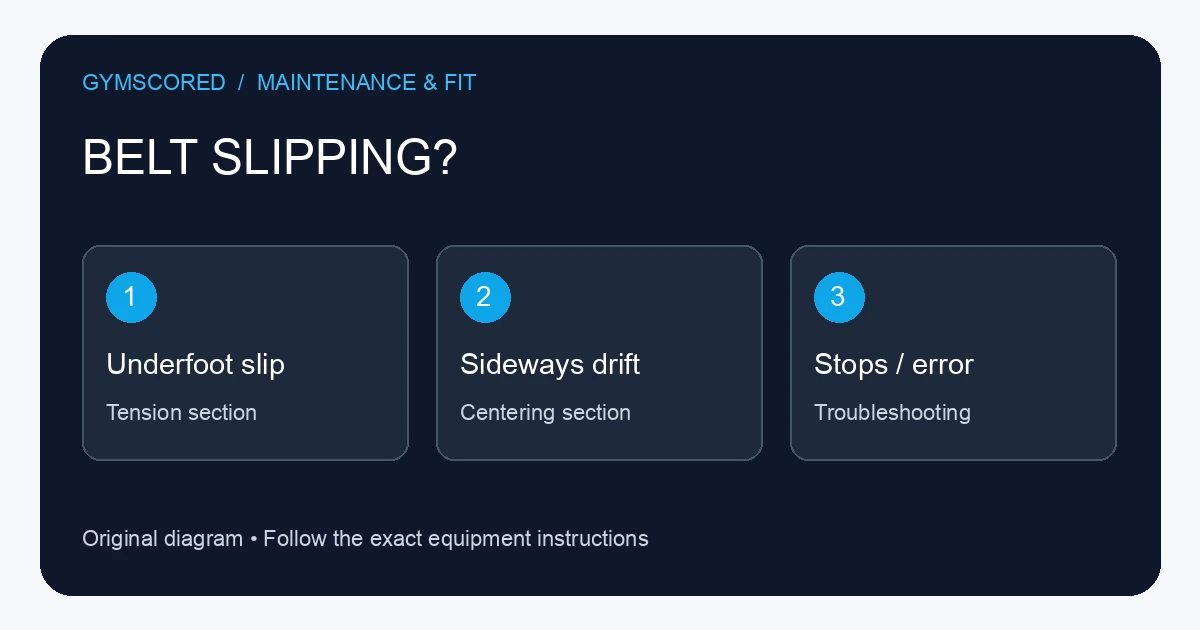
Is the belt slipping, drifting or stopping?
A treadmill belt slipping under your foot, a belt moving toward one edge and a treadmill shutting down are different observations. They should not trigger the same adjustment. Start by writing down what happened and when: while walking, during a speed change, or immediately after maintenance.
Horizon distinguishes tension from centering. Its tension instructions address a slipping sensation; its centering instructions address sideways movement. A symptom description gets you to the relevant manual section. It does not establish that a motor or control board is healthy.
| What you notice | What to check first | What it does not prove |
|---|---|---|
| Belt hesitates underfoot | Model's running-belt tension guidance | That oil is required |
| Belt approaches one edge | Model's centering guidance | That both bolts need tightening |
| Machine stops or displays an error | Troubleshooting section and service support | That rear roller bolts will fix it |
| Fault begins after maintenance | What was loosened, applied or changed | That repeating the maintenance will help |
Keep the repair question separate from the buying question
Our home treadmill rankings compare equipment. This guide is a triage checklist for a machine you already own. A slipping sensation alone is not a reason to replace the treadmill, nor enough information to order a belt.
Start with the symptom: Record what the belt and console do before changing anything. Sideways drift and underfoot slipping lead to different manual sections.
What should you do before touching the roller bolts?
Find the treadmill's model number and the manual for that revision. A general brand video can be useful, but a bolt direction or belt-lift measurement from another model is not your specification. If you cannot identify the machine or find its adjustment procedure, ask the manufacturer before experimenting.
- Stop using the treadmill while the belt feels unreliable.
- Record the model, displayed error and recent maintenance.
- Read the running-belt adjustment and troubleshooting sections.
- Follow the specified power state for each task.
- Make only the adjustment the manual authorizes, then follow its recheck procedure.
Do not combine tensioning and centering instructions into one routine. Horizon requires a stationary running belt during tensioning, but describes a moving-belt centering procedure. Read each operation independently and keep hands, hair and clothing away from moving parts. Do not put tools near a moving belt because another task happened to require power.
A quarter turn is an example, not a universal setting
Horizon’s published tension procedure, checked October 12, 2026, describes equal clockwise quarter turns of the rear roller bolts with the treadmill off, followed by a recheck. It warns that excessive tension can damage components. This example illustrates controlled adjustment; it is not an instruction for every treadmill.
The NordicTrack Commercial 1750 manual contains its own adjustment and belt-lift checks. Consult the exact document before applying a Horizon procedure to an iFIT machine. There is no useful universal answer to how high every treadmill belt should lift or how many turns its bolts need.
Why did the belt start slipping after lubrication?
Check whether the lubrication procedure changed belt tension. Horizon’s lubrication instructions include loosening the rear roller bolts and returning them by the same number of turns. They then require checking tension and alignment. Finishing the oil application does not mean the mechanical adjustment is finished.
For that procedure, the lubricant goes between belt and deck, never onto the running surface. If lubricant is visible where you stand, stop using the machine and ask the manufacturer how to remove it safely. Adding more is not a diagnostic test.
Useful information for support:
- Which lubricant you used and where you applied it
- Whether you loosened the bolts and recorded the turns
- Whether the belt now drifts as well as slips
- Whether the symptom appeared before or after the procedure
Changes that make the problem harder to trace:
- Adding another lubricant before checking the manual
- Turning both bolts repeatedly without recording the change
- Changing tracking, tension and lubricant at the same time
- Borrowing a different model's belt-lift measurement
For the separate question of whether your deck needs lubricant at all, use our manufacturer-by-manufacturer lubrication guide. Some manuals prohibit owner-applied substances. Slipping does not override that prohibition.
One change at a time: Keep a record of an authorized adjustment and its result. Repeated tightening without a clear stopping condition is not troubleshooting.
When should you stop adjusting and contact service?
Contact service when the authorized procedure does not resolve the problem, when the manual sends the symptom to support, or when you cannot establish the correct adjustment. Stop using a machine with an unexplained shutdown, damaged running surface, burning smell or electrical fault. Do not repeatedly load it to reproduce a dangerous symptom.
A service request should describe the observation rather than name a guessed part. Say that the belt hesitates when you step on it, that the console remains powered, and that it started after a particular maintenance step, if those things are true. Let the technician determine whether the running belt, drive system or another component is responsible.
Make the service handoff useful
Prepare this small record before calling:
- Model and serial number, kept private when posting publicly
- The exact console message, if any
- Whether the issue occurs unloaded or only underfoot
- Maintenance history and authorized adjustments already attempted
- A short description of any noise, smell or sideways movement
Do not remove the motor cover or run exposed equipment merely to film a diagnosis. If support needs additional observations, get the instructions for that exact machine. Our no-app treadmill guide also distinguishes operating controls from subscription features; neither tells you whether a mechanical fault is safe to ignore.
What can you reasonably conclude from a successful adjustment?
You can conclude that the symptom stopped during the prescribed check. You cannot conclude that the belt and deck are unworn, the motor is healthy or the treadmill is ready for every running speed. Resume use only as your manual directs, and contact support if the symptom returns.
We researched manufacturer instructions for this guide; we did not physically inspect your machine or test a repair. The practical endpoint is a stable belt through the model's specified check, with no recurring fault. If that endpoint remains unclear, service is the next step rather than another turn of the wrench.
Worked example: a fault after routine maintenance
Suppose the belt ran normally until you loosened its rear bolts to apply the lubricant your manual specifies. After reassembly it hesitates underfoot. Your support note should preserve that sequence: normal operation, bolts loosened, lubricant applied, bolts returned, symptom appeared. Do not label it a worn motor without evidence.
Return to the same manual's tension and alignment checks. If you did not record how far the bolts moved, say so to support rather than inventing a reset position. Keep the lubricant bottle available so you can identify the product. If the authorized check fails, describe its outcome and stop adjusting. This record gives service something actionable and avoids layering several guesses onto one new fault.
Frequently Asked Questions
Why does my treadmill belt slip when I walk?+
Underfoot slipping may call for the exact model’s tension procedure. First distinguish it from sideways drift or shutdown, and contact service if the authorized adjustment does not resolve it.
Should I lubricate a slipping treadmill belt?+
Only if the exact model manual calls for lubrication. Some procedures alter tension while lubricating, and some treadmill manuals prohibit owner-applied lubricant.
How tight should a treadmill belt be?+
Use the tension check and stopping condition in the manual for your exact model. Excessive tightening can cause wear; a generic belt-lift measurement is not a universal specification.
Sources & Research
- Horizon Fitness — Tensioning and centering the running beltmanufacturer
- Horizon Fitness — Running-belt lubrication proceduremanufacturer
- NordicTrack / iFIT — Commercial 1750 model NTL17125.0 manualmanufacturer
Related reviews
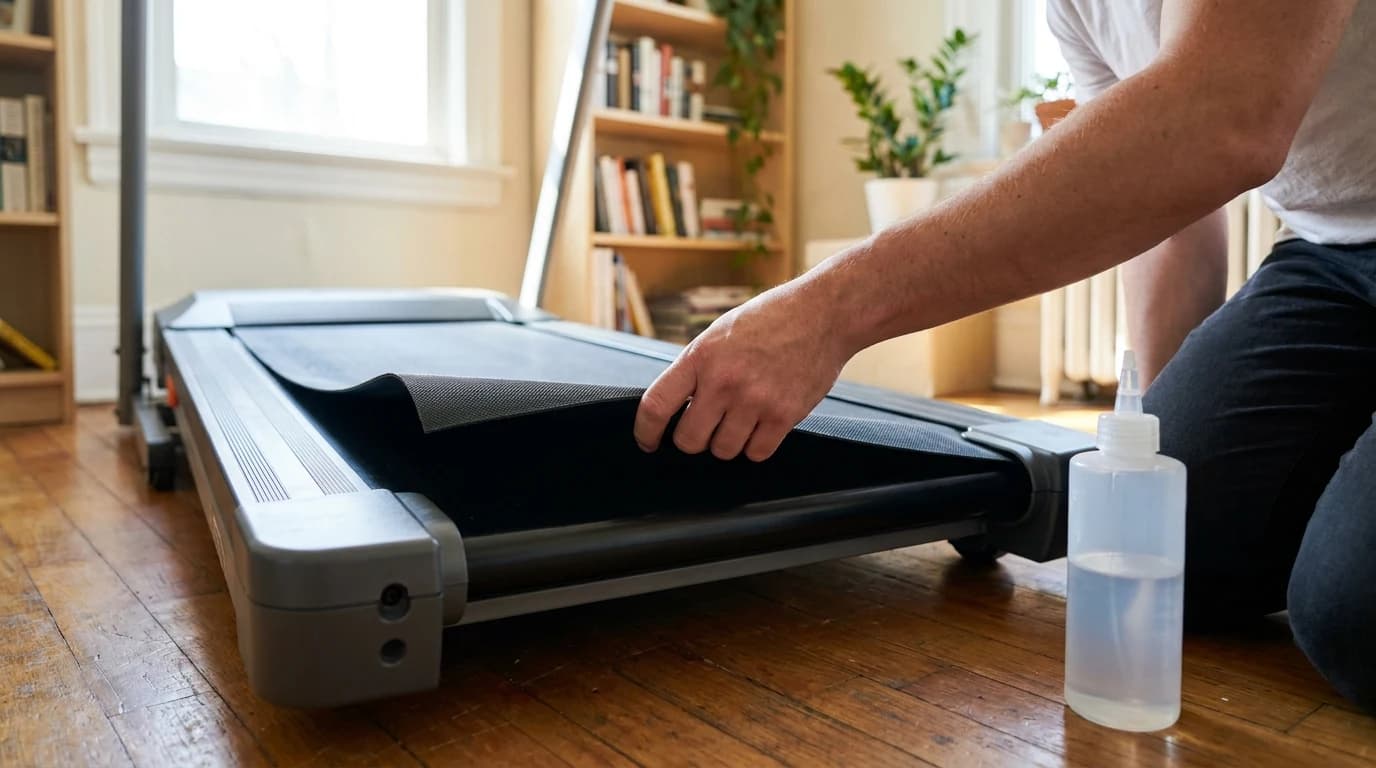
Treadmill Belt Lubrication: Five Brands, Five Answers
How often to lubricate a treadmill belt has no single answer: five manufacturers publish five different schedules, from never to weekly. Compare them.

Best Treadmill for Home Runners in 2026
The NordicTrack Commercial 1750 is the best running treadmill of 2026; the T Series 10 is the value runner and the MERACH is the incline pick. Seven decks scored.
Does Your Treadmill Need an App to Work? Three Tiers
Treadmills split into three tiers: standalone, account-to-activate, and membership-gated. No subscription does not mean no app - check before you buy.
Hilly Shore Labs
Editorial teamThe independent product research team behind GymScored. Every recommendation is researched, never hands-on tested — recommendations draw on manufacturer specifications and available published research. Category order is editorial; the Gym Score is a separate comparison aid.
161 listed products across 26 home gym categories. Scores use category criteria, value and owner-rating inputs; missing evidence limits what a score can tell you.
See the scoring methodology and who we are.
Affiliate disclosure: GymScored is a participant in the Amazon Services LLC Associates Program. We earn from qualifying purchases at no extra cost to you. Full disclosure →