Rank #4 in Kettlebells
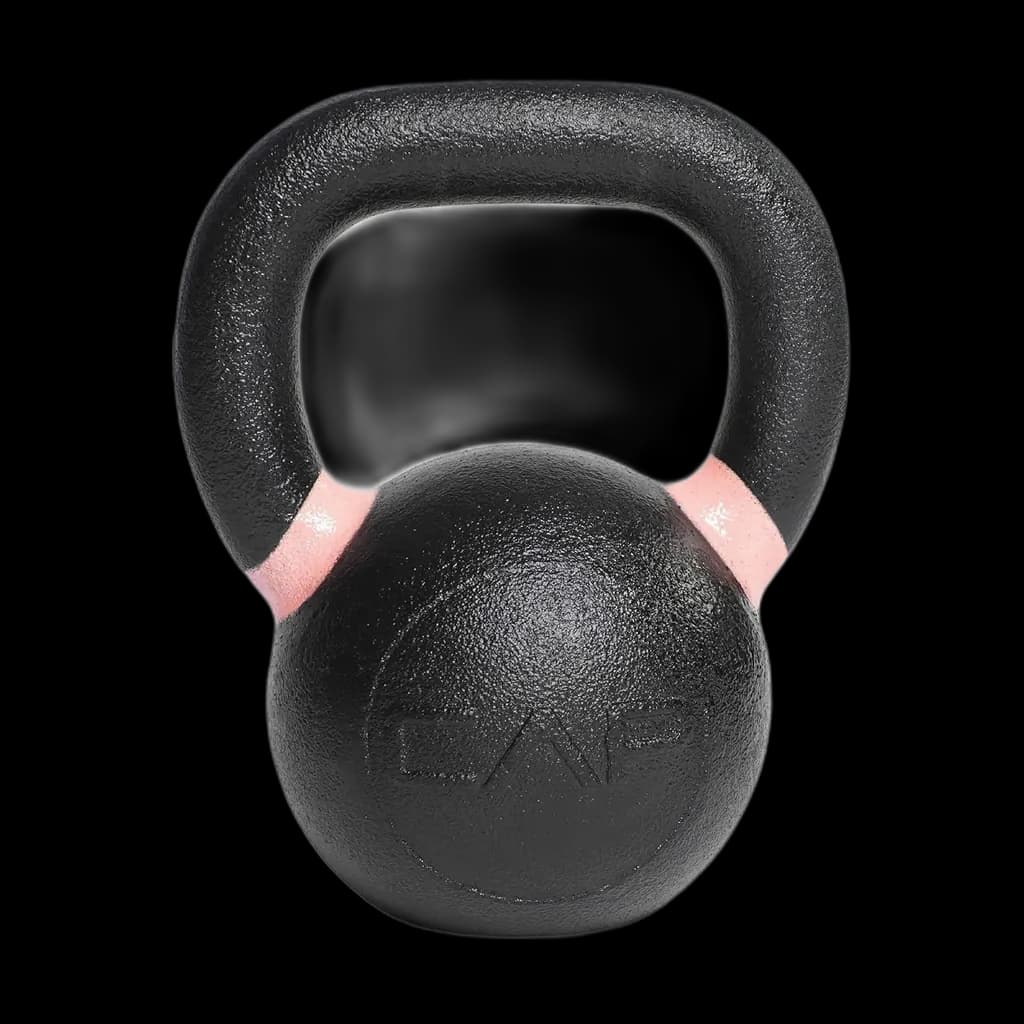
CAP Barbell Cast Iron Competition Kettlebell
by CAP BarbellOptional
Score
CAP's competition-style bell is the alternative if Yes4All's competition line is out of stock or you want a slightly larger handle. 35mm handle (vs. Yes4All's 33mm) is more forgiving for larger hands but slightly less optimal for very high-rep snatches. The powder coat is thicker than Yes4All's, which means fewer chips but also a slightly slicker feel until it wears in. Same uniform body sizing as any competition bell. Good middle-ground option.
- Lifters with larger hands who find 33mm competition handles cramped
- Buyers who want competition geometry but value Prime availability over IKFF spec purity
- Home gyms in the 53 to 88 lb range where the wider handle helps with high-load presses
- Replacement for a chipped Yes4All competition bell when only CAP has stock
- You're training for IKFF or IUKL competition (35mm handle is non-spec)
- You want the thinnest available handle for high-rep snatches
- You're particular about labeled weight being exact (CAP runs slightly over on some weights)
- You want the coating to look new for years (powder coat is durable, not premium-glossy)
Same as any kettlebell, with slightly larger storage footprint due to competition uniform body shape: 14 x 14 in storage spot, 6 x 6 ft swing zone, 9 ft overhead.
easy — No assembly. The CAP bells generally arrive cosmetically clean with a thicker powder coat than Yes4All's competition line. No filing or paint touch-up typically required.
Specialty accessory. Buy after foundational gym is set, and only if competition-style training matches your programming.
Strengths
- ↑Thicker powder coat — slower to chip
- ↑35mm handle better for larger hands
- ↑Available 9-88 lb (wider range than Yes4All)
- ↑Reliable Amazon Prime availability
Weaknesses
- ↓35mm handle is non-standard for IKFF/IUKL
- ↓Powder coat slightly slick when new
- ↓Heavier than Yes4All competition at same labeled weight (sometimes 1-3% over)
What owners actually complain about
Synthesized from owner reviews and community threads. Paraphrased, not quoted.
- 35mm handle is non-standard for IKFF/IUKL competition specifications, which matters only if you compete formally
- Powder coat feels slick out of the box and needs 2 to 3 sessions of chalk use to break in
- Labeled weight runs 1 to 3% over on some weights (a 35 lb bell measuring 35.5 to 36 lb)
- Heavier than Yes4All's competition line at the same labeled weight (the extra material is real, not perception)
- Stock is inconsistent on Amazon, with some weights frequently backordered
Buyer sentiment
Based on 426 user mentionsBuyers praise quality, value for money, texture and grip. Mixed feedback on finish and handle size.
Verdict: A budget competition-style bell with a deliberately thick 35mm handle — better for traditional training than for formal sport competition.
Specs that matter
| Spec | Value |
|---|---|
| Handle | 35mm (vs 33mm IKFF/IUKL spec) |
| Weight range | 9 to 88 lb |
| Construction | Solid cast iron / weighted shell |
| Weight tolerance | Runs ~1-3% heavy |
What you get
- Thick 35mm handle — more comfortable for larger hands and heavy pressing
- Durable powder coat — meaningfully thicker than Yes4All; slower to chip
- Wide range — 9-88 lb, broader than Yes4All competition, with reliable heavy-bell stock
What you give up
- Not IKFF-compliant — the 35mm handle is a non-starter for formal sport rules
- Slick out of the box — needs chalk and 2-3 break-in sessions
Buy it if you have large hands or train competition geometry without strict spec needs. Skip it if you train under formal sport-kettlebell rules.
Owner scale tests on r/kettlebell consistently report the ~1-3% over-weight bias, irrelevant for training.
Full specs
- Material
- Solid cast iron
- Coating
- Industrial powder coat
- Handle Diameter
- 35mm
- Body Size
- Uniform across weights
- Available Weights
- 9-88 lb
Common questions
Is the 35mm handle a dealbreaker?
Only if you compete formally. IKFF and IUKL both specify 33mm. For training, the 35mm handle is friendlier for larger hands and high-load presses. Many lifters who don't compete actually prefer the slightly thicker handle and find the 33mm cramped. Pick based on whether your training is sport-specific or general.
Why does CAP's bell weigh more than the labeled weight?
CAP's manufacturing tolerance runs slightly heavy. A 35 lb bell often measures 35.5 to 36 lb on a calibrated scale, and a 53 lb bell can measure 54 to 54.5. The 1 to 3% over isn't a defect but is real. For training this is negligible; for competition this would be problematic.
How does CAP compare to Rogue competition bells?
Rogue's competition bells are roughly 2.5x the price of CAP and offer machined handles, tighter weight tolerance, and IKFF-spec 33mm geometry. The build quality gap is real. For home training where the specs don't have to be exact, CAP wins on price. For serious sport-kettlebell training, Rogue earns the premium.
Does the powder coat hold up?
Yes, with normal use. CAP applies a thicker powder coat than Yes4All's competition line, which means slower chipping at the handle window edges. The trade-off is that the coat feels slicker out of the box and takes a few sessions to break in for grip.
Is CAP made in the USA?
No. CAP Barbell is a Texas-based company but manufactures internationally. This is standard for the budget and standard tiers of kettlebells. Made-in-USA kettlebells exist (Rogue, Kettlebell Kings) and run roughly 2 to 3x the CAP price.
Sources & references
- ResearchKettlebell Training Programming and Equipment— NIH/NCBI
- Independent reviewCAP vs Yes4All competition kettlebell comparison— Garage Gym Reviews
- Independent reviewBest Competition Kettlebells Tested— BarBend
- CommunityCAP Barbell competition bell owner thread— r/kettlebell
- ResearchHandle Diameter Effects on Grip Strength— NSCA
- ResearchSport Kettlebell Equipment Standards— American Council on Exercise
Full buying guide
Best Kettlebell for Home Gyms and Beginners (2026): Which to Buy
Read the full ranking →Other kettlebells we rate
Ranked alternatives from the same category, with our score and the current price.
The Yes4All powder-coated kettlebell is the default Amazon answer to 'I want one good kettlebell'. Single-piece cast iron, no welds or seams, and Yes4All lists each bell's actual weight within about 3% of the label. The powder coat has a slight texture that Yes4All says grips without chalk, and each weight is colour-coded. The flat bottom matters more than people expect: it lets you do renegade rows or push-ups on the bell without it rocking. Yes4All sells it from 9 to 88 lb.
The default beginner buy: a solid one-piece cast-iron bell with a vinyl coat that protects your floors and quiets the clank. Sold in single weights from 10 to 50 lb, so you can build a rack a plate at a time without committing to a full set.
The Amazon Basics enamel kettlebell is an inexpensive 'don't get scammed' kettlebell on Amazon. Solid cast iron core, glossy enamel finish, accurate labeled weight. The catch is that enamel: it's harder than powder coat, which means it doesn't grip chalk as well and feels slicker in sweaty hands. For unweighted-grip work (swings, goblet squats) it's a non-issue. For high-rep snatches or get-ups, you'll want a powder-coated bell. Good emergency-replacement option, or a fine first kettlebell to learn whether you actually like training with bells.
The adjustable option this category was missing — every other pick is a single fixed weight. BowFlex state a dial that swaps between 8, 12, 20, 25, 35 and 40 lb, which replaces six kettlebells in the footprint of one.
The low-cost route to adjustable if you already own dumbbells — it is a handle that clamps around a dumbbell rather than a bell in its own right.