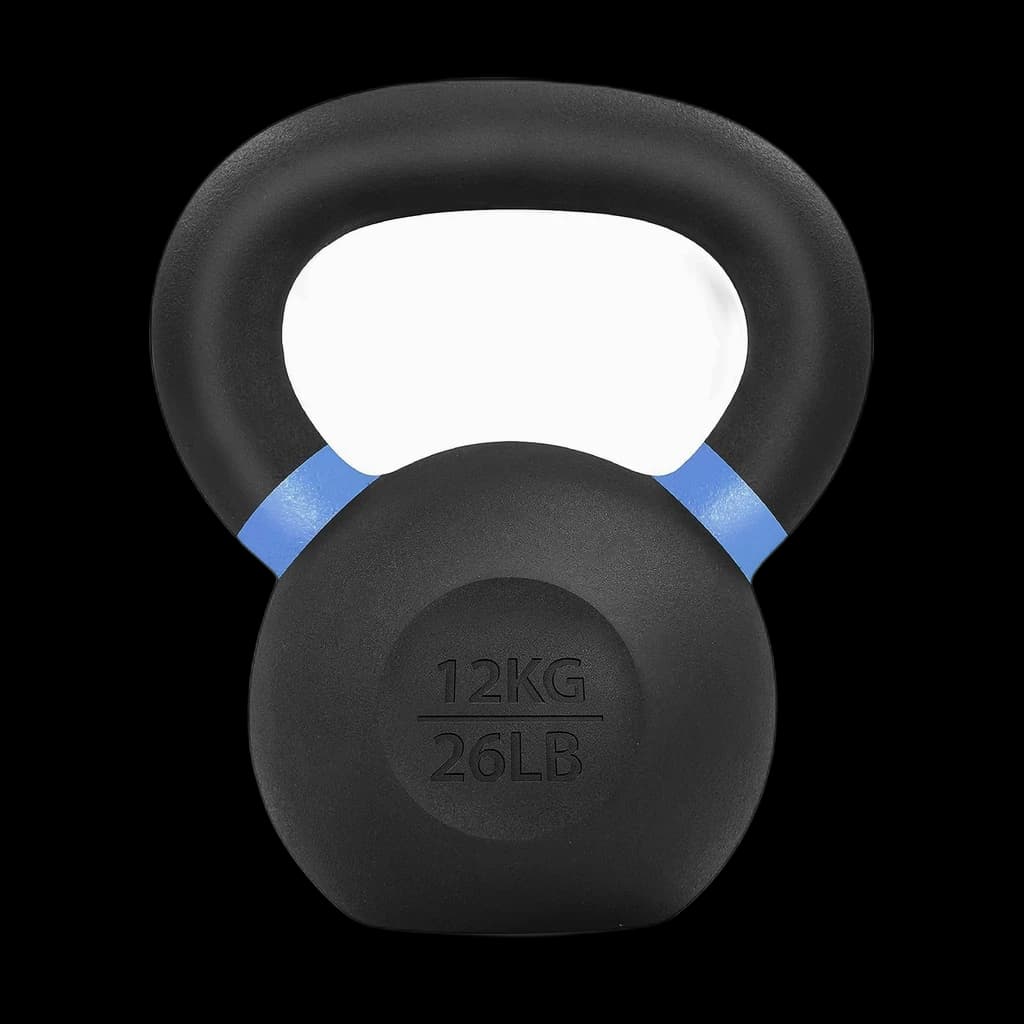
Rank #1 in Kettlebells
Yes4All Powder Coated Kettlebell
by Yes4AllOptional
Score
The Yes4All powder-coated kettlebell is the default Amazon answer to 'I want one good kettlebell'. Single-piece cast iron, no welds or seams, and Yes4All lists each bell's actual weight within about 3% of the label. The powder coat has a slight texture that Yes4All says grips without chalk, and each weight is colour-coded. The flat bottom matters more than people expect: it lets you do renegade rows or push-ups on the bell without it rocking. Yes4All sells it from 9 to 88 lb.
Best price at
Amazon
$41.99 (26 lb)
The link opens Yes4All's powder-coated listing on the 26 lb (12 kg) single bell. The price shown is for that one bell; choosing another weight on the listing changes it.
Buy on AmazonPrice checked Sep 24, 2026
- Anyone buying their first or second kettlebell for general training
- Lifters in the 26 to 53 lb range running Simple and Sinister or Enter the Kettlebell programs
- Budget-conscious buyers who want a real cast iron bell with good chalk-holding texture
- Hard-style kettlebell practitioners doing swings, get-ups, and presses
- You do high-rep snatches and need uniform body size at every weight (use competition style)
- You want every bell in a set to match (Yes4All colour-codes each weight)
- You need extreme handle precision (machined dimensions vary 1 to 2mm across the line)
- You're already past 70 lb of working weight (sizes top out at 88 lb)
A single kettlebell needs only a flat 12 x 12 in floor spot for storage. Swings need a clear 6 x 6 ft swing zone with no overhead obstacles under 9 ft, and ideally horse-stall mat flooring underneath.
easy — No assembly. The bell arrives ready to use. First-day check: run a hand around the handle window and lightly file any small casting burrs with a metal file. Takes 60 seconds.
Kettlebells are accessories. They don't replace a barbell, a rack, or a bench, but they pair well with all three. Buy one or two as your first additions once you have a foundation set up, or as the entire weight room if your training is kettlebell-first.
Strengths
- ↑Single-piece cast iron, no welds
- ↑Textured powder coat grips without chalk, per Yes4All
- ↑Flat bottom enables push-ups and rows
- ↑Yes4All states each bell’s actual weight range (about ±3% of label)
Weaknesses
- ↓Handle window can have small casting burrs (file in 30 sec)
- ↓Weight tolerance is about ±3% of label, per Yes4All — fine for training, not competition
- ↓Heavier weights (62+ lb) ship on Prime but are slow
What owners actually complain about
Synthesized from owner reviews and community threads. Paraphrased, not quoted.
- Handle window can have small casting burrs that need filing on arrival (30 seconds, but real)
- Handle diameter varies with weight (32mm on lighter, 38mm on heavier), which is the standard hard-style design but feels different bell to bell
- Heavier weights (62 lb+) ship slowly even on Prime because of warehouse stocking
- Yes4All lists about a ±3% weight tolerance (its 26 lb bell is stated as 25.22 to 26.78 lb), which is fine for training but not competition-grade
Buyer sentiment
Based on 968 user mentionsBuyers praise quality, value for money, grip and weight. Mixed feedback on handle quality and handle. Some flag durability.
Verdict: The default Amazon kettlebell — single-piece cast iron that gets the four things that matter right, at a fraction of premium prices.
Specs that matter
| Spec | Value |
|---|---|
| Construction | Single-piece sand-cast iron (no welds/seams) |
| Coating | Powder coat, colour-coded by weight |
| Handle | Hard-style scaling (32mm @ 26 lb, 35mm @ 53 lb, 38mm @ 70 lb) |
| Weight tolerance | About plus/minus 3% of label, per Yes4All |
What you get
- Solid casting — single-piece, no welds or glued seams to fail under load
- Grippy finish — textured powder coat that Yes4All says holds without chalk
- Usable geometry — large handle window for two-hand grip, flat bottom for renegade rows
What you give up
- Fit and finish — minor casting burrs and surface texture vs machined premium bells
- Not for sport — hard-style scaling; competitors want a uniform 33mm competition bell
Buy it if you're a first-time buyer or hard-style trainee on a budget. Skip it if you compete or want gym-aesthetic machined equipment (Rogue, Kettlebell Kings).
Per NSCA consensus, start with one swing-sized bell (women 18-26 lb, men 35-44 lb), train to 100 swings in 5 minutes, then add a size up.
Full specs
- Material
- Single-piece cast iron
- Coating
- Powder coat, colour-coded by weight
- Handle Diameter
- 32-38mm (varies with weight)
- Available Weights
- 9-88 lb
- Bottom
- Flat
Common questions
Is Yes4All as good as a Rogue kettlebell?
Rogue is the premium benchmark and costs considerably more; its machined handle and finish are a step up. For someone training swings, get-ups and presses at home, the gap is hard to feel and the price gap is hard to ignore. For a professional gym where bells get heavy daily use, Rogue is the safer long-term buy.
What weight kettlebell should I start with?
Common starting points from NSCA literature and practitioner consensus: women new to kettlebells start with 18 to 26 lb (8 to 12 kg), men with 35 to 44 lb (16 to 20 kg). The benchmark for two-hand swings is being able to do 100 reps within 5 minutes; if that's hard, you've started right. If easy, you went too light.
Why does the handle diameter change with bell weight?
This is the hard-style kettlebell standard: handle diameter scales roughly with bell weight because heavier bells are harder to grip and a thicker handle distributes load. Competition kettlebells deliberately use a uniform 33mm handle at every weight, which is friendlier for high-rep snatches but unfamiliar for traditional hard-style work.
Can you do TGUs (Turkish Get-Ups) safely with Yes4All?
Yes, for any weight you can press securely. The flat bottom (a Yes4All design choice) is actually preferable to some premium bells for the windmill phase of the get-up because it sits stable on the floor between reps. Just stay under your secure press weight; a TGU failure overhead is the most common kettlebell injury.
How accurate is the labeled weight?
Yes4All states a tolerance of about plus or minus 3%: its 26 lb bell, for example, is listed as weighing 25.22 to 26.78 lb. That is fine for training; competition kettlebells are made to a much tighter tolerance.
Sources & references
- ResearchKettlebell Training: A Review— NIH/NCBI
- ResearchKettlebell exercise prescription— NSCA
- Independent reviewYes4All powder-coated kettlebell review— Garage Gym Reviews
- Independent reviewBest Budget Kettlebells— BarBend
- CommunityYes4All vs Rogue kettlebell long thread— r/kettlebell
- ResearchKettlebell Selection and Training Principles— American Council on Exercise
Full buying guide
Best Kettlebell for Home Gyms and Beginners (2026): Which to Buy
Read the full ranking →Other kettlebells we rate
Ranked alternatives from the same category, with our score and the current price.
The default beginner buy: a solid one-piece cast-iron bell with a vinyl coat that protects your floors and quiets the clank. Sold in single weights from 10 to 50 lb, so you can build a rack a plate at a time without committing to a full set.
The Amazon Basics enamel kettlebell is an inexpensive 'don't get scammed' kettlebell on Amazon. Solid cast iron core, glossy enamel finish, accurate labeled weight. The catch is that enamel: it's harder than powder coat, which means it doesn't grip chalk as well and feels slicker in sweaty hands. For unweighted-grip work (swings, goblet squats) it's a non-issue. For high-rep snatches or get-ups, you'll want a powder-coated bell. Good emergency-replacement option, or a fine first kettlebell to learn whether you actually like training with bells.
CAP's competition-style bell is the alternative if Yes4All's competition line is out of stock or you want a slightly larger handle. 35mm handle (vs. Yes4All's 33mm) is more forgiving for larger hands but slightly less optimal for very high-rep snatches. The powder coat is thicker than Yes4All's, which means fewer chips but also a slightly slicker feel until it wears in. Same uniform body sizing as any competition bell. Good middle-ground option.
The adjustable option this category was missing — every other pick is a single fixed weight. BowFlex state a dial that swaps between 8, 12, 20, 25, 35 and 40 lb, which replaces six kettlebells in the footprint of one.
The low-cost route to adjustable if you already own dumbbells — it is a handle that clamps around a dumbbell rather than a bell in its own right.