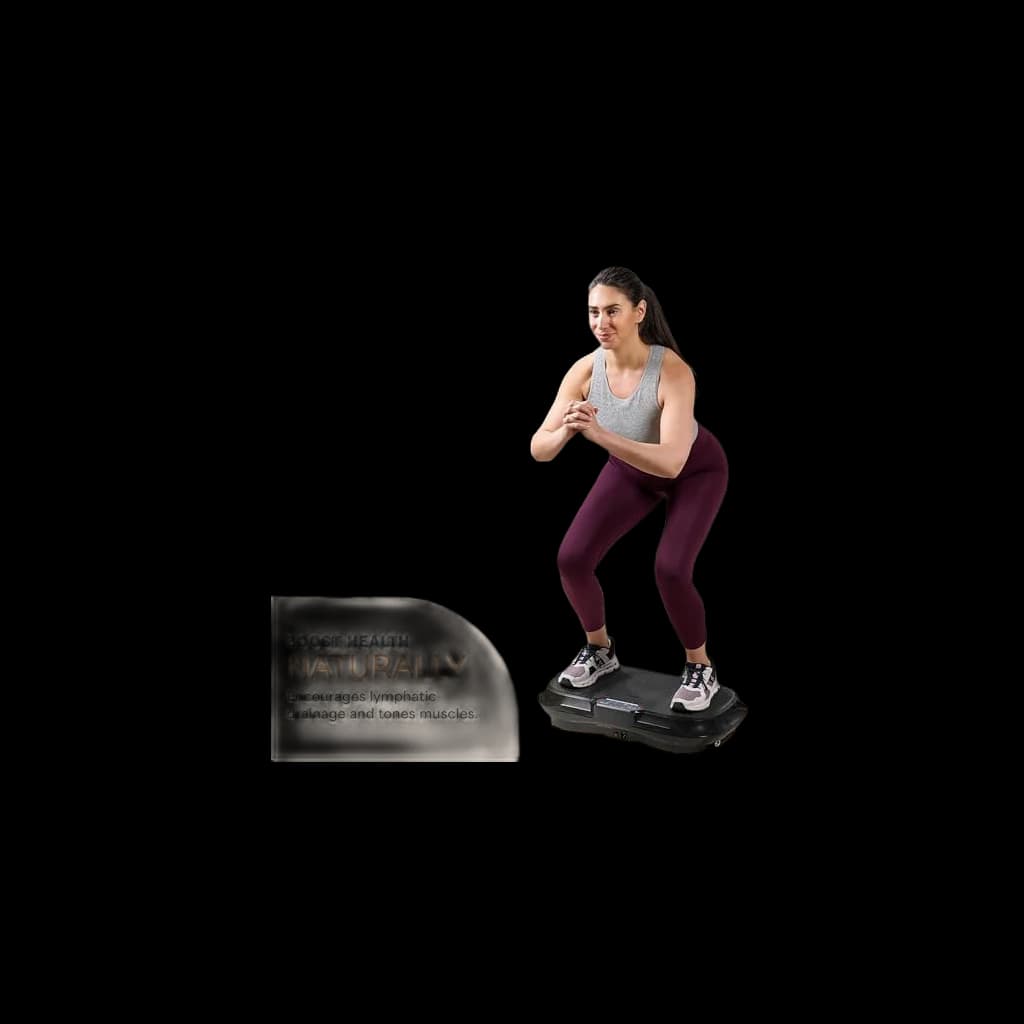
Rank #1 in Vibration Plates
LifePro Waver Vibration Plate
by LifeProBuy later
Score
Oscillating plate with 1-99 speed range and 330 lb user weight cap. The price-to-spec sweet spot for home users — covers recovery, lymphatic, and light strength work at a fraction of a Power Plate's price.
- Older adults building balance and proprioception under medical or PT supervision
- Office workers using brief 5-10 minute standing sessions for circulation breaks
- Beginners exploring whether vibration training has a place in their routine before spending Power Plate money
- Apartment use where the lower wattage and noise floor are tolerable to neighbors
- Buyers wanting a research-cited tool for whole-body vibration without commercial-grade pricing
- You have a pacemaker, defibrillator, deep brain stimulator, or any active implant , vibration can interfere with device function; consult physician (FDA medical-device guidance)
- You're pregnant , whole-body vibration is contraindicated during pregnancy (NIH OSH guidance)
- You have detached retina, recent eye surgery, or untreated retinopathy
- You have severe osteoporosis (T-score below -2.5) without explicit clinician supervision , vibration can stress brittle bone
- You have acute disc herniation, recent spinal fusion, or untreated DVT
- You expect commercial Power Plate performance , this is a consumer-grade unit with lower amplitude and frequency range
Base footprint is approximately 28x16 inches with a height around 6 inches when stationary. Plan on 4x4 feet of clear floor for standing exercise plus enough overhead clearance for arm raises. Hardwood or sealed concrete is fine; carpet absorbs vibration and reduces effective amplitude. Standard 120V outlet on any household circuit , peak draw is under 200W.
easy — Out of the box and operational in 5 minutes. Snap the resistance bands into the included anchors (optional), plug in, and use the remote control. The unit ships fully assembled; no tools required. The remote is the most common lost item , owners suggest taping a Velcro patch to the base so it has a home.
A vibration plate is a niche recovery and balance tool, not a foundation. Use it after primary strength and cardio gear is established. Owners who buy it as the centerpiece of their home gym almost always migrate to traditional resistance and cardio within 3-6 months once they realize vibration alone doesn't substitute.
Strengths
- ↑1-99 speed range
- ↑330 lb user weight cap
- ↑Resistance bands included
- ↑1-year warranty
Weaknesses
- ↓Oscillation only (no tri-planar)
- ↓Motor ~200W
What owners actually complain about
Synthesized from owner reviews and community threads. Paraphrased, not quoted.
- Lower amplitude (3-12mm) and frequency range than commercial Power Plate units, which limits training stimulus
- Remote control is small and easy to lose between sessions
- Carpet placement absorbs vibration meaningfully and reduces effective transmission
- Side-to-side oscillation only (no tri-planar movement); some research protocols call for vertical or tri-axial
- Plastic platform shows wear after 12-18 months of regular barefoot use
- Display lights are bright and hard to read in direct sunlight
Buyer sentiment
Based on 10,487 user mentionsBuyers praise quality, muscle toning, effectiveness and ease of use.
Verdict: The best-executed consumer-tier vibration plate — a genuine low-frequency balance and circulation tool, not the strength device the marketing implies.
Specs that matter
| Spec | Value |
|---|---|
| Frequency | 4-14 Hz |
| Amplitude | 3-12mm |
| Motion | Side-to-side oscillation |
| Service life | 4-5 yrs (light use) |
What you get
- Best-in-tier execution — strong customer support and remote ergonomics vs Bluefin/Hurtle
- Real circulation/balance use — daily 10-20 min sessions for under-65 adults; office breaks are the sweet spot
- Resistance bands included — for upper-body work
What you give up
- No strength stimulus — frequency/amplitude is categorically below Power Plate's tier
- Carpet kills it — ~30% effectiveness loss vs hardwood; needs a hard underlayment
Buy it if you're an older adult building balance under clinician guidance or want a daily home-office circulation tool. Skip it if you expect resistance-training gains, have any contraindication, or have only carpeted floors.
Research (NCBI-indexed, Mayo Clinic guidance) shows modest dose-dependent balance/strength gains in older adults (5-15% over 12 weeks) but it doesn't replace resistance training. Contraindications: pacemakers/implants, pregnancy, detached retina, severe osteoporosis, disc herniation, recent spinal fusion, untreated DVT.
Full specs
- Type
- Oscillating
- Speed Range
- 1-99
- User Weight Cap
- 330 lb
- Motor
- 200W
Common questions
Does whole-body vibration actually build muscle or bone?
The published research is mixed and dose-dependent. Systematic reviews on NCBI suggest modest improvements in lower-extremity strength and balance in older adults at frequencies of 30-50 Hz and amplitudes of 2-6mm over 12-24 week programs. Effects on bone density are smaller and largely limited to postmenopausal women under clinical protocols. Whole-body vibration does not substitute for resistance training and does not build muscle on the order of a barbell program. Mayo Clinic's position is that vibration may help certain populations under medical supervision but is not a replacement for traditional exercise.
How does the Waver compare to a commercial Power Plate?
The Power Plate Personal runs at a fixed 35 Hz (larger models such as the MOVE offer 30-40 Hz), and Power Plate describes its vibration as tri-planar. The Waver runs roughly 4-14 Hz at 3-12mm in a side-to-side oscillation pattern only. The frequencies are in different therapeutic ranges. The Waver is closer to a low-frequency lymphatic and balance tool; Power Plate is closer to a true vibration-strength stimulus. They are not interchangeable, and the price difference reflects real engineering differences.
Can I use the Waver if I have osteoporosis?
Only with explicit clinician sign-off. The research on vibration and bone density in osteoporosis is mixed; some protocols show modest benefit, while uncontrolled use risks compression injury in severely demineralized bone. T-score below -2.5 is a hard stop without medical supervision. The same applies to recent spinal fusion, hip replacement, and any active fracture site.
Why does my carpet make it feel less powerful?
Carpet absorbs the vibration before it transmits to your body. The base of the unit needs a rigid floor (concrete, hardwood, tile) to transmit the oscillation efficiently. If you must use it on carpet, place a 24x24 inch piece of plywood or a stall mat under the unit. Even then, you'll lose 20-30% of effective amplitude compared to direct-on-hardwood placement.
How long should sessions be?
Research protocols typically use 10-30 minute sessions, 3-5 times per week, with the user performing static or dynamic exercises (squats, planks, lunges) on the platform rather than just standing. Standing alone for 15 minutes produces minimal training stimulus. NIOSH does flag chronic whole-body vibration exposure as an occupational risk , workers exposed for hours daily over years can develop spinal issues , but consumer-protocol exposure of 30 minutes a day is well below those occupational thresholds.
Sources & references
- ResearchWhole-Body Vibration Training , systematic review of clinical effects— NIH / NCBI PMC
- ResearchWhole-Body Vibration Exposure , occupational safety guidance— NIOSH / CDC
- ResearchVibration and Bone Health , Mayo Clinic overview— Mayo Clinic
- Lifepro Waver , owner discussion and long-term reviews— r/homegym community consensus
- Vibration Plate Buyer Guide , amplitude and frequency comparison— Garage Gym Reviews
Full buying guide
Best Vibration Plates for Home Use in 2026: LifePro Waver Wins
Read the full ranking →Other vibration plates we rate
Ranked alternatives from the same category, with our score and the current price.
Power Plate's compact home plate: a fixed 35 Hz PrecisionWave vibration with Low/High amplitude, 30- or 60-second timers and a remote. Power Plate describes its vibration as tri-planar rather than side-to-side oscillation. The warranty is 1 year on hardware, electronics and labor.
Combines oscillation, linear vibration, and a curved deck. UK brand with strong US presence. Mid-tier sweet spot at ~$400 — more sophisticated motion than LifePro, less than Power Plate.
Budget oscillating plate under $200. Functional but the motor is the floor of acceptable — works for sub-180 lb users in moderate intensity. Acceptable starter plate, replace within 2-3 years.
LifePro Waver Mini
Compact Waver — same brand reliability, smaller footprint, lower weight cap (260 lb). Best for apartments and renters where the full Waver doesn't fit.
LifePro Rumblex Max 4D Vibration Plate
The step up from the entry Waver: three independent motors (oscillation, linear, pulsation) and a 500 lb platform make this the most capable LifePro plate for heavier users and standing strength work, not just seated recovery.