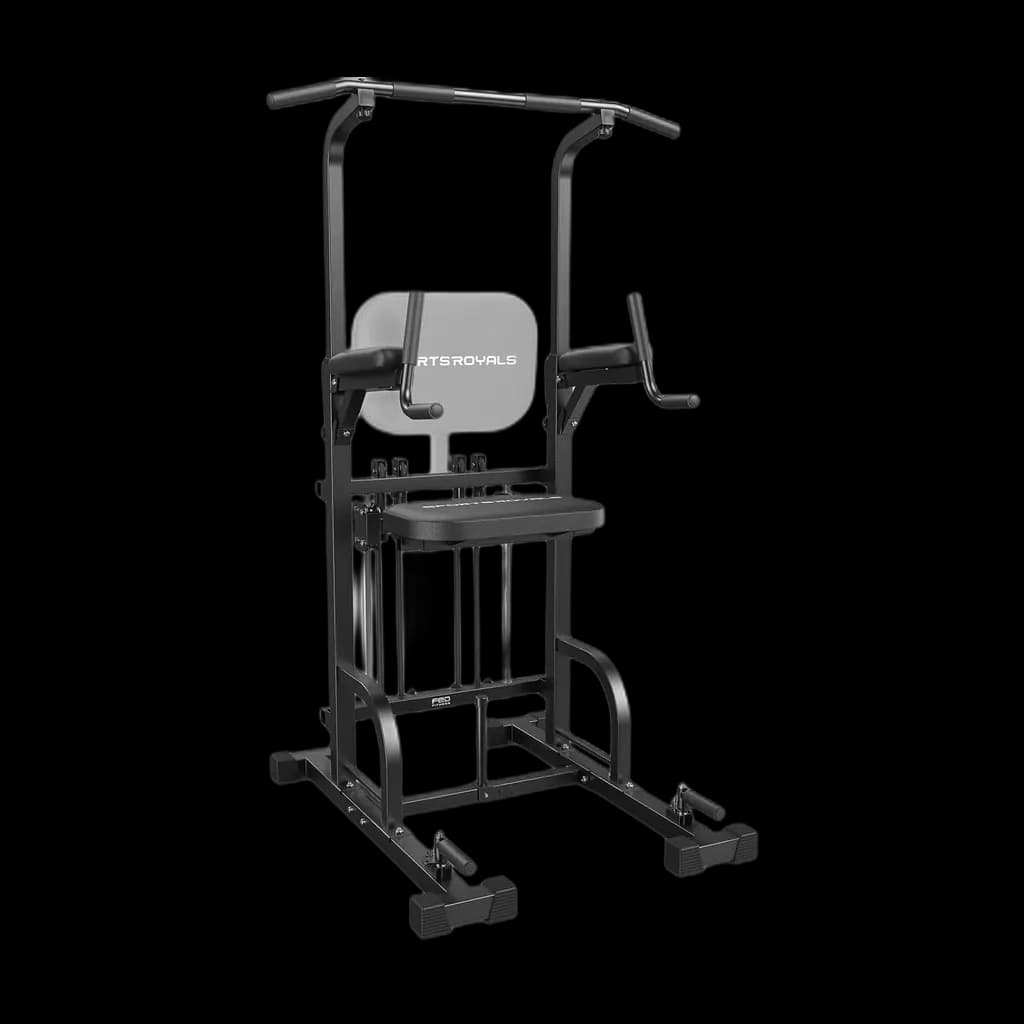
Rank #1 in Pull-up Bars & Dip Stations
Sportsroyals Power Tower
by SportsroyalsOptional
Score
The Sportsroyals Power Tower is the best square-foot return on investment in any home gym. 450 lb weight capacity, pull-up bar with multiple grip positions, dip handles, knee-raise pad, push-up grips, all in a footprint smaller than a recliner. 8 height adjustments accommodate users from 5'2" to 6'8". The thickened commercial steel doesn't wobble even on weighted dips. Where it loses points: assembly takes 1-2 hours and the included hardware is mediocre (consider upgrading the bolts). Once built, it's the kind of equipment you don't think about until something else breaks.
- Bodyweight-first lifters who can't justify a full power rack
- Apartments and basements without ceiling joists strong enough for a wall-mounted pull-up bar
- Home gyms wanting one tool covering pull-ups, dips, knee raises, and elevated push-ups
- Lifters working up to weighted pull-ups (vest or belt) up to the 450 lb total capacity
- You do kipping pull-ups or muscle-ups (the frame wobbles under ballistic load)
- Your ceiling is under 7 ft (the bar will be too low for full extension)
- You want minimal floor footprint (4 sq ft of permanent space)
- You'd rather mount a wall or doorway bar and skip the tower entirely
Footprint is 29 x 29 in at the base. Total height adjustable 57 to 83 in. Ceiling clearance needed: bar height plus 12 in for head clearance during pull-ups. For a 6 ft user that's roughly 7.5 ft minimum ceiling, ideally 8 ft.
hard — Assembly runs 1 to 2 hours for a competent DIYer working alone, faster with a helper. The stock hardware is mediocre; many owners upgrade the main connection bolts to grade 8 hardware (under $15 at any hardware store) for a meaningfully more rigid tower. Use Loctite blue on every threaded connection or expect to retighten every 2 to 3 months.
For a bodyweight-first training approach, a power tower can be the foundation itself, replacing a rack entirely. Pull-ups, dips, knee raises, and push-ups cover most upper body work. Pair with adjustable dumbbells and you have a complete home gym.
Strengths
- ↑450 lb capacity handles weighted pull-ups and dips
- ↑8 height adjustments fit users 5'2"-6'8"
- ↑Multiple stations: pull-up, dip, knee raise, push-up
- ↑Thickened commercial steel doesn't wobble
Weaknesses
- ↓Assembly takes 1-2 hours
- ↓Stock hardware mediocre — consider upgrading bolts
- ↓Eats ~4 sq ft of permanent floor space
What owners actually complain about
Synthesized from owner reviews and community threads. Paraphrased, not quoted.
- Assembly hardware feels low-grade; upgrading the main bolts is a near-universal recommendation in r/homegym threads
- Frame wobbles during kipping pull-ups or any dynamic ballistic movement, even with hardware upgraded
- Backrest pad foam compresses within 6 to 12 months of regular knee raise use
- Feet pads slide on smooth floors; rubber matting or anti-slip pads underneath the feet solve it
- The dip handle width is fixed and tends to be wider than ideal for smaller-framed users
Buyer sentiment
Based on 4,291 user mentionsBuyers praise sturdiness, assembly, quality and value for money. Mixed feedback on stability. Some flag missing parts and instructions.
Verdict: The best-value freestanding power tower — most stations and highest capacity at the budget end, for bodyweight-first builders.
Specs that matter
| Spec | Value |
|---|---|
| Frame | Welded commercial-grade steel |
| Capacity | 450 lb rated |
| Footprint | 29 x 29 in |
| Stations | Pull-up, dip, knee raise, push-up |
What you get
- Single-tool consolidation — pull-ups through push-ups in under 4 sq ft
- 450 lb cap — handles 220 lb body weight plus a 25 lb vest, no flex
- Multiple grips — wide overhand, narrow neutral, parallel
What you give up
- Wobble — pronounced under kipping or ballistic movement
- Cheap connection hardware — and grip/pad foam that compresses in 1–2 yrs
Buy it if you want a bodyweight foundation and can't ceiling-mount. Skip it if you train primarily barbell or have studs for a permanent bar.
Top r/homegym mod: swap the main connection bolts to grade-8 hardware (under $15) for a meaningfully more rigid feel.
Full specs
- Weight Capacity
- 450 lb
- Height Range
- 57-83 in
- Stations
- Pull-up, dip, knee raise, push-up
- Frame
- Commercial steel
- Footprint
- 29" x 29"
Common questions
Will it hold a 220 lb person doing weighted pull-ups?
Yes. The 450 lb total capacity gives meaningful headroom for body weight plus a weight vest or belt-loaded weight. The capacity is for static loads (controlled pull-ups); kipping or muscle-up dynamic loads exceed the static capacity and aren't recommended on any home power tower.
Does it wobble?
Yes, modestly. Under strict-form pull-ups and dips the wobble is minor and irrelevant. Under kipping pull-ups, knees-to-elbows, or any ballistic movement, the wobble becomes obvious. Hardware upgrades (grade 8 bolts on the main connections, Loctite on every thread) reduce but don't eliminate wobble. If you need rock-solid feel, a wall-mounted bar is the right answer.
Is the assembly really that long?
Yes. Most owner reports describe 1 to 2 hours for first assembly. The instructions are minimal, the hardware is plentiful, and getting the main vertical posts aligned correctly is the time-consuming part. With a helper holding pieces, the time drops to about 45 minutes.
Can it replace a power rack for a beginner?
For a beginner who plans to train mostly bodyweight (pull-ups, dips, push-ups, knee raises, inverted rows on the dip handles), yes. For a beginner who plans to barbell-train (squats, bench, deadlift, overhead press), no. The tower covers vertical pulls and dips but doesn't replace rack-based barbell work.
What ceiling height do I need?
Tower height at the highest pull-up bar setting is 83 in. You need at least bar height plus 12 in of head clearance, which is 95 in or about 8 ft. If your ceiling is 7 to 7.5 ft, use a lower bar height; full extension at the top of a pull-up will be the limiting factor.
Sources & references
- ResearchBodyweight Training: Programming and Equipment— NSCA
- Independent reviewPower Tower Buyer's Guide— Garage Gym Reviews
- Independent reviewBest Pull-Up and Dip Stations— BarBend
- CommunitySportsroyals power tower owner thread— r/homegym
- ResearchPull-Up Bar Capacity and Safety— American Council on Exercise
- ResearchVertical Pull Exercise Mechanics— NIH/NCBI
Full buying guide
Best Pull-Up Bars for Home Gyms in 2026: Sportsroyals Wins
Read the full ranking →Related Pull-up Bars & Dip Stations guides
Other pull-up bars & dip stations we rate
Ranked alternatives from the same category, with our score and the current price.
The ProsourceFit is the Iron Gym's main competitor in the doorway-bar category, with one structural difference worth caring about: the multi-grip layout includes two parallel grips that the Iron Gym lacks, which lets you do neutral-grip pull-ups (easier on shoulders for many lifters). 300 lb rated, fits 24-36 inch doorways. Same caveats as any leverage-mount bar — fine for users under 250 lb in homes with hardwood trim, sketchy in apartments with cheap composite trim. Good Iron Gym alternative if neutral grip matters to you.
Steel power tower with a built-in bench and rack plus a guided smart workout app.
The fix for the doorway bar's real problem: doorway bars limit how tall you can be and how hard you can kip. A joist mount bolts to the structure, and Fitarc state a 440 lb capacity.
The widest bar here at 48 inches, which is what makes wide-grip pull-ups possible — a doorway bar physically cannot give you that span.
The Iron Gym is the default doorway pull-up bar for a reason: it's $35, it works, and it's the bar that actually gets used because it doesn't require drilling. Three grip positions (wide, narrow, neutral), 300 lb capacity, fits doorways 24-32 inches. The leverage design means it locks tighter the more weight you put on it. Limitations: the foam grips wear out in 1-2 years (replaceable) and aggressive kipping can crack door trim. For renters and beginners, it's the right answer. For weighted pull-ups or anyone over 250 lb, upgrade to the Sportsroyals or a wall-mount. The current Amazon listing was unavailable when checked 2026-07-11, so we do not link it as a buy option.