Best Knee Sleeves for Squats (2026): 5mm vs 7mm Picks
Three researched knee sleeve picks for squats, plus what two controlled trials actually found about thickness and sizing down before you buy.
For most lifters squatting at home, a 5mm neoprene sleeve in the manufacturer-recommended size is the right buy. Controlled trials found that neither a denser sleeve nor a size smaller than recommended changed squat performance, so treat thickness as a warmth and stiffness dial. Choose 7mm only if you squat heavy and low-rep, and choose a competition-listed pair only if you actually compete.
How GymScored is paid: Amazon Associates commission plus brand-direct affiliate (Rogue / REP / Titan when approved). No sponsored placements, no paid reviews, no pay-to-rank. Picks are ranked by the Gym Score formula and nothing else. Read the full disclosure.
Buy a 5mm pair in the manufacturer-recommended size unless you squat heavy and low-rep, in which case 7mm buys warmth and stiffness rather than strength. The two variables lifters argue about, thickness and tightness, have both been tested and neither changed squat performance. Pick for how long you keep the sleeves on, and only pay for a competition-listed pair if you actually compete.
| Product | Owner rating | Key specs | Pros | Cons | Price | Buy |
|---|---|---|---|---|---|---|
Rehband 5mm Knee Sleeves The 5mm all-rounder. Four-panel neoprene that stays bendable when the session is not only squats. | Owner rating | Key specs
| Pros
| Cons
| $39.99 | Buy on Amazon |
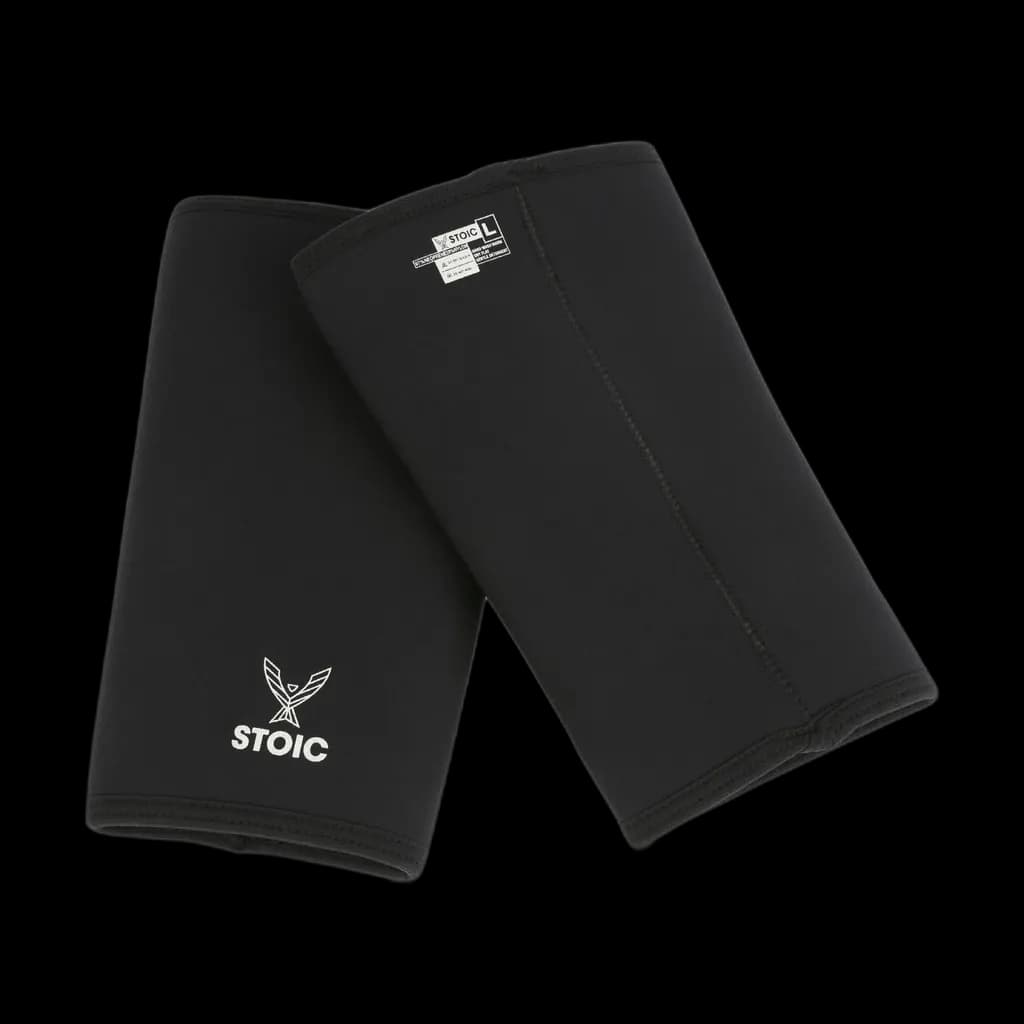 The value 7mm pair. Stiff neoprene compression for heavy low-rep squats without premium-brand pricing. | Owner rating Gym Score 93 | Key specs
| Pros
| Cons
| $75.00 | Buy on Amazon |
Gymreapers Knee Sleeves 7mm Listed by the brand as IPF Approved and backed by the largest review base here. The meet-day option. | Owner rating | Key specs
| Pros
| Cons
| $59.97 | Buy on Amazon |
Amazon prices checked Oct 10, 2026. Amazon prices change often — the listing is authoritative.
What the controlled trials actually compared
Two trials manipulated the variables lifters argue over. Neither produced the result the marketing implies.
| Trial | What it compared | What it found |
|---|---|---|
| J Funct Morphol Kinesiol, 2026 | Low-density vs high-density sleeves, incremental back squat | No significant difference in maximal force, velocity or power |
| J Strength Cond Res, 2021 | Recommended size vs one size smaller vs a minimal control sleeve | Both neoprene sleeves beat the control on squat 1RM; no difference between them |
| The Knee, 2013 | Sleeve vs brace vs no support, healthy athletes | No significant change in detection of passive knee movement |
Which pair, by how you train
Decide by your situation, not the generic ranking.
| If | You want | Pick |
|---|---|---|
| You squat but also run, jump or do conditioning | Warmth without stiffness | Rehband 5mm |
| You squat heavy and low-rep at home | The most warmth and squeeze for the money | Stoic 7mm |
| You have a tested federation meet booked | A sleeve the maker lists as competition legal | Gymreapers 7mm |
| Your knees hurt rather than feel cold | A diagnosis, not a purchase | See a clinician first |
The best knee sleeves for squats: three pairs, not twelve
Knee sleeves attract more opinion than almost any other piece of home-gym kit, and nearly all of it is about feel. That is fair. But two controlled trials have now manipulated the exact variables lifters argue over — thickness and tightness — and both landed somewhere awkward for a ranking. The sleeve matters less than the marketing implies, and the real choice is about how you train rather than which pair wins.
So this is three pairs, not twelve. Each is here because it fits a specific lifter, and the reasoning matters more than the order.
Brand tier against thickness
Thickness is a warmth dial; brand tier buys sizing charts, panel construction and competition listings. They intersect like this.
| Brand tier | At 5mm | At 7mm | What the money buys |
|---|---|---|---|
| Own-label neoprene | Thin, warms up, seams fail first | Stiff enough to squat in, sizing is the weak point | The neoprene and nothing else — check it says pair |
| Value lifting brands | Rarely stocked; these lead at 7mm | The default heavy-squat sleeve — Stoic Knee Sleeves 7mm, $75.00 | A real sizing chart, a large review base |
| Sport and rehab brands | The reference 5mm — Rehband 5mm Knee Sleeves, $39.99 | More squeeze, usually sold per sleeve | Panel construction, consistency between pairs |
| Competition specialists | Not what the tier is for | Gymreapers Knee Sleeves 7mm are listed by the maker as IPF Approved | Approval status you can look up, not infer |
Rehband 5mm: the default when you do more than squat
Five millimetres is where most home lifters should start. Rehband builds this one as a four-panel neoprene sleeve it describes as handcrafted in Europe and usable on either knee, and the listing pitches functional training and cross-training alongside powerlifting. That is the honest use case: warm and snug under a heavy set, still bendable when the session turns into lunges, step-ups or intervals. If your training is varied, the Rehband 5mm is the pair least likely to end up in a drawer.
Stoic 7mm: the value pair for heavy, low-rep days
Seven millimetres is a warmth-and-stiffness upgrade, not a strength one. The Stoic 7mm pair is the one we have researched most closely, and it earns its place on the numbers rather than the branding: a high owner rating across a large review base, priced well under the premium powerlifting brands. It is stiff enough that high-rep work gets irritating, which is precisely the trade you are making. Our full Stoic knee sleeves review covers who should skip it.
Gymreapers 7mm: the pair to buy if a meet is on the calendar
Gymreapers lists its 7mm sleeve as IPF Approved, and it carries by far the largest review base of the three. If you are entering a tested federation meet, treat that listing claim as a starting point rather than a guarantee — approved lists get revised, and the responsibility on the day is yours. Check the current IPF approved list first, then buy the Gymreapers 7mm pair knowing exactly what you are buying it for.
Rule of thumb: buy the thickness you will still tolerate in your last set, not the one that sounds most serious. A 7mm pair you peel off halfway through the session is worse than a 5mm pair you forget you are wearing.
The two dials lifters argue about are both flat
Thickness moved nothing measurable
A 2026 study in the Journal of Functional Morphology and Kinesiology put fifteen resistance-trained men through an incremental back squat in low-density versus high-density sleeves and modelled the full force-velocity-power profile. It found no statistically significant differences in maximal force, velocity or power between the two densities.
Sizing down moved nothing either
This is the finding that should change how you shop. A 2021 Journal of Strength and Conditioning Research trial ran the same lifters through three conditions: a minimally supportive control sleeve, a neoprene sleeve in the manufacturer-recommended size, and a neoprene sleeve one size smaller. Both real sleeves beat the control on squat one-rep max — 166 kg and 166 kg against 161 kg — with no difference between them. The authors concluded that sleeves "may function independent of tightness", unlike knee wraps.
The advice this kills: "go a size down from the chart for a proper squeeze" is the most repeated knee-sleeve tip online. It is also the only sizing advice that has been tested head-to-head against normal sizing, and it produced an identical squat.
What genuinely changes how a sleeve feels:
- Measuring your leg before you order, instead of guessing from your trouser size.
- Thickness, treated as a warmth and stiffness dial rather than a support rating.
- Whether the listing is selling you a pair or a single sleeve.
What the research says changes nothing:
- Ordering a size smaller than the chart tells you.
- Paying up for denser neoprene expecting more force out of the hole.
- Expecting sharper joint awareness — a study in The Knee found no significant change in the detection of passive knee movement in healthy athletes wearing either a sleeve or a brace.
How to size a pair without guessing
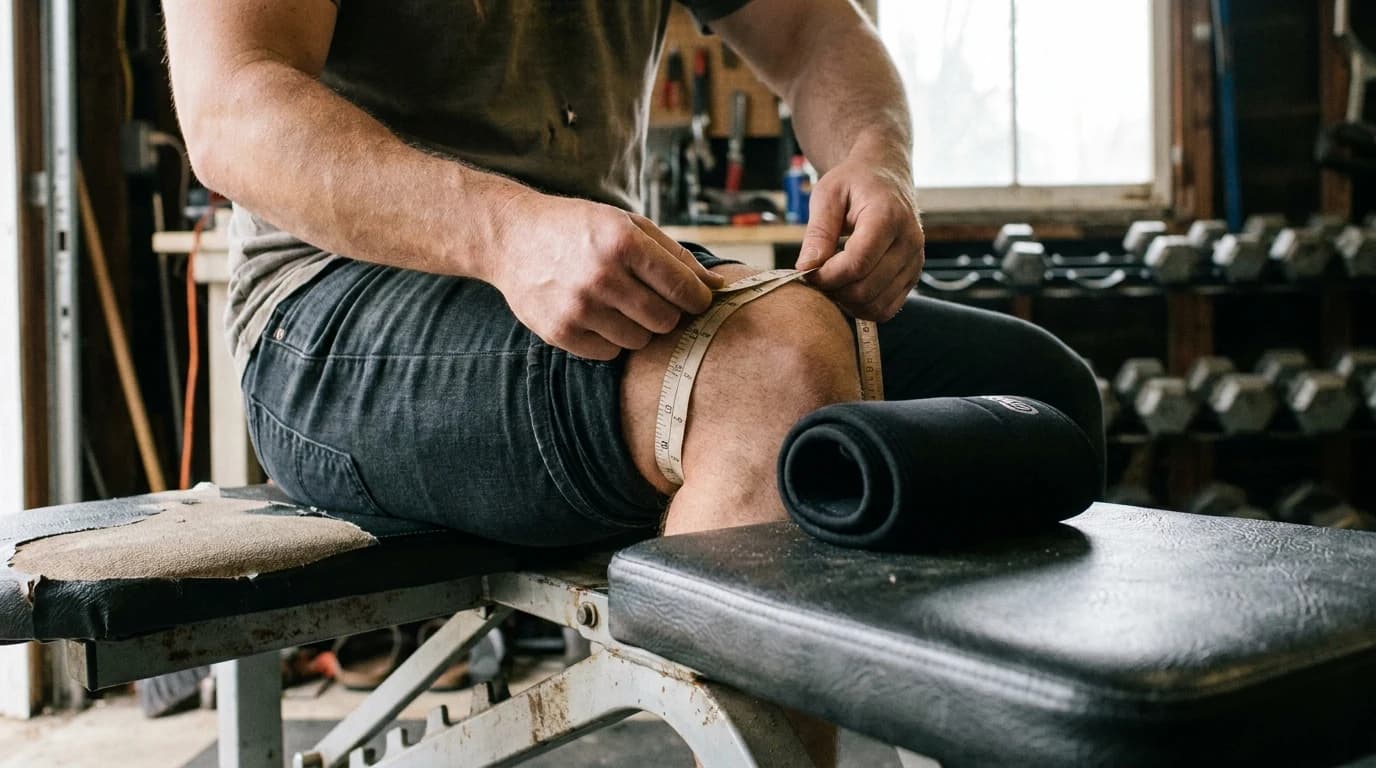
- Measure the circumference of your thigh roughly four inches above the middle of the kneecap, standing and relaxed.
- Read that number against that brand's chart. Charts are not interchangeable, and the same leg lands on different sizes across brands.
- Take the size the chart gives you. The evidence for going smaller is that it achieves nothing.
- If you sit between two sizes, choose by session length: the smaller size for short heavy sessions, the larger one if the sleeves stay on for an hour.
The trap: a sleeve that leaves your calf tingling or your knee numb by the third set is not "breaking in". It is too tight, or it has been on too long. Take them off between heavy sets.
If the sleeves are a gift, the home gym gift guide covers getting the measurement without spoiling it.
Living with them
| What happens | Why | What to do |
|---|---|---|
| They smell within weeks | Neoprene holds sweat against the seams | Turn them inside out and air-dry after every session |
| They roll down mid-set | The sleeve is too large, or the leg is damp | Re-measure, and dry your legs before pulling them on |
| They feel looser after months | Neoprene relaxes with repeated stretching | Expect it, and replace rather than sizing down mid-life |
One practical thing worth checking before you order: quantity. The Gymreapers listing spells out that it is a pair. Not every listing is that clear, and arriving with a single sleeve when you expected two is a common and entirely avoidable annoyance.
When a sleeve is the wrong tool
- You want the rebound out of the bottom of a squat. That is a knee wrap — a different piece of equipment, with different rules attached.
- You have diagnosed knee pain or instability. That is a clinician's call, and a sleeve is not a brace.
- You want a bigger squat. Start with progressive overload at home instead.
If you are still deciding whether you need a pair at all, do you actually need knee sleeves works through that question properly. For the rest of the kit, the lifting accessories category covers belts, wraps and straps.
Frequently Asked Questions
What thickness knee sleeve is best for squats?+
5mm is the right default for most home lifters, and 7mm is worth it only if you squat heavy and low-rep and want the extra warmth and stiffness. A 2026 study comparing low-density and high-density sleeves during back squats found no significant difference in maximal force, velocity or power, so treat thickness as a comfort dial rather than a performance one.
Should I size down my knee sleeves for squats?+
No. A 2021 trial compared a neoprene sleeve in the manufacturer-recommended size against one a size smaller and found an identical squat one-rep max, with both beating a minimal control sleeve. Take the size the brand's chart gives you and measure your thigh about four inches above the kneecap first.
Are Gymreapers knee sleeves IPF approved?+
Gymreapers lists its 7mm sleeve as IPF Approved. Approved lists are revised over time and the responsibility on meet day is the lifter's, so check the current IPF approved list before you compete rather than relying on a product listing.
Do knee sleeves make your squat stronger?+
Only marginally, and only on the squat. The 2021 trial found neoprene sleeves produced a higher squat one-rep max than a minimally supportive control sleeve, but no improvement in jump power, velocity or leg extension endurance. Warmth, compression and confidence are the honest reasons to buy a pair.
Sources & Research
- Journal of Strength and Conditioning Research (2021) — Machek et al. — neoprene knee sleeves of varying tightness augment barbell squat 1RM without improving other indices of strength, power or enduranceresearch
- Journal of Functional Morphology and Kinesiology (2026) — Effects of knee sleeve density on theoretical neuromuscular capacities derived from the force-velocity-power profile in the back squatresearch
- The Knee (2013) — The effect of knee brace and knee sleeve on the proprioception of the knee in young non-professional healthy sportsmenresearch
- International Powerlifting Federation — Approved List — current approved equipment and status noticesgoverning body
Related reviews
Stoic Knee Sleeves Review: Who Should Buy the 7mm Pair?
Stoic 7mm knee sleeves fit home-gym lifters on a budget. A researched review of the squat carryover, competition caveats, and who should skip the pair.
Do You Actually Need Knee Sleeves for Lifting?
Whether you actually need knee sleeves for lifting at home: what the science says they do and don't do, plus how to pick a thickness without overpaying.
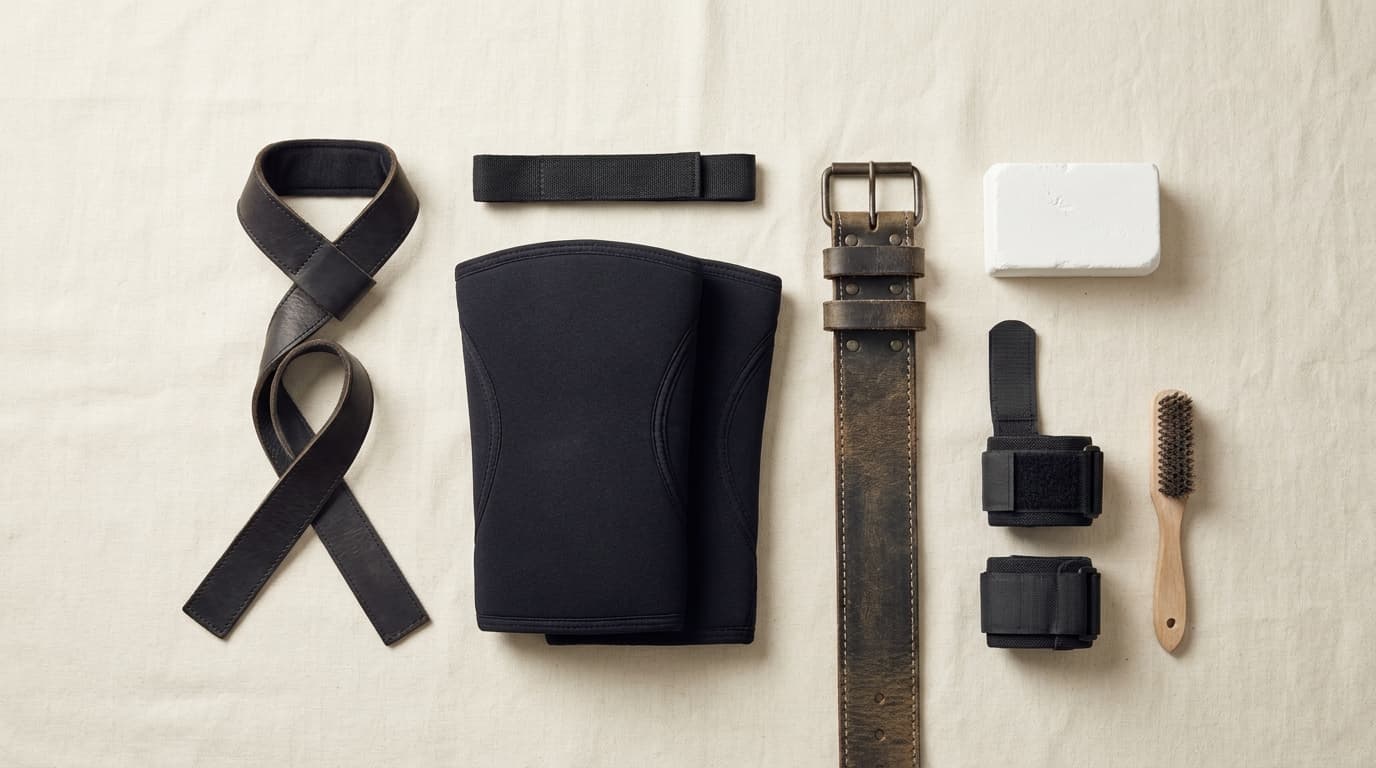
Best Lifting Accessories in 2026: Inzer Forever Wins
The Inzer Forever is the lifetime lifting belt; Element 26 makes the default wrist wraps. Seven lifting accessories scored on durability, function, value.
Hilly Shore Labs
Editorial teamThe independent product research team behind GymScored. Every recommendation is researched, never hands-on tested — recommendations draw on manufacturer specifications and available published research. Category order is editorial; the Gym Score is a separate comparison aid.
161 listed products across 26 home gym categories. Scores use category criteria, value and owner-rating inputs; missing evidence limits what a score can tell you.
See the scoring methodology and who we are.
Affiliate disclosure: GymScored is a participant in the Amazon Services LLC Associates Program. We earn from qualifying purchases at no extra cost to you. Full disclosure →