Can Your Floor Handle a Home Gym? The Real Math
Whether your floor can handle a home gym is rarely about total weight - it's load per square foot and dropped weights. The real math by floor type.
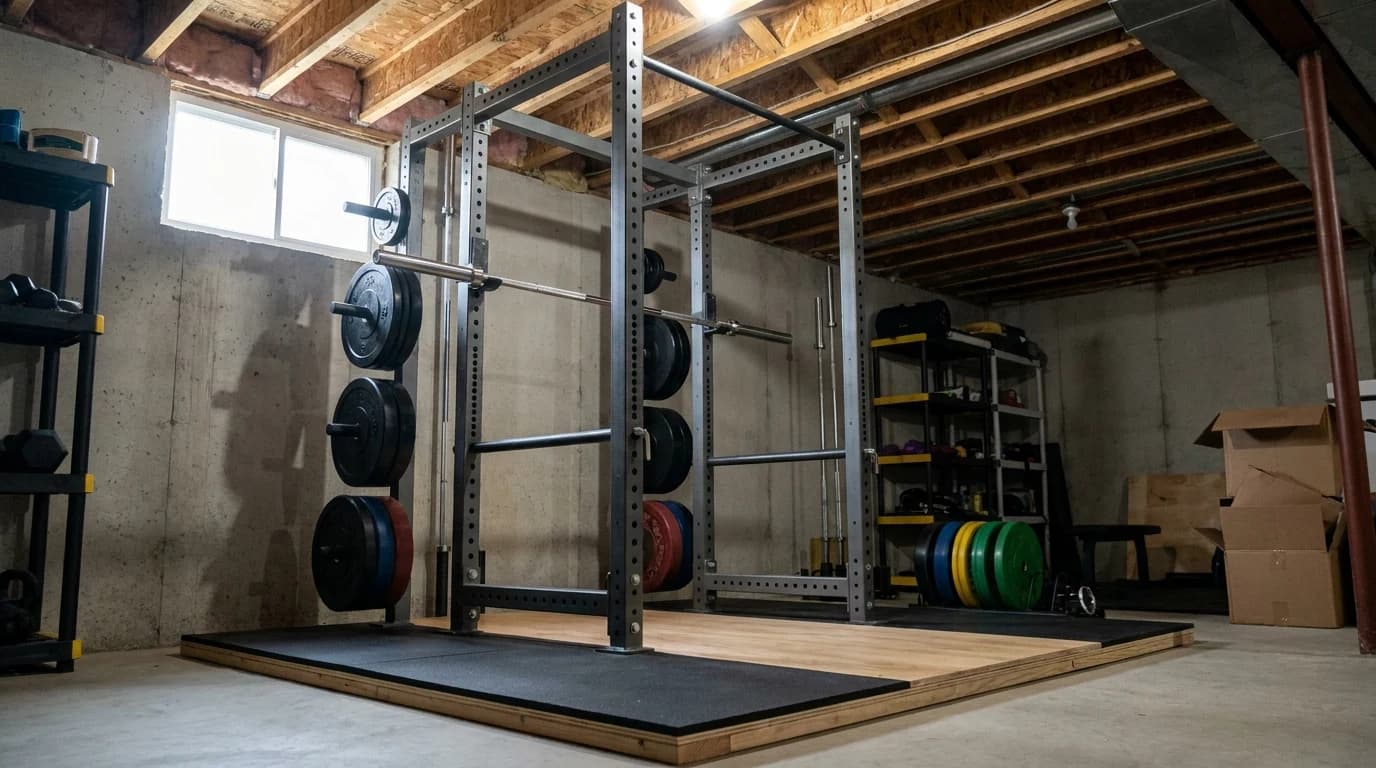
Probably yes, but the question people ask is the wrong one. Floors are not rated in total pounds; they are rated in pounds per square foot. US code requires residential floors to carry at least 40 psf in living areas and 30 psf in bedrooms, spread across the area. A 900-pound rack on a tiny footprint can exceed that locally, but the same rack on an 8-foot platform is well under it. The bigger risk is dropping weight: a dropped bar creates an impact load many times its static weight. On a concrete slab, neither is a real issue. On a suspended wood floor, spread the load with a platform, keep heavy gear near a bearing wall, and do not drop loaded bars.
How GymScored is paid: Amazon Associates commission plus brand-direct affiliate (Rogue / REP / Titan when approved). No sponsored placements, no paid reviews, no pay-to-rank. Picks are ranked by the Gym Score formula and nothing else. Read the full disclosure.
For a concrete slab in a garage or basement, stop worrying: static weight is a non-issue and your only real concern is flooring and noise. For a suspended wood-frame floor, the code minimums of 40 psf in living areas and 30 psf in bedrooms are real but generous, and the answer is almost never "you can't." It is spread the weight across a platform, keep heavy gear near a load-bearing wall, and never drop loaded bars onto a bedroom floor. The number that gets people in trouble is not the plate total. It is the small footprint and the dropped bar nobody did the math on.
Can your floor handle it? By what's underneath the room
The same equipment is safe in one room and questionable in another. What sits under the floor decides almost everything, not the weight on the plates.
| Floor type | Static weight risk | Dropping risk | What to do |
|---|---|---|---|
| On-grade concrete slab (garage, basement) | Essentially none — load goes into the ground | Low — mostly a flooring and noise question | Build whatever you want; spend on flooring and noise control |
| Suspended wood-frame floor (most upstairs / main-level rooms) | Real but generous (40 psf living, 30 psf bedroom) | High if you drop loaded bars | Spread load on a platform, keep heavy gear near a bearing wall, do not drop |
| Older or unknown construction (pre-1960s, sagging spans) | Treat published minimums as optimistic | High — less margin for error | Get a structural engineer to look before a heavy build |
The short version
Almost every home gym anxiety online is about the wrong number. People weigh their rack plus plates, divide by the room, panic at the total, and ask if the joists will hold. The static weight is rarely the problem. The two things that actually decide it are how the weight is spread out and whether you drop it. A 1,000-pound setup that sits on a wide footprint over a concrete slab is a non-event. The same weight concentrated on four small feet over a 1950s second-floor bedroom — with deadlifts being dropped — is a real conversation.
Here is how to think about it like the engineers who write the code do, without needing to hire one.
The one number that matters: load per square foot
Floors are not rated in "total pounds." They are rated in pounds per square foot (psf) — a spread-out load, not a point load. US residential floors are designed to a minimum live load defined by ASCE 7, the standard building codes reference, and mirrored in the International Residential Code. The numbers are modest and worth memorizing:
- 40 psf — general living areas (the default for any room that isn't a bedroom).
- 30 psf — sleeping rooms.
That is the minimum a new floor must be designed to carry across its whole area, on top of its own weight, with a safety factor already baked in. Per the ASCE engineering discussion, "bedrooms must be designed for at least 30 psf and all other floors must be designed for at least 40 psf."
The trap: a spare bedroom — the most popular upstairs home-gym spot — is held to the lowest number in the house.
The math you can do in your head
Take your total gym weight and divide it by the floor area it actually occupies. That is your average psf. Compare it to 40.
Same rack, same weight, four times the spread
A loaded power rack with bar and plates might be 900 lb. If it sits inside a 4 ft × 4 ft footprint, that's 16 sq ft, or about 56 psf in that zone — already over the 40 psf living-area minimum, and well over a bedroom's 30. Slide a stall mat under it and treat the whole 8 ft × 8 ft platform as the load area (64 sq ft) and the same rack is ~14 psf. Completely different answer.
This is the single most useful move in the whole topic: spread the load. A plywood-and-rubber platform under a rack or rower doesn't "absorb" weight in any magic sense — it transfers a concentrated point load across many more floor joists instead of two unlucky ones.
Sustained loads are harder on wood than moving ones
That is also why the engineering caveat about sustained loads (a water tank, a stacked plate tree left in one corner for a year) matters more than a barbell you use for an hour. Wood creeps under constant load, so permanent heavy clusters are worse than the same weight moving around the room.
What most people get wrong: it's the drop, not the weight
Static math covers a rack standing still. It does not cover a deadlift returning to the floor. When you drop a loaded barbell, the floor doesn't just feel the plates' weight — it feels an impact (dynamic) load, the force needed to stop a falling mass in a few milliseconds, which is many times the static weight for that instant.
This is the part the "will 600 lb sit on my floor?" question completely misses. Six hundred pounds sitting there is fine almost anywhere. Six hundred pounds dropped repeatedly onto a thin second-floor zone is the failure mode that actually shows up — as cracked tile, popped drywall seams below, and rattled neighbors — long before anything dramatic happens to the structure.
What actually fixes it
- Drop onto a real platform, not bare floor or thin tiles. Layered horse-stall mats over plywood is the standard.
- Use bumper plates so the load lands soft and flat instead of a steel edge.
- Move the dropping downstairs. Lower the bar on anything above a slab, or don't drop on a suspended floor at all.
- Place heavy gear along a load-bearing wall, where joists are best supported, rather than the dead center of a span.
What people try first, and shouldn't
- Cancelling the plan over a total-weight number. The total is almost never the deciding figure.
- Adding a thin foam or interlocking tile layer and calling it a platform. Thin mats manage noise and floor finish, not impact distribution.
- Piling plates in one corner "out of the way." That's the sustained point load the creep caveat is about.
The location decides almost everything
The same equipment is safe in one room and questionable in another. Rank your space by what's under it:
| What's under the room | Static weight | Dropping | Verdict |
|---|---|---|---|
| On-grade concrete slab (garage, basement) | Essentially a non-issue — load goes into the ground | A flooring and noise question, not a structural one | The default home-gym answer |
| Suspended wood-frame floor (upstairs, most main levels) | The 40/30 psf limits genuinely apply | The real constraint | Fine for most setups if you spread the load and don't drop |
| Older or unknown construction (pre-1960s, sagging spans) | Treat published minimums as optimistic | Avoid | Worth a structural engineer's look before a heavy build |
A 60-second self-check before you buy
- What's under the room? Slab = relax. Suspended floor = keep reading.
- Total weight ÷ footprint area = your psf. Over 40 in a living area (or over 30 in a bedroom) on a concentrated footprint is your signal to spread it out, not to cancel the plan.
- Will you drop weight here? If yes and it's a suspended floor, either build a real platform or move the lifting downstairs.
- Is anything heavy staying put for months? Sustained clusters are harder on wood than moving loads — distribute, don't pile.
- Anything feel off? Existing bounce, slope, or cracks under normal use = get eyes on it before adding hundreds of pounds.
The honest bottom line
For a slab-floor garage or basement, stop worrying — you can build essentially any home gym you want, and the only real question is flooring and noise. For a suspended floor, the limits are real but generous, and the answer is almost never "you can't."
Rule of thumb: the number that gets people into trouble isn't the one on the plate stack. It's the small footprint and the dropped bar nobody did the math on.
Plan the layout around the load path
Once you know your floor can take the weight, the next question is where everything goes. The free GymScored planner lays real equipment into your room's dimensions, so you can keep the rack over the joists' strong axis and still have space to train.
Sources
- ASCE 7 — Minimum Design Loads and Associated Criteria for Buildings and Other Structures — the standard building codes reference for minimum live loads.
- International Residential Code, Chapter 5 (Floors), Table R301.5 — residential floor live-load minimums (40 psf living, 30 psf sleeping).
- ASCE engineering discussion: typical residential floor live loads — confirms 40 psf / 30 psf split and the sustained-load (wood creep) caveat.
Frequently Asked Questions
How much weight can a normal house floor hold?+
US residential floors are designed to a minimum live load of 40 pounds per square foot in general living areas and 30 psf in bedrooms, per ASCE 7 and the International Residential Code (Table R301.5). That is a spread-out figure across the whole floor with a safety factor already included, not a single point you can pile weight on. The practical takeaway is to divide your gym's total weight by the floor area it actually occupies and compare that to 40 (or 30 in a bedroom), rather than fixating on the total pounds.
Is it the weight or the dropping that breaks floors?+
Usually the dropping. A heavy load sitting still is covered by the static math and is fine almost anywhere. Dropping a loaded barbell creates an impact, or dynamic, load: the force needed to stop a falling mass in milliseconds is many times its static weight for that instant. Repeated drops onto a thin suspended floor are what crack tile, pop drywall seams below, and rattle neighbors long before total weight becomes a structural problem. Drop onto a plywood-and-rubber platform with bumper plates, and ideally avoid dropping on any suspended floor at all.
Is a basement or garage safe for a heavy home gym?+
Generally yes, because both typically sit on an on-grade concrete slab. The slab transfers load straight into the ground, so static weight is essentially a non-issue and even dropping is mostly a flooring and noise question rather than a structural one. That is exactly why garages and basements are the default recommendation for heavy setups. Your spending there should go to good gym flooring and noise control, not to worrying about the floor giving way.
Can I put a home gym in an upstairs bedroom?+
Often, but with care, because a suspended wood floor is where the limits actually apply and a bedroom is held to the lowest code minimum (30 psf). Spread the load across a platform so the weight reaches many joists instead of two, place heavy equipment along a load-bearing wall rather than the center of a span, and do not drop loaded bars there. Avoid leaving large sustained clusters of weight in one spot for months, since wood creeps under constant load. If the floor already bounces, slopes, or shows cracks, get a structural engineer to look before adding hundreds of pounds.
Does a lifting platform actually protect the floor?+
Yes, but not by absorbing weight in any magic way. A plywood-and-rubber platform spreads a concentrated point load (a rack on four small feet) across far more floor joists than the bare equipment would, which is what lowers the load per square foot in that zone. It also cushions impact when you set down or drop a bar, especially with bumper plates. The same rack can go from roughly 56 psf on a tight footprint to about 14 psf when its load is treated across a full 8-by-8-foot platform: same weight, four times the spread, a completely different answer.
Sources & Research
- ASCE 7 — Minimum Design Loads and Associated Criteria for Buildings and Other Structures (the standard building codes reference for minimum live loads)
- International Residential Code, Chapter 5 (Floors), Table R301.5 — residential floor live-load minimums: 40 psf living areas, 30 psf sleeping rooms
- ASCE engineering discussion: typical residential floor live loads — confirms the 40 psf / 30 psf split and the sustained-load (wood creep) caveat
Your next step
Spread the load — start with flooring.
Related reviews
How Much Ceiling Height Do You Need for a Home Gym?
Home gym ceiling height comes down to power rack and overhead clearance math. The numbers you need, and what to do when a basement ceiling sits too low.
How to Make a Home Gym Quiet (Apartment and Upstairs Fixes)
Most home gym noise is impact, not effort. Layer dense rubber and cushion flooring, isolate cardio, and lower weights under control in an apartment.
Best Gym Flooring for Home Gyms in 2026: Stall Mats Win
Horse stall mats win best home gym flooring for barbell setups, no contest. We scored 6 flooring options on thickness, durability, and impact reduction.
Hilly Shore Labs
Editorial teamThe independent product research team behind GymScored. Every recommendation is researched, never hands-on tested — rankings come from manufacturer specifications, published standards, and aggregated buyer sentiment.
163 products scored across 26 home gym categories, each on the same 5-dimension Gym Score formula.
See the scoring methodology and who we are.
Affiliate disclosure: GymScored is a participant in the Amazon Services LLC Associates Program. We earn from qualifying purchases at no extra cost to you. Full disclosure →