How Much Ceiling Height Do You Need for a Home Gym?
Home gym ceiling height comes down to power rack and overhead clearance math. The numbers you need, and what to do when a basement ceiling sits too low.
For a full home gym including standing barbell overhead presses and pull-ups, you want about 8 feet (96 inches) of clear ceiling height. You can build a real gym at 7 feet (84 inches), the building-code minimum for a habitable room, but standing presses and jumping movements get tight. Measure to the lowest obstruction, such as a duct or light, then subtract 0.5 to 2 inches for flooring and about 2 inches for a loaded bar overhead. Ceiling height limits which movements you can do, not how much strength you can build.
How GymScored is paid: Amazon Associates commission plus brand-direct affiliate (Rogue / REP / Titan when approved). No sponsored placements, no paid reviews, no pay-to-rank. Picks are ranked by the Gym Score formula and nothing else. Read the full disclosure.
Measure to the lowest obstruction, then subtract for flooring and the bar. About 8 feet (96 inches) of clear height lets you do everything including standing presses and pull-ups; 7 feet (84 inches), the code minimum for a habitable room, still builds a real gym with a short rack and seated or landmine pressing. Ceiling height caps which movements you can do, not how much strength you can build.
Ceiling height vs. what you can train
Measure to the lowest obstruction, then subtract flooring and the bar before buying a rack.
| Clear ceiling height | What it supports | Notes |
|---|---|---|
| 96+ in (8 ft or more) | Everything: squats, presses, standing overhead press, pull-ups | Standard residential ceiling; comfortable for a 72-inch rack with room above |
| 84 in (7 ft) | Squats, bench, rows, deadlifts, short-rack work; pull-ups are tight | Building-code minimum for a habitable room; standing presses often need swaps |
| Below 84 in | Seated press, landmine, dumbbells, low-rack work | Skip standing barbell presses; mount pull-up bars below the lowest point |
The short version
The number that decides what you can do in a home gym is not floor space, it is the distance from your floor to the lowest thing above your head. For full standing barbell work, you want about 8 feet (96 inches) of clear height. You can build a real gym at 7 feet (84 inches), the building-code minimum for a habitable room, but standing overhead presses and jumping pull-ups get tight or impossible. Measure to the lowest obstruction, not the highest part of the ceiling, then subtract for flooring and the bar itself before you buy a rack.
Key takeaways
- Measure to the lowest point. An HVAC duct or recessed light sets your real ceiling, not the joists in the open span.
- 8 feet is the comfortable threshold for standing presses and most pull-up bars. 7 feet works for everything done at or below shoulder height.
- Leave 15 to 18 inches above a power rack so you can press a loaded bar overhead and clear the pull-up bar safely.
- Flooring counts against you. Rubber mats and platforms add 0.5 to 2 inches and come straight off your head clearance.
- No room overhead? Change the movement, not the goal. Seated presses, landmines, and dumbbells build the same strength without the vertical demand.
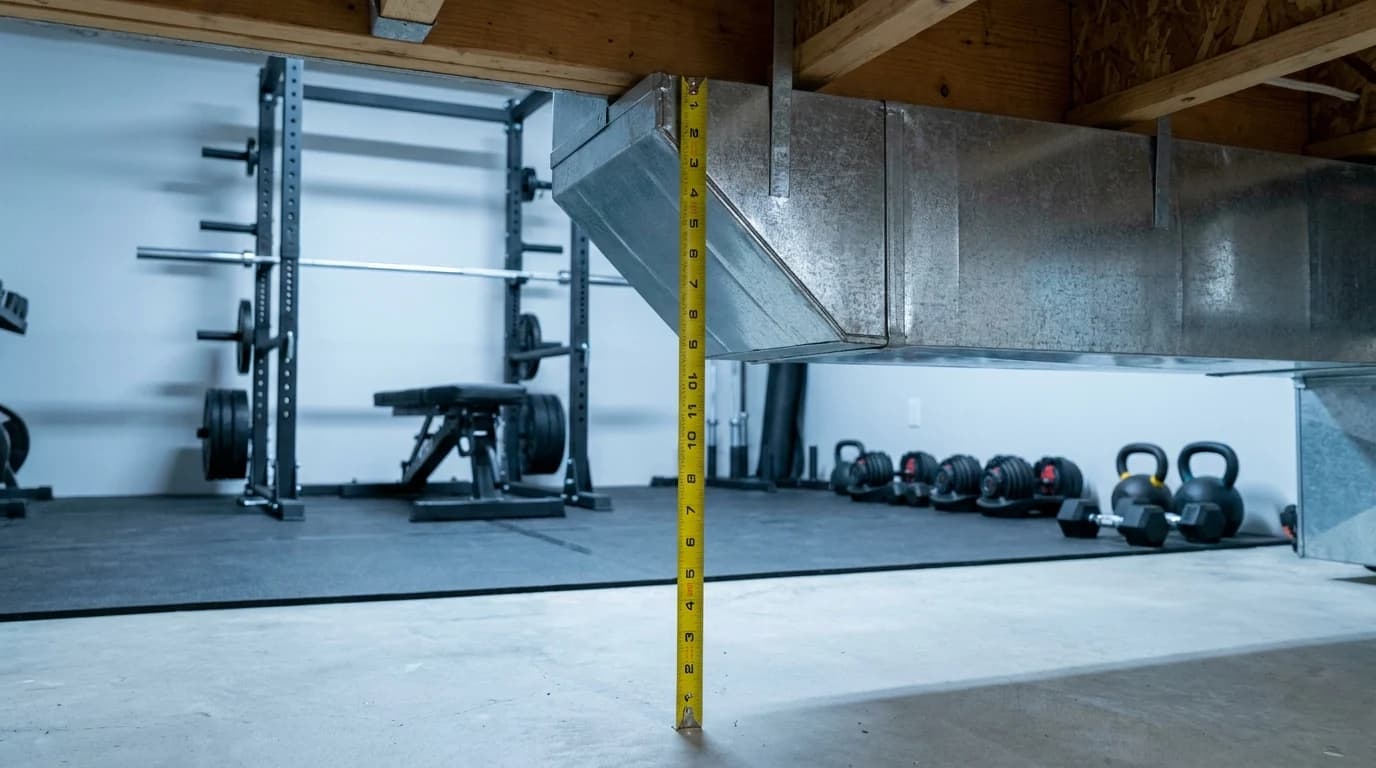
The mistake almost everyone makes: measuring the open part of the ceiling and forgetting the duct, the light, and the half-inch of rubber matting that quietly eat the clearance they were counting on.
What the building code actually requires
For a room to legally count as habitable, the International Residential Code (Section R305) sets the minimum ceiling height at 7 feet, or 84 inches, and California's building code (Section 1208.2) matches it for dwelling units. Most finished homes are built to a standard 8-foot (96-inch) ceiling, while basements and converted garages often come in right at the 7-foot minimum, sometimes lower once you account for ducts and beams.
That code number is a useful anchor because it tells you the floor of what is normal: if your space is below 84 inches anywhere you plan to stand, you are working in genuinely low-ceiling territory and need to plan around it.
The clearance math that matters
Ceiling height is not the same as usable training height. Three things come off the top before you ever raise a bar:
| Subtract this | Typical amount | Why it matters |
|---|---|---|
| Flooring | 0.5 to 2 inches | Rubber mats, horse-stall mats, and lifting platforms all raise the floor you stand on |
| Loaded barbell diameter | ~2 inches | When a 7-foot bar is overhead, its thickness adds height above your hands |
| Head and bar clearance | 15 to 18 inches above a rack | Space to press a bar to lockout and clear a pull-up bar without ducking |
What that leaves you for a rack
A common low-ceiling guideline from rack sellers is that your ceiling should sit at least 15 inches taller than the rack itself, with 18 inches preferred for comfortable overhead pressing. So an 84-inch room with three-quarter-inch flooring realistically supports a rack around 66 to 69 inches tall, while a 96-inch room comfortably fits a 72-inch (6-foot) rack with room to press above it.
How much height each movement needs
Different exercises have wildly different vertical demands. This is why two people with the same ceiling can have very different "is my gym good enough" answers.
| Movement | Vertical demand | Works at 7 ft (84 in)? |
|---|---|---|
| Squat, bench, row, deadlift | Low (stays at or below shoulder height) | Yes, comfortably |
| Standing overhead press | High (bar finishes well above your head) | Often no for taller lifters |
| Pull-ups on a fixed bar | High (bar near ceiling, body hangs and rises) | Tight; depends on bar placement |
| Jumping / box jumps / wall balls | Very high (you leave the floor) | Usually no |
| Seated press, landmine press, dumbbells | Low to moderate | Yes |
The standing press, not the squat, is the real ceiling test
At lockout the bar sits above your fully extended arms, and anthropometric reach data (such as the NC State Ergonomics Center's standing-reach tables) shows overhead fingertip reach for an average-height adult already approaches 7.5 feet with arms raised. Add a barbell and a few inches of margin and you can see what an 8-foot ceiling really buys you.
What to do if your ceiling is too low
Low ceilings do not end the project. They change the equipment list.
Swaps that work:
- Pick a short rack. 72-inch (6-foot) racks are a whole category built for basements; some 70-inch models go lower. See our power rack picks for short-frame options.
- Mount the pull-up bar smart. A doorway or wall-mounted pull-up bar placed below the highest point can salvage vertical pulling even when a rack-mounted bar would be too high to hang from.
- Trade barbell presses for alternatives. Seated dumbbell presses, landmine presses, and adjustable dumbbells deliver overhead loading without a bar traveling to the ceiling.
- Account for your flooring. Thinner mats preserve clearance; if every inch counts, choose gym flooring on the thin end rather than a thick platform.
Compromises that aren't worth it:
- Buying a tall rack and "ducking." A rack you can't stand up inside is a rack you'll stop using.
- Skipping flooring to buy an inch. Bare concrete costs you more in noise, plate damage, and joint comfort than the inch is worth.
- Writing off the room entirely. A low ceiling caps your exercise menu, not your results.
What the research does not support
The popular claim that you "need a 9- or 10-foot ceiling for a real home gym" does not hold up. That figure comes from commercial gyms and Olympic-lifting platforms, where coaches want overhead room for jerks, snatches, and drop-the-bar safety. For a home lifter doing squats, presses, pulls, and pull-ups, the evidence from how the equipment is actually dimensioned points to 8 feet being comfortable and 7 feet being workable with smart choices.
Worth knowing: ceiling height limits which movements you can perform, not how much muscle or strength you can build. Seated and landmine pressing load the same shoulders; a shorter rack squats the same weight.
Bottom line
Before you buy anything, do this in order:
- Tape-measure to the lowest obstruction in the space — duct, light, beam — and write that number down.
- Subtract your flooring (0.5 to 2 inches) to get real standing height.
- Subtract 15 to 18 inches and that is the tallest rack that belongs in the room.
If your number is 96 inches or more, you can build essentially any home gym you want. If it is 84 inches, you have a real gym with a short rack and a few movement swaps. If it is below 84 inches, you are not out of luck — you are just doing seated and landmine work instead of standing barbell presses, and your results will not know the difference.
If you want the clearance math done for you, enter your room's dimensions in the free home gym layout planner — it places real equipment into your ceiling height and floor plan and tells you what fits before you order anything.
Frequently Asked Questions
How much ceiling height do I need for a home gym?+
About 8 feet (96 inches) of clear height covers everything, including standing barbell overhead presses and pull-ups. You can build a functional gym at 7 feet (84 inches), the building-code minimum for a habitable room, but standing presses and jumping movements get tight. Measure to the lowest obstruction, such as a duct or light, not the open part of the ceiling.
Can I do overhead press with an 8-foot ceiling?+
Usually yes, if you stand in the highest part of the room and account for flooring. At lockout a loaded barbell sits above your raised arms, so an average-height adult clears a 96-inch ceiling with a few inches to spare. Taller lifters or rooms with thick flooring may need to switch to a seated or landmine press.
What is the minimum ceiling height for a power rack?+
As a rule of thumb, your ceiling should be at least 15 inches taller than the rack, with 18 inches preferred for comfortable overhead pressing. A 72-inch (6-foot) rack fits an 8-foot ceiling well; for a 7-foot basement, look at 70- to 72-inch short racks and remember that flooring raises your standing height.
Can you build a home gym with a low ceiling?+
Yes. Use a short 72-inch power rack, mount pull-up bars below the highest point, and replace standing barbell presses with seated dumbbell presses or landmine presses. Ceiling height limits which movements you can perform, not how much muscle or strength you can build.
Sources & Research
- 2021 International Residential Code, Section R305 Ceiling Height (habitable rooms not less than 7 feet / 84 inches) — ICC Digital Codes
- California Building Code 2025, Section 1208.2 Minimum Ceiling Heights (dwelling/sleeping units not less than 7 feet) — UpCodes
- Best Power Racks for Low Ceilings — ceiling should be 15 to 18 inches taller than the rack; flooring and a ~2-inch loaded bar reduce clearance — BestHomeGymRacks
- Anthropometric Detailed Data Tables (standing overhead fingertip / vertical reach) — NC State University Ergonomics Center
Your next step
Know your headroom? Pick the rack next.
Related reviews
How Much Space Does a Functional Trainer Need?
A functional trainer needs working clearance, not just its footprint: budget an 8x10 ft floor, the cable arc, and ceiling height before you buy.
How to Plan a Home Gym in a Small Space (Without Wasting Money)
Plan a small-space home gym goal-first: real equipment footprints, ceiling-height math, the buy order that avoids waste, and what beginners over-buy.
Home Gym Layout Planner: How to Map Your Space Before You Buy
Map your home gym layout before you buy: measure floor space, ceiling height, clearances, noise, and storage so nothing you order fails to fit the room.
Hilly Shore Labs
Editorial teamThe independent product research team behind GymScored. Every recommendation is researched, never hands-on tested — rankings come from manufacturer specifications, published standards, and aggregated buyer sentiment.
163 products scored across 26 home gym categories, each on the same 5-dimension Gym Score formula.
See the scoring methodology and who we are.
Affiliate disclosure: GymScored is a participant in the Amazon Services LLC Associates Program. We earn from qualifying purchases at no extra cost to you. Full disclosure →