Cold Plunge Water: How Often to Change It, and Why
Cold water slows chlorine as much as it slows bacteria. What the CDC and EPA numbers mean for a home cold plunge, and the signal that says drain it.
There is no published standard for a residential cold plunge, so replace the calendar with a residual test: drain when the water will no longer hold free chlorine overnight, and drain immediately if it turns cloudy, smells, or leaves the walls slick. The reason ordinary pool advice under-delivers here is temperature. The CDC's familiar chlorine kill times are measured at 77°F, and the EPA's tables ask for four times the contact time at 5°C (41°F) as at 25°C (77°F) for the same inactivation. Cold slows the sanitizer as much as it slows the bacteria.
How GymScored is paid: Amazon Associates commission plus brand-direct affiliate (Rogue / REP / Titan when approved). No sponsored placements, no paid reviews, no pay-to-rank. Picks are ranked by the Gym Score formula and nothing else. Read the full disclosure.
Cold water is not self-cleaning. The same free chlorine needs roughly four times the contact time at plunge temperatures as it does at 77°F, so test for a residual before each session and let the test — not a calendar — decide the water change.
What temperature does to chlorine's contact time
CT values (min-mg/L) from Tables B-1 and B-2 of the EPA's Disinfection Profiling and Benchmarking Technical Guidance Manual, read August 2026. Giardia column is 3-log inactivation at pH 7.5 with 2.0 mg/L free chlorine; virus column is 4-log inactivation at pH 6-9. The last column is the Giardia CT divided by 2 mg/L. These are drinking-water treatment values, not a bathing standard.
| Water temperature | CT, 3-log Giardia | CT, 4-log viruses | Contact time at 2 ppm |
|---|---|---|---|
| 77°F (25°C) | 50 | 2 | 25 min |
| 68°F (20°C) | 75 | 3 | 38 min |
| 59°F (15°C) | 100 | 4 | 50 min |
| 50°F (10°C) | 150 | 6 | 75 min |
| 41°F (5°C) | 200 | 8 | 100 min |
| 33°F (0.5°C) | 286 | 12 | 143 min |
What to do, by what your tub actually has
Decide by your situation, not the generic ranking.
| If | You want | Pick |
|---|---|---|
| No circulation — a manual-ice barrel or inflatable | Water you can leave in for more than a few days | A measured residual before every session, and a full drain the moment it will not hold |
| Filter plus ozone or UV in a circulation loop | To let the hardware carry the load | Dose a residual anyway — ozone and UV leave none in the tub |
| Buying sanitizer from the pool aisle | The cheapest tablets on the shelf | Unstabilised chlorine — the CDC advises against cyanuric acid products in tubs |
| Several people sharing one tub | A schedule you can trust | More frequent testing, not a longer interval — bather load is what moves the number |
| Any tub, any hardware | One rule to remember | Cloudy, smelly or slick means drain now, whatever the calendar says |
Cold plunge marketing leans on one idea: cold water stays clean longer. It is half true, and the missing half matters more. Cold slows your sanitizer as thoroughly as it slows the bacteria — and every reassuring number in this category, the ones where chlorine clears most bacteria in under a minute, was measured in water thirty-odd degrees warmer than your tub.
That one fact moves the answer off a calendar and onto a test strip.
The kill times everyone quotes are 77°F numbers
The CDC publishes a timetable for how long free chlorine needs to inactivate common waterborne germs. E. coli O157:H7 goes in under a minute. Hepatitis A takes about 16 minutes. Giardia takes about 45. Cryptosporidium takes about 15,300 minutes — 10.6 days.
Those figures get repeated everywhere. The footnote underneath them almost never travels with them: the times are based on 1 ppm free chlorine at pH 7.5 and 77°F (25°C).
The footnote is the story: every familiar chlorine kill time is a 77°F measurement. A tub held in the high 30s is not a slightly colder version of that water. It is a slower reaction.
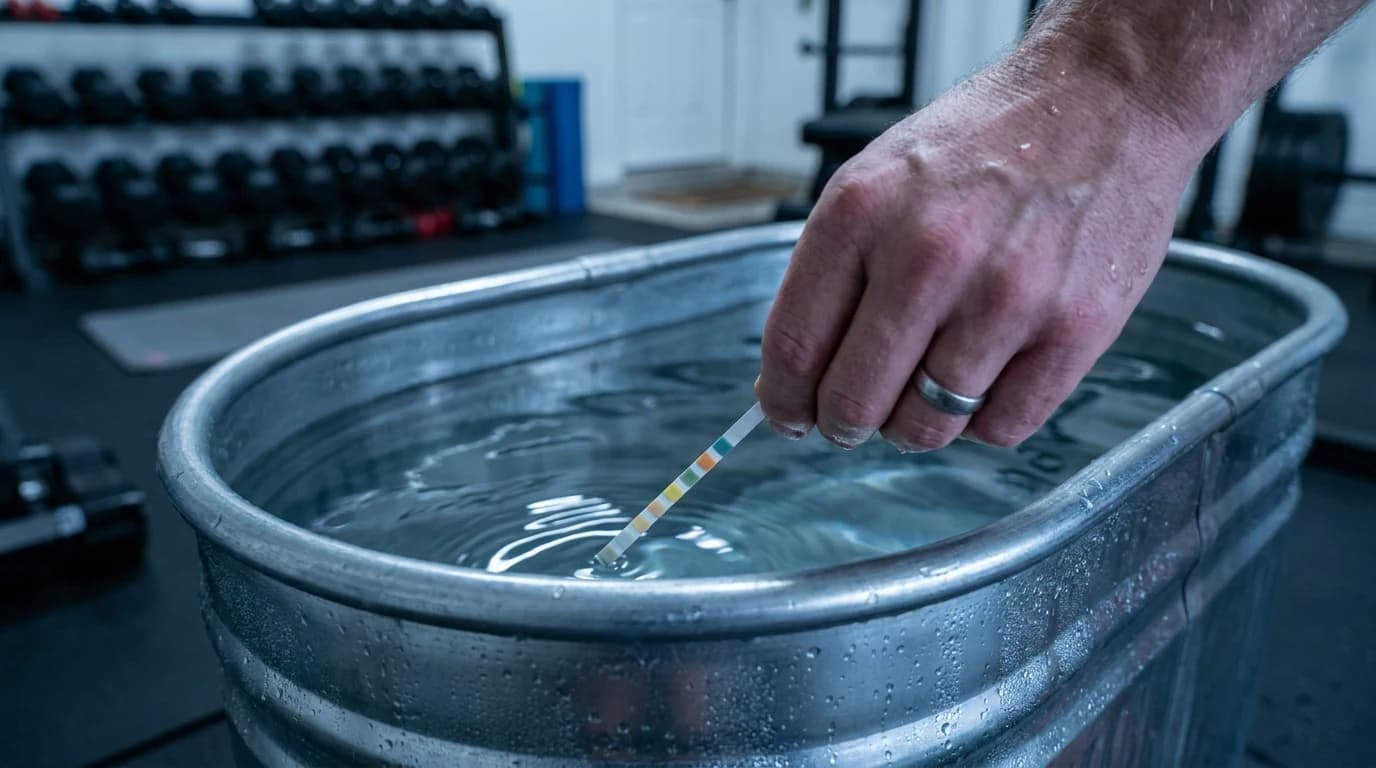
What the cold costs you, in contact time
Drinking-water regulation already quantified the penalty, because treatment plants must hit inactivation targets in water that stays cold for months. The EPA's CT tables — concentration multiplied by contact time — are published by temperature, and the table above pulls the rows that bracket a plunge.
Read one line of it. At pH 7.5 with 2 mg/L of free chlorine, three-log Giardia inactivation asks for a CT of 50 at 25°C and 200 at 5°C. Same chemical, same concentration, four times the contact time. The virus table moves by the same multiple, 2 up to 8.
Two honest limits on that transfer:
- These are treatment-plant values, not a bathing standard. Nobody has published a CT table for a garage tub.
- What carries over is the direction and size of the temperature coefficient, not the minutes. Cold is not a rounding error in disinfection; it is a multiplier.
Where the cold genuinely helps
This is not an argument that cold water is dirtier. It buys two real things.
What the cold does buy you
- Slower disinfectant decay. The CDC's hot tub guidance names heat as an accelerant of disinfectant decay; a cold tub is not doing that to your residual.
- Water below Legionella's favourable growth window. The CDC puts that window at 77–113°F and notes hot tubs sit inside it. A plunge in the high 30s does not.
What it does not buy you
- Faster kill times. The published minutes are warm-water minutes.
- A pass on a residual. The CDC lists temperature, water age and disinfectant residual as three separate factors; cold addresses one of them.
- Protection from what walks in. Sweat, skin oil, sunscreen and hair product arrive at the same rate whatever the temperature — and the CDC names exactly those as the things that consume chlorine.
Ozone and UV are loop treatments, not tub residuals
The premium tubs advertise ozone, UV, or both. Plunge's published model specifications pair a 20-micron filter with ozone sanitation — real hardware, and routinely misread.
The EPA's guidance manual is blunt about both. Ozone auto-decomposes, so its residual is much less stable than other chemical disinfectants and dissipates rapidly. UV leaves no residual in the water at all, which is why a secondary disinfectant has to be added alongside it.
| Hardware | Where it works | What it does not do |
|---|---|---|
| Filter cartridge | In the circulation loop | Inactivate anything |
| Ozone injector | In the loop, then it decays | Persist in the tub |
| UV lamp | Only inside the lamp chamber | Leave any residual |
| Chlorine or bromine | Everywhere the water is | Remove particles |
Read the spec sheet as a division of labour: the filter takes out particles, ozone and UV treat water as it passes through the plumbing, and a dissolved residual is the only thing still working in the tub while you are sitting in it.
Barrels change the maths again, because they have no loop at all. The Ice Barrel 500 is a 94-gallon insulated barrel with 3/4-inch NPT chiller ports and no chiller — that is a separate product. Nothing circulates and nothing filters, so everything rides on the residual and the refill.
The pool-aisle habit that costs you twice
The CDC recommends pH 7.0–7.8 with at least 1 ppm free chlorine in pools and at least 3 ppm in hot tubs. It also recommends against using cyanuric acid, or chlorine products containing it, in hot tubs at all — and its kill-time table repeats the warning, noting that disinfection times run longer when cyanuric acid is present.
Stabilised tabs from the pool aisle are exactly that product. Dropping them into a cold tub stacks two penalties onto the same reaction.
What the published guidance actually asks for:
- pH 7.0–7.8. Above 8.0 chlorine's ability to kill germs falls off; below 7.0 the plumbing starts to suffer.
- At least 1 ppm free chlorine in a pool, at least 3 ppm in a hot tub. A cold plunge has no published figure of its own; the hot tub number is the nearest analogue, and treating it as a floor is a judgement call.
- No cyanuric acid in a tub.
- Testing at least twice a day, and more often when several people are using the water.
- A DPD test kit rather than strips. Strips are less accurate, and above 10 ppm a test can bleach out entirely and report a false zero.
Replace the calendar with a trigger list
Search this question and you get schedules: every eight weeks, every twelve, every three months. None of those intervals traces to a public-health standard, because none exists for a residential cold plunge. They come from the companies selling the tubs, and they disagree with one another.
A routine you can defend looks like this instead.
- Test before you get in, not on a schedule. Free chlorine and pH are the two numbers.
- Treat a residual that will not hold overnight as the drain signal. Water that eats its sanitizer faster than you can dose it has an organic load beyond the chemistry.
- Drain on sight for cloudiness, odour or slick walls, whatever the calendar says.
- Rinse before you plunge. Sweat and sunscreen you keep out is chlorine demand you never pay for.
- Keep the lid on. It is the cheapest control you have over temperature and over what lands in the water.
What nobody can tell you honestly
There is no code for this. The CDC's parameters were written for pools and hot tubs, the EPA's CT tables for municipal treatment, and neither has published anything about a hundred gallons of 39°F water in a garage. Anyone quoting a precise water-change interval is extrapolating — this guide included.
What is not extrapolation is the shape of the problem: the colder the water, the more contact time the same residual needs. Cold buys slower decay and a temperature Legionella dislikes. It does not buy a sanitizer you can skip.
Choosing hardware? The sanitation stack deserves more weight than the cabinet finish — our ranked cold plunges and the cold plunge category score it. Already own the tub? The protocol guide covers how cold and how long.
Frequently Asked Questions
How often should you change cold plunge water?+
There is no public-health standard for a residential cold plunge, so no honest fixed interval exists — the eight-, twelve- and sixteen-week figures circulating online come from tub manufacturers and disagree with each other. Use a trigger instead: drain when the water no longer holds a free chlorine residual overnight at a sensible dose, and drain immediately on cloudiness, odour or slick walls. A tub with filtration and a circulation loop will hold longer than a manual barrel, and more bathers shorten the interval regardless of hardware.
Does cold water keep a plunge clean by itself?+
Only partly. Cold slows disinfectant decay and sits below the 77-113°F window the CDC identifies as most favourable for Legionella growth, both of which help. It also slows the sanitizer: the EPA's free-chlorine CT tables ask roughly four times the contact time at 5°C as at 25°C for the same inactivation. Cold changes the rate at which everything happens, in both directions, so it is not a substitute for a residual.
Can you use pool chlorine tablets in a cold plunge?+
The cheap tablets are usually stabilised with cyanuric acid, and the CDC recommends not using cyanuric acid or chlorine products containing it in hot tubs — its own kill-time table notes that disinfection times run longer when cyanuric acid is present. In cold water that penalty stacks on top of the temperature penalty. Unstabilised chlorine or bromine, dosed to a tested residual, is the more defensible route.
Is an ozone or UV system enough on its own?+
No, and the manufacturers of the underlying technology say so. The EPA's guidance manual notes that ozone auto-decomposes and its residual dissipates rapidly, and that UV leaves no residual in the water at all, which is why a secondary disinfectant is added alongside it. Both treat water as it passes through the plumbing; neither protects the water you are actually sitting in.
What should I test for, and how?+
Free chlorine and pH. The CDC recommends pH 7.0-7.8 with at least 1 ppm free chlorine in pools and at least 3 ppm in hot tubs, and testing at least twice a day, more often with several users. It also recommends a DPD test kit over strips — strips are less accurate, and above 10 ppm a test can bleach out and report a false zero, which reads as no chlorine when the truth is far too much.
Sources & Research
- CDC — Home Pool and Hot Tub Water Treatment and Testing — pH 7.0-7.8; at least 1 ppm free chlorine in pools and 3 ppm in hot tubs; no cyanuric acid in hot tubs; the chlorine kill-time table and its 1 ppm / pH 7.5 / 77°F basis; test twice daily; DPD kits over strips
- US EPA — Disinfection Profiling and Benchmarking Technical Guidance Manual — Table B-1 free-chlorine CT values for 3-log Giardia inactivation by temperature and pH, Table B-2 for 4-log virus inactivation, plus the statements that ozone's residual dissipates rapidly and that UV leaves no residual in the water
- CDC — Controlling Legionella in Hot Tubs — hot tubs hold water inside the most favourable growth range for Legionella (77-113°F, 25-45°C) and accelerate the decay of disinfectants; temperature, water age and disinfectant residual are named as the key factors
- Plunge — Model specifications — 20-micron filter plus ozone sanitation, with per-model chiller and circuit ratings
- Ice Barrel — Ice Barrel 500 product details — 94-gallon insulated barrel with 3/4-inch NPT chiller ports; the chiller is a separate product
Related reviews
Best Cold Plunges for Home Use
Plunge wins best home cold plunge on its full stack; Ice Barrel on price, Renu Therapy on premium build. Five tubs scored on cooling, hygiene, footprint.
Cold Plunge Protocol: How Cold, How Long, How Often
A safe cold plunge protocol: what temperature to start at, how long to stay in, weekly frequency, timing around lifting, and what cold does not do.
Best Infrared Sauna for Home Use in 2026: HigherDOSE Wins
The HigherDOSE V4 blanket is the best infrared sauna for apartments; the Dynamic Saunas Elite is our 1-person cabin pick. Compared on heat, EMF and build.
Hilly Shore Labs
Editorial teamThe independent product research team behind GymScored. Every recommendation is researched, never hands-on tested — rankings come from manufacturer specifications, published standards, and aggregated buyer sentiment.
161 products scored across 26 home gym categories, each on the same 5-dimension Gym Score formula.
See the scoring methodology and who we are.
Affiliate disclosure: GymScored is a participant in the Amazon Services LLC Associates Program. We earn from qualifying purchases at no extra cost to you. Full disclosure →