Home Gym Storage: Where to Put Plates, Bars, and Dumbbells
Store home gym gear by weight, not type: heavy stays low, bars and bands go vertical. Where plates, dumbbells, and accessories belong in a small space.
Sort your gear by weight, not by type. Heavy items — plates, dumbbells, kettlebells, the loaded bar — belong low and near a wall, stored in the knee-to-chest range where you can lift them safely; occupational-safety guidance flags reaching above shoulder height to handle load as an injury risk. Light, long, awkward items — the empty barbell, resistance bands, ropes, a foam roller — are what should go up the wall on mounts anchored into studs (drywall alone will not hold a loaded bar holder). The single biggest space win is a vertical bar holder: it converts roughly six square feet of floor into about one square foot of wall. Vertical storage frees the floor; it does not let you stack heavy iron overhead.
How GymScored is paid: Amazon Associates commission plus brand-direct affiliate (Rogue / REP / Titan when approved). No sponsored placements, no paid reviews, no pay-to-rank. Picks are ranked by the Gym Score formula and nothing else. Read the full disclosure.
Store a small home gym by weight, not by type. Keep the heavy things — plates, dumbbells, kettlebells — low and near a wall, in the knee-to-chest range you can lift safely. Send the light, long, and awkward things — the empty barbell, bands, ropes, a foam roller — up the wall on stud-anchored mounts. The biggest single win is a vertical bar holder, which turns about six square feet of floor into a one-square-foot wall footprint. The mistake almost everyone makes is treating "go vertical" as "put everything up high," which trades a floor problem for a shoulder problem. Heavy stays low; height is for the featherweights.
Where each piece of gear should live
Sort by weight, not type: the bottom of the wall holds the heavy iron in your safe lifting range, the top holds the featherweights. Most people load a storage wall upside-down.
| Equipment | Store it | Height | Why |
|---|---|---|---|
| Weight plates | Floor weight tree near a wall | Low (knee–chest) | Heaviest items you handle; keep in the safe power zone |
| Dumbbells | Low rack / saddle stand | Hip height | Grab without bending low or reaching overhead |
| Kettlebells | Floor or a sturdy low shelf | Low | Heavy with an off-center pull; never overhead |
| Empty / specialty barbells | Vertical wall holder (into studs) | Tall, light end up | Long and awkward on the floor, light enough to lift high safely |
| Resistance bands, ropes | Wall pegs or a hook strip | Wherever | Near-weightless; pure floor-clutter savings |
| Foam roller, mat | Wall hooks or a top shelf | High | Bulky but light — the one thing that belongs up high |
The short version
Most small-home-gym advice tells you to "go vertical to free up the floor," and then people stack everything they own up high. That is half-right, and it quietly causes the two problems a home gym actually has: a back tweak from hauling a 45-pound plate down off a high shelf, and a trip hazard from a floor that never got clear.
The fix is to split your gear by weight, not by type. Heavy things stay low and near a wall; light, long, and awkward things go up the wall. That one rule, plus a few cheap mounts, turns a cramped corner into a setup you can move around in.
Key takeaways
- Heavy stuff lives in the power zone, not overhead. The safest place to grab and return a loaded plate or a 50-pound dumbbell is between knee and chest height. Reaching above your shoulders to lift weight is a recognized injury risk, not a space hack.
- Vertical storage is for the light and long. Barbells, bands, foam rollers, and jump ropes are what should climb the wall. They are awkward on the floor and weigh almost nothing up high.
- Anchor anything wall-mounted into studs. Drywall alone will not hold a loaded bar holder. Lag bolts into framing are non-negotiable for heavy mounts.
- What most people get wrong: they treat "vertical storage" as "put it all up high." Putting your heaviest gear overhead trades a floor problem for a shoulder problem.
The one rule: sort by weight, not by type
Walk into a cluttered home gym and you see plates leaning on a wall, dumbbells on the floor, and a bar lying across the rack feet waiting to roll under your foot. The instinct is to buy "storage" and pile everything on it. The better move is to sort each item into one of two buckets.
Stays low, near a wall (heavy):
- Plates, dumbbells, kettlebells, the loaded bar.
- Stored where you can pick them up and set them down inside your safest lifting range.
Climbs the wall (light, long, or awkward):
- Empty barbells, resistance bands, foam rollers, jump ropes, a lifting belt.
- These are the things to get off the floor entirely.
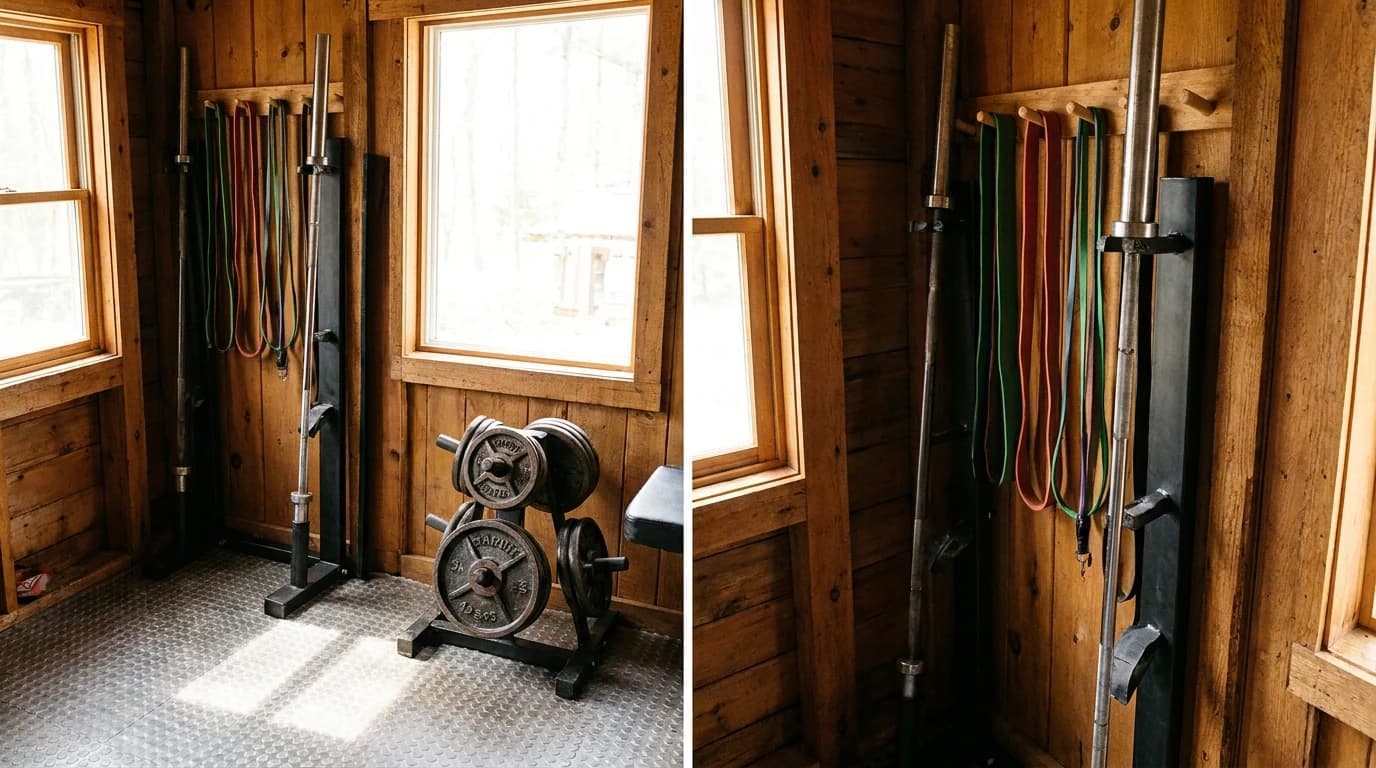
Rule of thumb: the reason is ergonomics, not looks. The body handles load most safely in a specific window, and overhead handling is where shoulders and backs get hurt.
Where each thing actually goes (and why)
The safest zone to lift and lower a load is above the knees or mid-thigh, and below the shoulders or mid-chest — the Canadian Centre for Occupational Health and Safety states plainly that "the risk of injury generally increases when a worker has to lift a load over shoulder height or lower a load that starts from a height higher than the shoulders." OSHA lists "prolonged or repetitive reaching above shoulder height" as an ergonomic risk factor for musculoskeletal disorders. Warehouse storage guidance from Safe At Work California reaches the same conclusion from the other side: "store only lightweight items on top shelves."
| Equipment | Where to store it | Why |
|---|---|---|
| Weight plates | Floor weight tree or low pegs, near a wall | Heaviest items you handle; keep them in the knee-to-chest power zone |
| Dumbbells | Low rack or saddle stand at hip height | Easy to grab without bending or reaching overhead |
| Kettlebells | Floor or a sturdy low shelf | Heavy, with an off-center pull; never overhead |
| Loaded / Olympic bar | Power rack J-cups or a floor bar holder | The bar already lives on the rack; a vertical holder works only for the empty bar |
| Empty barbells & specialty bars | Vertical wall holder (light end down) | Long, awkward on the floor, light enough to lift high safely |
| Resistance bands, ropes | Wall pegs or a simple hook strip | Near-weightless; pure floor-clutter savings |
| Foam roller, mat | Wall hooks or a top shelf | Bulky but light; the one thing that belongs up high |
The wall is upside down from how you'd load it
The bottom of your wall does the heavy lifting (literally), and the top of your wall holds the featherweights. That is the inverse of how most people instinctively load a storage wall.
The footprint math that makes it worth doing
Here is the accounting most "go vertical" posts skip. Vertical storage does not make a small gym hold more weight — it makes the floor usable. A weight tree and a dumbbell stand still sit on the ground; you are not levitating 300 pounds of iron. What you reclaim is the walking-and-lifting space that loose bars, mats, and bands eat up.
Ranked by floor space freed per dollar spent
- Wall-mounted vertical bar holder — turns ~6 sq ft of floor (a bar lying down plus its roll radius) into a 1 sq ft wall footprint. Biggest single win, and the bar is light enough to lift high safely.
- Wall pegs for bands and ropes — a few dollars, clears a whole tangled corner.
- Hooks for foam roller / mat — small win, but these roll into walkways otherwise.
- A low plate tree and dumbbell stand — these do not save floor space versus a pile, but they consolidate the footprint and, more importantly, stop you from bending to floor level to grab heavy iron.
Notice that the things that climb the wall are exactly the light ones, and the heavy storage stays a low, consolidated floor footprint. That is the rule doing its job.
The part that fails: how it's mounted
A wall holder is only as good as what it is screwed into. Drywall has almost no holding strength under sustained or dynamic load. A holder loaded with two or three steel barbells will pull plastic drywall anchors straight out of the wall — and a falling loaded bar is exactly what this whole exercise was meant to avoid.
Three rules for anything you bolt to a gym wall
- Hit the studs. Find the framing behind the drywall and drive lag bolts or heavy structural screws into solid wood. For a holder carrying real weight, span two studs if you can.
- Mount heavy holders low-ish. A bar holder does not need to be at head height. Keeping the loaded end of the bars near the floor means a dropped or slipping bar has nowhere to fall.
- Leave nothing heavy above shoulder height. This is the same ergonomics rule again. The top of your wall is for the foam roller, not the spare set of bumpers.
A 20-minute first pass
If you do nothing else, do this in order:
- Stand the empty bar up. Mount one vertical bar holder into studs and get the bar off the floor. Instantly safer and ~6 sq ft back.
- Hang the bands and ropes. A peg strip or three hooks into studs. The corner clears in minutes.
- Consolidate the iron low. Slide a plate tree and dumbbell stand against the wall, both loaded in the knee-to-chest zone. Don't lift it up — keep it down.
- Clear the walkways. Mat and foam roller onto hooks. Floor empty.
- Re-walk the space. Do a fake set. If you bend below your knees or reach above your shoulders to grab anything heavy, that item is in the wrong bucket — move it.
Worth knowing: the goal is a gym where every heavy thing is in your safe lifting range and every light thing is off the floor. Get the weight-sorting right and a 6-by-8 corner stops feeling cramped.
Design the storage in from the start
Storage works best when it is planned with the layout, not bolted on after. The free GymScored layout planner accounts for storage walls and walking lanes when it places equipment into your room, so the plates have a home before the first delivery arrives.
Sources
- Canadian Centre for Occupational Health and Safety — Lifting and Handling Loads (safe zone is above the knee/mid-thigh and below the shoulder/mid-chest; risk rises lifting over shoulder height)
- OSHA — Ergonomics: Identify Problems (prolonged or repetitive reaching above shoulder height is a musculoskeletal-disorder risk factor)
- Safe At Work California — Storage Area Ergonomics (store only lightweight items on top shelves; frequently used items between knee and elbow)
Frequently Asked Questions
Should I store weight plates on a wall or on the floor?+
Keep plates low, on a floor weight tree or low pegs near a wall, not up high. Plates are the heaviest things you handle, and lifting load above shoulder height is a recognized injury risk. The point of vertical storage is to clear the floor of light, awkward items like the empty barbell and bands — not to stack iron overhead. Heavy gear stays in the knee-to-chest power zone where you can grab and return it safely.
What is the best way to store a barbell in a small home gym?+
Stand it up. A wall-mounted vertical bar holder turns about six square feet of floor — a bar lying down plus the space it can roll into — into roughly a one-square-foot wall footprint, and it is the single highest-payoff storage move in a small gym. Mount the holder into wall studs with lag bolts, not drywall anchors, and store the bar with the light end accessible. Only the empty bar goes on a vertical holder; the loaded bar lives in your rack's J-cups.
Can I screw gym storage straight into drywall?+
No, not for anything that holds weight. Drywall has almost no holding strength under sustained or dynamic load, and a holder loaded with steel barbells will pull plastic anchors out of the wall — a falling loaded bar is exactly the hazard you were trying to prevent. Find the framing studs behind the drywall and drive lag bolts or heavy structural screws into solid wood, spanning two studs for a heavy holder. Drywall anchors are fine only for near-weightless items like a single resistance band on a peg.
Does vertical storage actually let a small gym hold more equipment?+
Not more weight — more usable floor. A plate tree and a dumbbell stand still sit on the ground; you are not levitating the iron. What vertical storage reclaims is the walking-and-lifting space that loose bars, mats, ropes, and bands otherwise eat up. The biggest gains come from getting long, light, awkward things off the floor and onto the wall, while the heavy storage stays a low, consolidated footprint near a wall.
Sources & Research
- Canadian Centre for Occupational Health and Safety — Lifting and Handling Loads (safe zone above the knee/mid-thigh and below the shoulder/mid-chest; risk rises when lifting over shoulder height)
- OSHA — Ergonomics: Identify Problems (prolonged or repetitive reaching above shoulder height is a musculoskeletal-disorder risk factor)
- Safe At Work California — Storage Area Ergonomics (store only lightweight items on top shelves; frequently used items between knee and elbow)
Your next step
Gear that stores flat.
Related reviews
How to Plan a Home Gym in a Small Space (Without Wasting Money)
Plan a small-space home gym goal-first: real equipment footprints, ceiling-height math, the buy order that avoids waste, and what beginners over-buy.
Can Your Floor Handle a Home Gym? The Real Math
Whether your floor can handle a home gym is rarely about total weight - it's load per square foot and dropped weights. The real math by floor type.
Best Gym Flooring for Home Gyms in 2026: Stall Mats Win
Horse stall mats win best home gym flooring for barbell setups, no contest. We scored 6 flooring options on thickness, durability, and impact reduction.
Hilly Shore Labs
Editorial teamThe independent product research team behind GymScored. Every recommendation is researched, never hands-on tested — rankings come from manufacturer specifications, published standards, and aggregated buyer sentiment.
161 products scored across 26 home gym categories, each on the same 5-dimension Gym Score formula.
See the scoring methodology and who we are.
Affiliate disclosure: GymScored is a participant in the Amazon Services LLC Associates Program. We earn from qualifying purchases at no extra cost to you. Full disclosure →