How Much Protein to Build Muscle (And How Much Just to Keep It)
A healthy adult who lifts has a defensible range: about 1.4-2.0 g of protein per kg a day. Where it comes from, and why maintaining needs no lower number.
For a healthy adult who trains with resistance, the International Society of Sports Nutrition's position stand puts the working range at roughly 1.4-2.0 grams of protein per kilogram of body weight per day - about 0.64-0.91 grams per pound. There is no separate, proven “just maintaining” number that is reliably much lower, and protein only matters alongside training that actually challenges the muscle.
How GymScored is paid: Amazon Associates commission plus brand-direct affiliate (Rogue / REP / Titan when approved). No sponsored placements, no paid reviews, no pay-to-rank. Picks are ranked by the Gym Score formula and nothing else. Read the full disclosure.
Pick a figure inside 1.4-2.0 g per kg of body weight per day, translate it into food you will actually eat, and spend the rest of your attention on training that progresses. There is no proven low maintenance number that applies to everyone, and no evidence that pushing far above the range buys anything. Chronic kidney disease, pregnancy, clinician-recommended restrictions and a history of disordered eating all change the advice entirely - those are conversations for a care team, not a formula.
Protein advice gets confusing because every number is presented as the number — a gram per pound, the adult dietary allowance, a cap on what one meal can use. Those claims concern different populations, goals and kinds of evidence.
For a healthy adult doing regular resistance training, a defensible starting framework is roughly 1.4–2.0 grams of protein per kilogram of body weight per day — about 0.64–0.91 grams per pound. The International Society of Sports Nutrition's position stand applies it to most exercising people, not only competitive bodybuilders.
- 0.8 g/kg/day The commonly quoted adult recommended dietary allowance. Not a muscle-growth target for people who lift.
- 1.4-2.0 g/kg/day The ISSN position stand's range for exercising adults building or maintaining muscle, or about 0.64-0.91 g per pound.
- 1.62 g/kg/day Morton et al.'s estimated breakpoint, beyond which added protein was not associated with further average gains in fat-free mass.
Source: ISSN position stand (Jäger et al., 2017) and Morton et al., British Journal of Sports Medicine, 2018 — both linked in full at the foot of this page.
They answer three different questions: what meets a healthy population’s needs, what supports adaptation to resistance training, and what one average trial result looked like. None is a personal requirement — age, training, total food intake and health all change it.
What the Morton meta-analysis actually found
Robert Morton and colleagues' 2018 systematic review and meta-analysis examined protein supplementation alongside resistance training in healthy adults, across 49 studies and 1,863 participants. Its model estimated a breakpoint near 1.62 grams per kilogram per day, beyond which added protein was not associated with further average gains in fat-free mass.
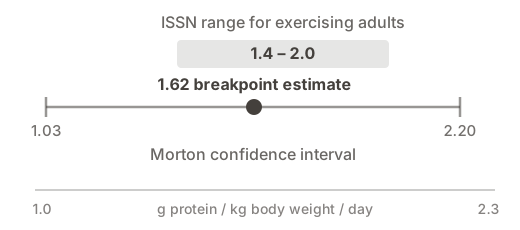
Only figures the sources state are plotted. No dose-response curve is drawn, because neither source supplies one — the point is that the estimate sits inside a wide interval.
The estimate was uncertain: the reported confidence interval ran from approximately 1.03 to 2.20 grams per kilogram. The data support a useful approximate region, not a decimal-point prescription, and certainly not a biological ceiling.
Turn the range into usable numbers
From body weight to a daily number you can actually use
- Get your body weight in kilograms. If you weigh yourself in pounds, divide by about 2.205 — a 176-pound person is roughly 80 kilograms.
- Pick a figure inside the range rather than at its edge. The example below uses 1.6 g/kg.
- Multiply. At 1.6 g/kg that is 112 grams for a 70-kilogram person and 128 grams for an 80-kilogram person.
- Round to a planning number you can hit. Food labels, portion estimates and appetite are not precise enough to justify chasing single grams.
Why "just maintaining" does not automatically mean much less
It sounds logical that building muscle needs a large target while keeping it needs very little, but no low maintenance threshold has been shown to preserve everyone's muscle across different training schedules and diets. The ISSN range covers maintaining as well as building, so if your weight is stable and training is going well, there may be no reason to cut protein at all.
Before you change the number, check what actually changed
- Am I still doing genuinely challenging resistance exercise, or has the training quietly got easier?
- Am I eating enough food overall, not just enough protein?
- Has an injury, illness or schedule change made me less active?
- Is my body weight roughly stable, or trending somewhere I did not intend?
Resistance training is the other half of the answer
A high-protein diet does not tell a muscle that it needs to become stronger. Training provides that challenge.
Research on protein and hypertrophy studies protein in the context of training, not as a stand-alone treatment. For a home lifter the priority is a repeatable program that works the major movement patterns and progresses in a controlled way. Another protein snack is easy to add; when progress stalls, look at the sessions before the shopping list.
Weight loss changes the context
The ISSN position stand notes that higher protein intakes may help preserve lean mass during calorie restriction in resistance-trained people, but recommendations built for lean, trained athletes should not become advice for everyone trying to lose weight. What matters is the total pattern — energy intake, resistance exercise, and the pace of loss. That matters more still when considering muscle loss during rapid weight loss.
A medication-assisted weight-loss plan or major appetite change deserves individualized clinical guidance. Do not copy a bodybuilding cut, change medication, or diagnose sarcopenia from a bathroom scale.
Age can change the conversation too
Older adults should not assume that eating less protein is an inevitable part of aging. The PROT-AGE Study Group recommended at least approximately 1.0–1.2 grams per kilogram daily for healthy older adults, with higher needs in some active or illness-related circumstances, alongside appropriate exercise and with exceptions such as certain kidney conditions.
That answers a different question from maximizing gains in younger lifters; it is not an age chart where a birthday changes the target. For an older person struggling with eating, weakness or unintentional weight loss, the next step is a clinician.
Spread protein in a way you can sustain
The daily total is the practical place to start. After that, it helps to include protein-containing foods in more than one eating occasion rather than a single very large evening meal. The ISSN position stand discusses distribution across the day — but a missed meal does not ruin progress, and shift workers need a pattern that fits their own day.
Build meals before adding complexity
Think in terms of a recognizable protein source plus the rest of the meal, which still needs room for carbohydrates, fats, produce and foods you enjoy. Protein is an important nutrient, not the only one.
Everyday protein sources to build a meal around
- Eggs
- Dairy
- Fish
- Poultry
- Meat
- Beans and lentils
- Tofu and other soy foods
A lentil-based meal and a chicken-based meal do not necessarily provide the same protein in the same volume, so read labels while learning portions. Plant-based eating can include plenty of protein-containing foods.
What about protein powders and shakes?
Protein powders are a convenience option, not a requirement imposed by the muscle-building process; ordinary food can supply dietary protein. A concentrated source is practical when appetite, time or meal preparation makes the daily pattern difficult, and its portion size is easy to know without estimating. But replacing meals with something that contributes little variety or energy is not the same as topping up a complete day.
This article recommends no brand and no supplement routine. Before making food more complicated, identify the obstacle: a missed lunch, a dinner without a substantial protein source, or a target that leaves no room for normal eating.
Medical conditions change the advice
General sports-nutrition ranges are not a blanket instruction for people with kidney disease or another condition requiring dietary management. The National Institute of Diabetes and Digestive and Kidney Diseases explains that protein needs in chronic kidney disease depend on the person's circumstances, including whether dialysis is involved.
A sensible way to put it together
Choose a reasonable starting range, with professional input where it is needed, translate it into your usual foods and schedule, and watch performance, recovery, appetite and weight over time rather than day to day.
For maintaining muscle, resist the promise of a secret lower number. For building muscle, resist the promise that ever-higher protein produces better results. The useful answer combines adequate protein, enough overall food, and a training routine your life can support.
Frequently Asked Questions
How much protein do I need to build muscle?+
For a healthy adult doing regular resistance training, the International Society of Sports Nutrition's position stand uses a range of roughly 1.4 to 2.0 grams per kilogram of body weight per day, which is about 0.64 to 0.91 grams per pound. It is a starting framework rather than an exact requirement, and it applies to most exercising people, not only competitive bodybuilders.
Is 1.62 grams per kilogram the magic number?+
No. Morton and colleagues' 2018 meta-analysis estimated a breakpoint around 1.62 grams per kilogram per day, but the reported confidence interval extended from approximately 1.03 to 2.20. That supports a useful approximate region, not an exact biological ceiling, and it does not mean everyone needs 2.20.
Do I need much less protein if I am only maintaining muscle?+
There is no single low maintenance threshold proven to preserve everyone's muscle across different training schedules and diets. The ISSN range covers maintaining as well as building muscle in exercising adults, so if your eating pattern is comfortable, your weight is stable and your training is going well, there may be no practical reason to cut protein sharply.
Is one gram per pound the same as one gram per kilogram?+
No, and confusing them is a common error. One gram per pound is approximately 2.2 grams per kilogram, so it is a substantially higher target. Mixing the two units can nearly double an intended amount.
Do I need a protein powder?+
No. Protein powders are a convenience option, not a requirement imposed by the muscle-building process, and ordinary food can supply dietary protein. A concentrated source may be practical when appetite, time or meal preparation makes the daily pattern difficult. If you have kidney disease or another condition requiring dietary management, follow your care team rather than a general range.
Sources & Research
- Journal of the International Society of Sports Nutrition — ISSN Position Stand: protein and exercise (Jäger et al., 2017)research
- British Journal of Sports Medicine — Morton et al., protein supplementation and resistance-training-induced gains in muscle mass and strength (2018)research
- JAMDA — PROT-AGE Study Group: optimal dietary protein intake in older people (Bauer et al., 2013)research
- MedlinePlus — Protein in dietauthority
- NIDDK — Healthy Eating for Adults with Chronic Kidney Diseaseauthority
Related reviews
Progressive Overload at Home Without Adding Weight
Progressive overload without adding weight: progress with reps, sets, tempo, range, and rest when the next dumbbell jump is too big. The full method.
Best Adjustable Dumbbells in 2026
Bowflex 1090 wins on its 10-90 lb range, NUOBELL 80 on feel, PowerBlock on durability. We scored 8 adjustable dumbbell sets on mechanism and build.
How Often Should You Train Each Muscle at Home?
About twice a week per muscle, says the research - but once weekly volume is equal, frequency barely matters. How to set your volume and split at home.
Hilly Shore Labs
Editorial teamThe independent product research team behind GymScored. Every recommendation is researched, never hands-on tested — rankings come from manufacturer specifications, published standards, and aggregated buyer sentiment.
163 products scored across 26 home gym categories, each on the same 5-dimension Gym Score formula.
See the scoring methodology and who we are.
Affiliate disclosure: GymScored is a participant in the Amazon Services LLC Associates Program. We earn from qualifying purchases at no extra cost to you. Full disclosure →