How to Protect Garage Gym Equipment From Rust
Garage gym equipment rusts when the air crosses a humidity threshold, not because the steel is cheap. The line that matters and 5 fixes ranked by payoff.
Rust in a garage or basement gym is a humidity problem, not an equipment-quality problem. Bare steel barely corrodes below ~45% relative humidity but rusts fast above it, and sweat (salt water) accelerates it further. Buy a $10 hygrometer, keep the room below 50% RH (use a dehumidifier when it climbs past 55-60%), wipe sweat off your bar after every session, and oil bare steel monthly. Coatings like chrome or Cerakote slow rust but do not make steel immune.
How GymScored is paid: Amazon Associates commission plus brand-direct affiliate (Rogue / REP / Titan when approved). No sponsored placements, no paid reviews, no pay-to-rank. Picks are ranked by the Gym Score formula and nothing else. Read the full disclosure.
Garage and basement gyms rust because the air around the steel crosses a humidity line, not because the gear is cheap. Keep the room below 50% relative humidity, wipe sweat off bars after every session, and run a dehumidifier when it reads above 55-60%. Those three habits protect a $150 bare-steel bar better than a $400 coating ever will in a damp room.
Which gym gear rusts fastest (by finish)
Rust risk is set by the steel's finish, not its price. Bare metal goes first; sealed and stainless hardware shrug off the same damp air.
| Finish / material | Rust risk | Common on | What to do |
|---|---|---|---|
| Bare steel / raw cast iron | Highest | Bare power bars, raw iron plates | Oil monthly, wipe sweat off every session |
| Black oxide / phosphate | High | Many budget bars and dumbbells | Wipe and oil; reapply when finish dulls |
| Chrome / hard chrome | Moderate | Mid-range bars, rack hardware | Wipe dry; light oil if pores show spotting |
| Zinc / Cerakote | Low | Premium bars, coated plates | Keep dry; rarely needs oil in a controlled room |
| Stainless / sealed urethane | Lowest | Stainless bars, bumper plates, rubber-coated dumbbells | Wipe clean; effectively maintenance-free |
The short version
A garage or basement gym sees temperature swings and damp air that a climate-controlled spare room never does. That is why bare barbells, plates, and rack uprights in those spaces grow a film of orange rust within a season — not because the steel is cheap, but because the air around it crosses a humidity line. Below roughly 45% relative humidity, bare steel barely corrodes. Above it, rust accelerates fast, and once sweat (which is salt water) lands on a knurled bar, it accelerates faster still.
This is a maintenance problem with a cheap fix. Control the air, wipe what you touch, and the same gear lasts decades.
Key takeaways
- Humidity is the trigger, not water. Steel does not need a puddle to rust. Once relative humidity sits above ~45%, a microscopic moisture film forms on bare metal and corrosion runs faster the higher the humidity climbs.
- A $10 hygrometer is the first purchase. You cannot manage what you do not measure. Aim to keep the room below 50% RH; the EPA's mold guidance (the same physics) is below 60%, ideally 30–50%.
- Sweat is the accelerant most people ignore. Sweat is rich in sodium chloride. A documented "rusters" phenomenon shows palmar sweat alone corrodes bare steel — a sweaty bar left overnight is the single most common rust starter in a home gym.
- Coatings buy you time; they do not make steel immune. Bare steel and cast iron rust fastest. Chrome, zinc, and Cerakote slow it down. Only sealed/coated plates and stainless hardware shrug it off.
Why garage and basement gyms rust (and a spare bedroom does not)
The humidity threshold
Rust is iron meeting oxygen and water. The water part is the variable you control. The General Air Products review of corrosion science is blunt about the threshold: when relative humidity drops below 35–45%, essentially no corrosion occurs; above 45%, corrosion can run at an exponential rate as humidity climbs — and the moment the air carries any contaminant, the "critical" humidity at which rust takes off drops to around 70% and below (General Air Products, Relative Humidity, Dew Point, and Corrosion).
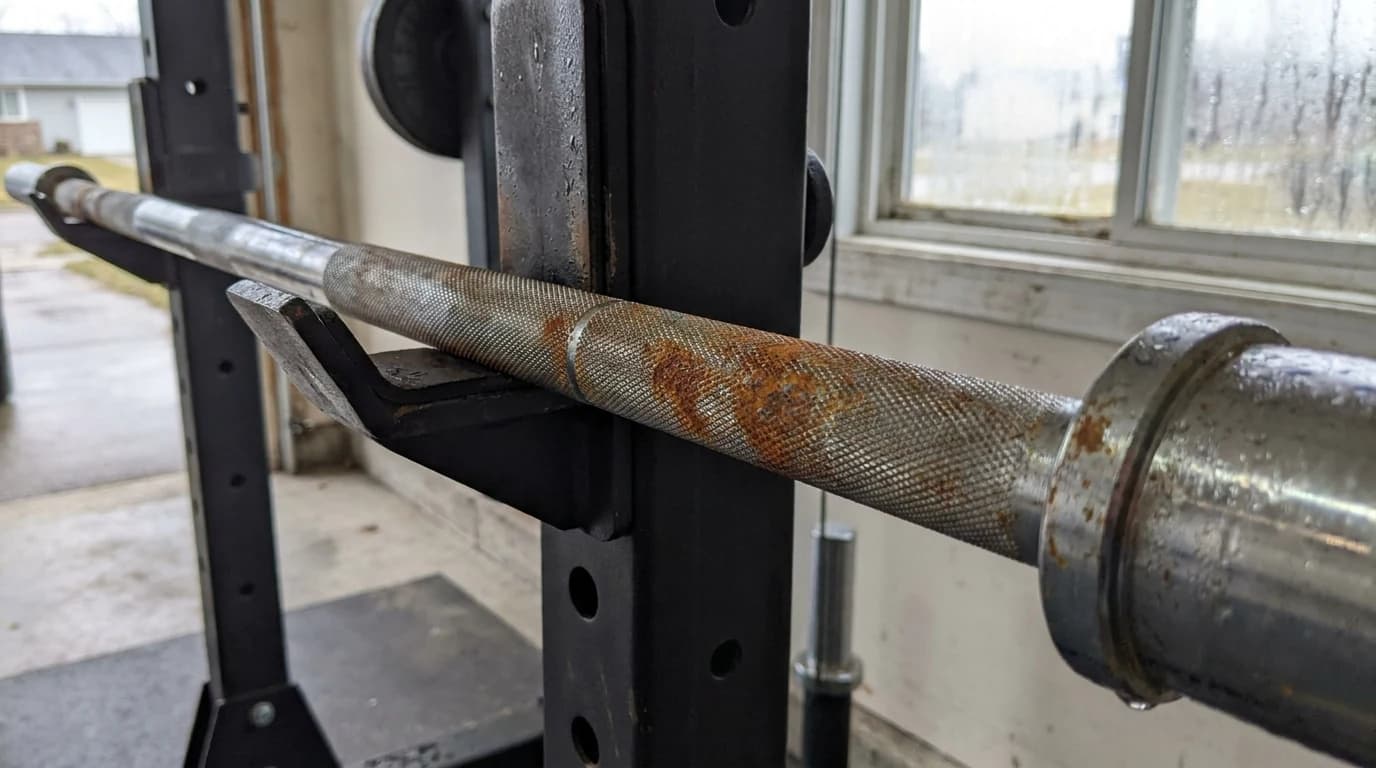
The dew point is what actually gets your bar
A garage crosses that line constantly: uninsulated, vented to outdoor air, swinging in temperature daily. The killer is the dew point. When a warm humid afternoon is followed by a cold night, the air's moisture condenses onto whatever is coldest — usually your barbell and plates. That visible bead of water on a cold bar is the same signal the EPA flags indoors: "rust is an indicator that condensation occurs," and condensation means the air is too wet (US EPA, A Brief Guide to Mold, Moisture and Your Home).
Rule of thumb: below roughly 45% RH, bare steel barely corrodes. Above it, every extra point costs you.
What rusts fastest: a material risk map
Not all of your gear is at equal risk. The finish on the steel decides how forgiving it is.
| Finish | Rust risk | What it needs |
|---|---|---|
| Bare steel (bars, knurling) | Highest | Wipe every session, oil on a cadence |
| Cast iron (plates, kettlebells) | Highest | Off cold concrete; wipe and cover |
| Chrome / zinc | Moderate | Still oil the shaft — coatings slow rust, not stop it |
| Cerakote | Moderate | Slower to corrode; bare knurling still needs care |
| Sealed/coated plates, stainless hardware | Lowest | Essentially shrugs it off |
The 5 fixes, ranked by payoff
The order matters — do the top two first and you have solved 80% of the problem for under $50.
- Measure the air with a hygrometer. A $10–15 hygrometer tells you whether you actually have a humidity problem or just a habits problem. Check it across a full day, not once. If it lives below 50% RH, you mostly need fix #4 (wipe sweat). If it spikes above 60%, you need a dehumidifier.
- Wipe down bars and contact points after every session. Sweat is the accelerant. A documented dermatology study on the "rusters" phenomenon found that the sodium chloride in palmar sweat alone is enough to corrode bare metal it contacts (Acta Dermato-Venereologica, The Corrosive Action of Palmar Sweat). A dry microfiber wipe across the knurling and sleeves after lifting takes ten seconds and removes the salt before it sits overnight.
- Run a dehumidifier when the room reads above 55–60% RH. The single biggest lever for a damp basement: a compressor unit pulls the room under the corrosion threshold and holds it there. Pair it with a hygrometer so it is not running for no reason, and store gear off the cold concrete — see the gym flooring guide for why a rubber base layer helps here too.
- Oil bare steel on a cadence, not in a panic. A light film of 3-in-1, mineral or dedicated bar oil fills the microscopic pores where moisture starts. Monthly is plenty in a controlled room, weekly if your garage swings hard. Brush the knurling with a nylon brush first so the oil reaches the grooves.
- Cover or relocate the most vulnerable pieces. Bare cast-iron plates and an exposed bar are the first to go. A cheap fitted cover, or simply racking the bar vertically off the floor, removes them from the condensation zone. If a piece already has surface rust, a green scrub pad with a little oil lifts it before it pits the steel permanently.
The humidity kit: four things, and what each one is for
The five fixes above need almost nothing to execute. This is the whole basket, in the order the fixes are ranked.
| What | Its job in the kit | Why this shape |
|---|---|---|
| A digital hygrometer | Tells you whether you have a humidity problem at all | Two-packs let you read the floor and a shelf, which often disagree |
| A desiccant dehumidifier | Pulls a small enclosed space under the corrosion threshold | Rechargeable silica, no power, no bucket to empty |
| A compressor dehumidifier | The only real answer for a whole damp room | Needs a drain hose or you will empty a bucket daily |
| Light machine oil | The film that keeps moisture out of bare steel pores | A drip bottle, not a spray, so it goes where you aim it |
Three of the four are cheap enough to buy together: a two-pack hygrometer, a rechargeable desiccant unit for a bar case or cabinet, and a bottle of 3-in-1 multi-purpose oil — the classic bar oil because it is thin, cheap and non-gumming. The compressor dehumidifier is the one real expense, and the only thing that fixes a damp room rather than a damp box.
The order matters more than the list: buy the hygrometer first and read it for a week. If the room sits under 50%, you have a habits problem, not a humidity problem, and oil plus a microfibre cloth is the entire fix.
The r/GarageGym rust in humid climates and r/homegym combating moisture threads converge: run a dehumidifier, and run it with a drain hose so you are not emptying a bucket daily. In genuinely wet climates owners report needing it near-continuously with the door shut — a sealed room you dehumidify, or an open one you accept rust in.
What most people get wrong
The common belief is that a rusty bar means you bought a cheap bar. That is rarely true.
What actually protects your steel:
- Humidity under control.
- Sweat wiped off before it sits overnight.
- A light oil film on bare and chrome shafts.
- Gear stored off cold concrete.
What people buy instead:
- A premium coating instead of a dry room.
- A pricier bar, kept in the same conditions.
- A dehumidifier "later," after the plates have pitted.
The trap: a $400 stainless bar in a 70% RH basement will pit; a $150 bare-steel bar in a controlled 45% room looks new in five years. The room is the variable, not the price tag.
Surface rust is not the same as pitting
The second myth is that a little surface rust ruins a bar. Surface oxidation wipes off; it is not the deep pitting that destroys knurling. Catch it early with the wipe-and-oil habit and it never becomes structural.
A dehumidifier is not a "nice to have"
In a genuinely damp space it is the highest-return gym purchase you will make, because it protects every steel item you own at once.
Sources
- US EPA — A Brief Guide to Mold, Moisture and Your Home — keep indoor relative humidity below 60% (ideally 30–50%); condensation and rust are signs the air is too wet.
- General Air Products — Relative Humidity, Dew Point, and Corrosion — below 35–45% RH essentially no corrosion; above 45% corrosion accelerates; contaminants drop the critical RH to ~70%.
- Acta Dermato-Venereologica — The Corrosive Action of Palmar Sweat ("Rusters") — the sodium chloride in sweat is corrosive to bare metal.
Frequently Asked Questions
At what humidity does gym equipment start to rust?+
Bare steel essentially does not corrode below 35-45% relative humidity. Above 45% it begins to rust, and the rate climbs steeply the higher the humidity goes. If the air carries any contaminant, the critical humidity at which rust accelerates drops to around 70%. The practical target for a home gym is to keep the room below 50% RH, measured with a cheap hygrometer.
Why does my barbell rust in the garage but not in a spare room?+
A garage is uninsulated and vented to outdoor air, so it swings through daily temperature and humidity changes a climate-controlled room never does. The real culprit is condensation: when a warm humid day cools overnight, moisture beads onto the coldest surfaces, which is usually your steel bar and plates. A spare bedroom stays under the corrosion threshold, so the same equipment never gets wet.
Does sweat actually rust a barbell?+
Yes. Sweat is rich in sodium chloride, and salt water is far more corrosive than plain moisture. A documented dermatology phenomenon called 'rusters' shows that the sweat from a person's hands alone can corrode bare metal they touch. A sweaty bar left overnight is the single most common way home-gym bars start to rust, which is why wiping the knurling and sleeves after every session matters.
Do I need a dehumidifier for a home gym?+
Only if the room reads above about 55-60% relative humidity on a hygrometer. In a genuinely damp basement or humid-climate garage, a dehumidifier is the highest-payoff purchase you can make because it protects every steel item at once. In a drier space, a hygrometer plus wiping sweat off the bar is usually enough.
How do I remove surface rust from a barbell?+
Light surface oxidation on the shaft is cosmetic, not structural. Scrub it with a green abrasive pad and a little oil, then wipe dry. For the knurling, use a nylon or brass brush so the oil reaches the grooves. Catching it early with a wipe-and-oil habit keeps surface rust from ever progressing to the deep pitting that actually ruins a bar.
Sources & Research
- US EPA — A Brief Guide to Mold, Moisture and Your Home (keep indoor relative humidity below 60%, ideally 30-50%; condensation and rust signal air that is too wet)
- General Air Products — Relative Humidity, Dew Point, and How They Relate to Corrosion (below 35-45% RH essentially no corrosion; above 45% corrosion accelerates; contaminants drop critical RH to ~70%)
- Acta Dermato-Venereologica — 'Rusters': The Corrosive Action of Palmar Sweat (sodium chloride in sweat corrodes bare metal)
- r/GarageGym — For those with garage gyms in humid climates: any rust concerns?
- r/homegym — How do you all combat moisture in your garage gym?
Your next step
Sealed flooring is the first line of defence.
Related reviews
Is Your Garage Gym Too Hot to Train In Safely?
A hot garage gym is more than uncomfortable. The warning signs, when to stop training, and the cheapest fixes that make a sweatbox usable again.
Best Gym Flooring for Home Gyms in 2026: Stall Mats Win
Horse stall mats win best home gym flooring for barbell setups, no contest. We scored 6 flooring options on thickness, durability, and impact reduction.
Can Your Floor Handle a Home Gym? The Real Math
Whether your floor can handle a home gym is rarely about total weight - it's load per square foot and dropped weights. The real math by floor type.
Hilly Shore Labs
Editorial teamThe independent product research team behind GymScored. Every recommendation is researched, never hands-on tested — rankings come from manufacturer specifications, published standards, and aggregated buyer sentiment.
163 products scored across 26 home gym categories, each on the same 5-dimension Gym Score formula.
See the scoring methodology and who we are.
Affiliate disclosure: GymScored is a participant in the Amazon Services LLC Associates Program. We earn from qualifying purchases at no extra cost to you. Full disclosure →