Resistance Band Storage: Inspect Before You Put Away
Resistance band storage starts with inspection. Compare maker guidance on cracks, peeling and powder, then choose storage away from heat and sharp edges.
Store resistance bands relaxed, away from direct sunlight, heat and sharp edges, following the instructions for your exact material and model. Inspect the band and connections before use. Cracks or cuts are retirement signals; powder or minor peeling can have brand-specific explanations. Good storage does not make a damaged band fit to use.
How GymScored is paid: Amazon Associates commission plus brand-direct affiliate (Rogue / REP / Titan when approved). No sponsored placements, no paid reviews, no pay-to-rank. Picks are ranked by the Gym Score formula and nothing else. Read the full disclosure.
Store resistance bands relaxed, away from direct sunlight, heat and sharp edges, following the instructions for your exact material and model. Inspect the band and connections before use. Cracks or cuts are retirement signals; powder or minor peeling can have brand-specific explanations. Good storage does not make a damaged band fit to use.
What should you check before storing resistance bands?
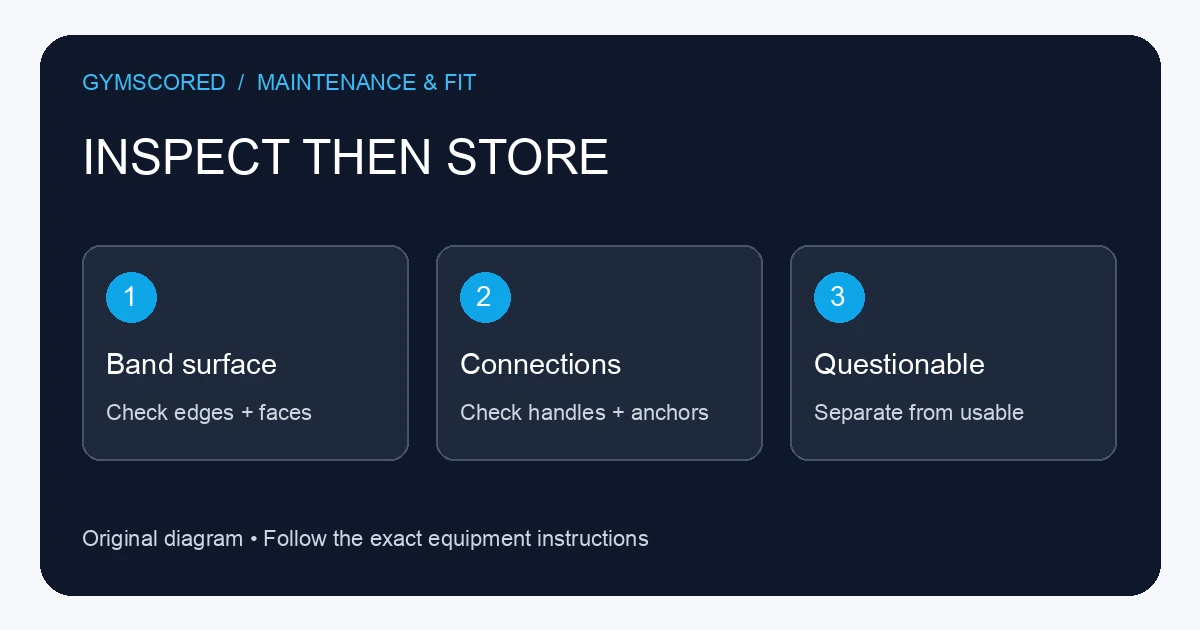
Inspect the band and its connections before packing it away, then inspect again before training. Storage can conceal damage if you bundle a whole set together and only pull out the color you need. Keep each band accessible enough to examine its full surface and the areas that contact handles or anchors.
THERABAND’s support guidance calls for checking tears, abrasion and cracks, particularly at connection points. It says to replace bands or tubing showing wear. B-LINES’ instructions also include handles and stitching in the inspection, rather than treating the elastic as the only component that can fail.
- Lay the band out without loading it.
- Examine both surfaces and the edges along its length.
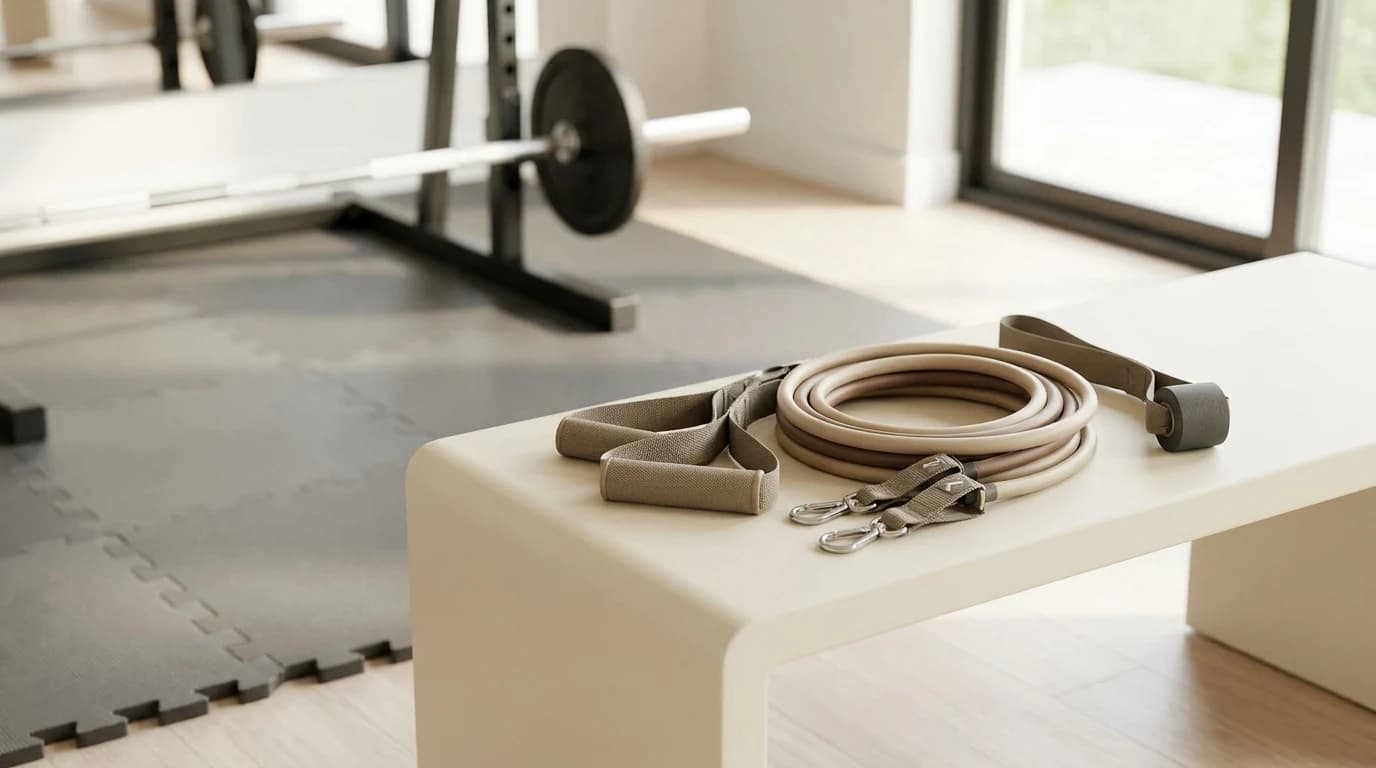
- Look closely where the band meets handles, clips or anchors.
- Check textile parts for fraying and hardware for damage.
- Set questionable equipment aside until its maker answers the question.
This is an inspection routine, not a stress test. Pulling a suspicious band as hard as possible to see whether it survives is not a useful clearance procedure. Nor does a fabric sleeve or internal cord establish that the elastic underneath is sound.
Inspect the complete setup: Band, connection, handle and anchor all belong in the check. A tidy storage box does not certify any of them.
Are cracks, peeling and white powder the same problem?
They are different observations, and the manufacturer matters. A white coating on one maker's latex tube may be cosmetic; a cut in its elastic remains a separate defect. Do not transfer a reassuring explanation for one observation to another.
Bodylastics explains that a whitish coating can be manufacturing talc reaching the surface. In the same FAQ it tells owners to stop using bands with cracks or splits. Serious Steel distinguishes minor peeling in its layered bands from worsening peeling that can indicate aging. These are specific construction explanations, not permission to ignore all surface damage.
| Observation | Published manufacturer distinction | Practical next step |
|---|---|---|
| Tears, abrasion or cracks | THERABAND treats wear as a replacement signal | Remove that band from use |
| White coating on Bodylastics latex | Maker identifies talc as a cosmetic explanation | Check separately for cracks and splits |
| Minor peeling on Serious Steel layers | Maker says minor peeling can be cosmetic | Inspect; ask support if extent is unclear |
| Worsening peeling or an edge cut | Serious Steel flags aging or edge abrasion | Stop guessing and resolve with the maker |
| Frayed handle stitching or damaged parts | B-LINES includes these in stop-use checks | Remove the affected setup from use |
A brand exception is not a general rubber rule
A thin layered loop, latex tube and fabric-covered band need not share the same construction or care instructions. Find the instructions that came with yours. If a band has lost its label, identify it from the order record before adopting another company's cleaning product or replacement interval.
Our resistance-band buying guide compares formats. The relevant difference here is maintenance: what you can inspect, how the attachment works and what the manufacturer considers a defect.
Where should resistance bands live in a garage gym?
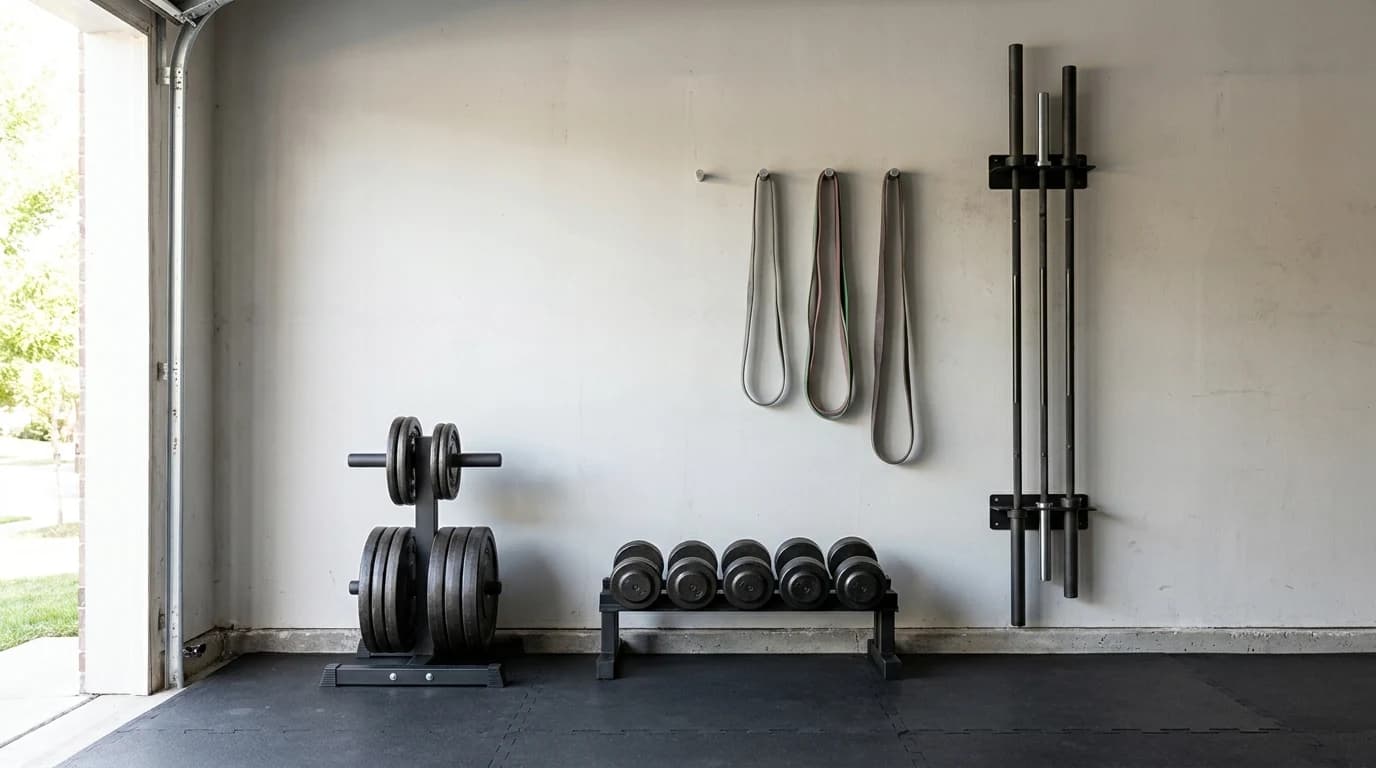
Choose storage that avoids the exposure your maker prohibits. B-LINES’ care instructions warn against extreme temperatures, direct sunlight, nearby heat sources and abrasive or sharp objects. For a garage that gets very hot or cold, an indoor cupboard can make more sense than leaving bands next to the weights all year.
The useful decision is where the bands actually spend the day. A storage solution can be visually neat while putting the elastic beside a sunny window or rough metal hook. Do not prioritize matching the gym's display wall over the care instructions.
Storage that supports inspection:
- A dedicated indoor box with each band identifiable
- A smooth compartment separate from sharp accessories
- Handles and anchors kept visible rather than buried
- A separate marked area for equipment awaiting support advice
Storage habits to change:
- Leaving bands permanently stretched around equipment
- Mixing suspect bands with the usable set
- Choosing a location beside a heater or in direct sun
- Putting elastic against rough edges to save drawer space
Keeping bands relaxed and individually accessible is our organization recommendation, not a measured promise of additional lifespan. We have not tested storage systems or established a temperature threshold for every band material. If your manufacturer provides an exact storage range, use that range rather than a general rubber-storage chart.
Hooks and drawers solve different space problems
A drawer makes sense if you want the bands protected from light and out of the way. Smooth hanging storage can make inspection and selection easier, provided the band rests without being stretched or pressed against a damaging edge. Neither format is inherently a warranty-approved solution for every model.
Before adding a hook, check its contact surface and the band maker's directions. Before filling a box, reserve enough room to retrieve one band without dragging it over clips or metal handles. Our small-space gym storage guide covers the rest of the equipment; bands benefit from their own compartment even inside a shared cabinet.
How should you clean bands before putting them away?
Follow the maker's cleaning directions. There is no universally appropriate conditioning product. B-LINES directs a damp cloth and prohibits soap or chemicals on its bands. Bodylastics names a particular third-party cleaner and conditioner in its FAQ. These instructions are different, so copying one routine across every band in a mixed kit is poor maintenance.
Record the care instructions once where you can find them. A short note with the model, cleaning method and support link is more useful than a reminder saying clean bands. Check textile handle and anchor directions separately if their care differs from the elastic.
Do not interpret a cleaning instruction as a repair instruction. Washing a band does not resolve a cut, and applying a conditioner does not reverse a stop-use warning. If the problem is structural, remove the item from the usable set.
When should you replace resistance bands?
Visible damage and the exact maker's replacement directions matter more than a generic annual schedule. THERABAND recommends replacement every one to two months under heavy use such as a physical therapy clinic. That is not evidence that every lightly used home band expires at the same interval, or that an old home band is safe because it has not reached a calendar deadline.
Use an inventory note to make replacement decisions easier:
- Identify the model and approximate purchase date.
- Save its instructions and support contact.
- Note damage or unusual changes when discovered.
- Remove the questionable item from regular storage.
- Replace or return it according to the maker's guidance.
The purchase date helps identify the product and warranty; it does not replace inspection. Even a new band can have a defect. An old band with no obvious defect still needs the checks its maker specifies.
Find the source of an edge cut before replacing the band
Serious Steel links edge cuts to rubbing against plastic or metal edges. Replacing the band while retaining the same damaging contact can leave the cause untouched. Check where the band traveled, then follow the maker's instructions for the anchor or protective interface.
Do not buy a stronger band to solve a storage or abrasion problem. Choose resistance for the exercise and fix the contact problem separately. Our guide to building muscle with bands addresses training; it assumes equipment suitable for use, not a band you are hoping will last one more session.
Frequently Asked Questions
Can I store resistance bands in the garage?+
Follow the exact maker’s temperature and light instructions. If the garage exposes bands to extreme temperatures, direct sunlight or heat sources, choose indoor storage instead.
Should I replace a resistance band with cracks?+
Stop using a cracked band. THERABAND treats visible wear as a replacement signal, and Bodylastics tells owners not to use bands with cracks or splits.
Does white powder mean resistance bands are damaged?+
Bodylastics identifies a whitish talc coating on its latex as cosmetic. That explanation does not clear cracks or splits, and it should not be generalized to an unidentified band.
Sources & Research
- Performance Health / THERABAND — Inspection and replacement guidancemanufacturer
- Serious Steel Fitness — Layer peeling and edge cuts FAQmanufacturer
- Bodylastics — Talc coating, cracks and product care FAQmanufacturer
- Beachbody / B-LINES — Care, storage and complete-system inspection instructionsmanufacturer
Related reviews

Best Resistance Bands for Home Gyms in 2026: Bodylastics Wins
Bodylastics wins best resistance bands for home gyms with its stackable tube system; Rogue Echo tops premium loops. Five systems ranked on durability.
Home Gym Storage: Where to Put Plates, Bars, and Dumbbells
Store home gym gear by weight, not type: heavy stays low, bars and bands go vertical. Where plates, dumbbells, and accessories belong in a small space.
Do Resistance Bands Actually Build Muscle? The Science
Yes - meta-analyses show resistance bands match free weights for strength in most lifters. The evidence, the mechanism, the hard ceiling, and how to train.
Hilly Shore Labs
Editorial teamThe independent product research team behind GymScored. Every recommendation is researched, never hands-on tested — recommendations draw on manufacturer specifications and available published research. Category order is editorial; the Gym Score is a separate comparison aid.
161 listed products across 26 home gym categories. Scores use category criteria, value and owner-rating inputs; missing evidence limits what a score can tell you.
See the scoring methodology and who we are.
Affiliate disclosure: GymScored is a participant in the Amazon Services LLC Associates Program. We earn from qualifying purchases at no extra cost to you. Full disclosure →