 Premium Pick
Rank #3 in Foam Rollers & Mobility Tools
RumbleRoller Original
by RumbleRollerOptional
Score
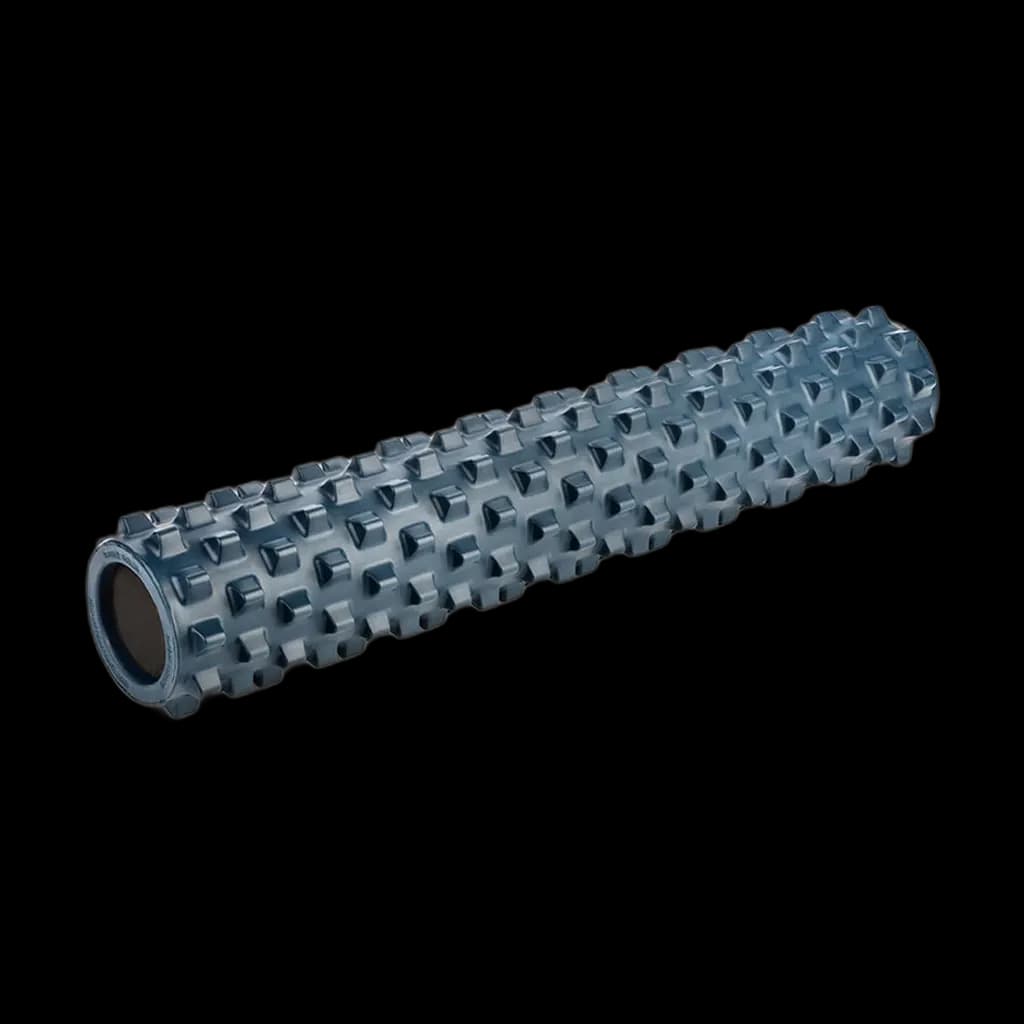
Spiked-surface roller for users who want aggressive trigger-point work. The bumps mimic finger pressure and reach deeper than smooth rollers. Polarizing — beloved or painful, no in-between.
- Intermediate-to-advanced users with established rolling tolerance
- Targeted trigger-point release on glutes, piriformis, IT band, lats
- Athletes whose muscle density makes smooth rollers feel ineffective
- Users who specifically want aggressive bump-pattern pressure
- Recovery tools for chronic upper-trap and rhomboid tightness
- You are new to foam rolling (start with TriggerPoint GRID first)
- You are pregnant or have unexplained abdominal or pelvic pain
- You have acute injury, herniated disc, or recent surgery on the affected area
- You have low pain tolerance or anxiety around discomfort
- You have osteoporosis or known bone fragility
A 4 by 6 foot floor space. The 31-inch version stands taller in a corner; the 22-inch stores like a standard roller.
none — Out of the box ready to use. No tools, no charging, nothing to assemble.
Best used post-lift or on rest days for sustained trigger-point work. Pre-lift use is fine for warmed-up tissue, but new users should not do aggressive bump-pattern rolling cold.
Strengths
- ↑Aggressive trigger-point release
- ↑Reaches deeper than smooth rollers
- ↑Durable EVA build
Weaknesses
- ↓Painful for beginners
- ↓Not for sensitive areas
What owners actually complain about
Synthesized from owner reviews and community threads. Paraphrased, not quoted.
- Painful for beginners; multiple users report giving up and returning to a smooth roller
- Bumps leave temporary red marks on skin (not bruises, just compression marks)
- Not appropriate for direct lower-back work over the spine
- EVA bump pattern eventually rounds down after 5+ years of heavy use
- 31-inch length is awkward to store in small home gyms
Buyer sentiment
Based on 999 user mentionsBuyers praise effectiveness, quality, pain relief and deep tissue massage. Mixed feedback on firmness and value for money. Some flag pain.
Verdict: The aggressive bump-pattern roller for intermediate-to-advanced users who've outgrown smooth rolling — the wrong starter for everyone else.
Specs that matter
| Spec | Value |
|---|---|
| Lengths | 22 in (standard), 31 in (thoracic) |
| Material | Dense EVA over closed core |
| Firmness | Original (most users) or X-Firm (therapist-grade) |
| Lifespan | 5–10 yr heavy daily use |
What you get
- Targeted bump pressure — mimics fingertips on dense tissue
- Effective on stubborn glutes, IT bands, lats
- Holds shape under load for years
What you give up
- Genuine discomfort — painful on unconditioned tissue
- Wrong for beginners — needs a 2–3 wk tolerance build
Buy it if you've plateaued on a smooth roller and want deeper release. Skip it if you're new to rolling — start with a TriggerPoint GRID.
Per NIH and ACSM, bump vs smooth rollers show no strong difference in measurable ROM/soreness outcomes — keep doses to 30–90 sec/muscle and never roll the lumbar spine.
Full specs
- Length
- 22" or 31"
- Diameter
- 6"
- Material
- EVA with bump pattern
Common questions
Is the RumbleRoller worth the extra pain?
Only if you have built tolerance on a smooth roller first and find it insufficient. For most users a TriggerPoint GRID is plenty. The RumbleRoller is the upgrade for users who specifically want deeper, more targeted pressure.
Will the bumps bruise me?
Not typically. They leave temporary red compression marks that fade in 30-60 minutes. True bruising suggests you are pressing too hard or staying too long. The NIH guidance of 30-90 seconds per muscle group applies more strictly here.
22-inch or 31-inch?
22-inch for most users; covers all standard rolling movements. The 31-inch is for users who want to lay full back across the roller for thoracic mobility work.
Can I roll my lower back on this?
No. The bumps over the lumbar spine are aggressive enough to be genuinely uncomfortable and potentially harmful. Roll glutes and lats instead, which is where most lower-back tightness refers from anyway.
Will it help with sciatic-style pain?
Possibly, if the issue is referred from a tight piriformis or glute. Not a substitute for medical evaluation if you have radiating leg pain. See a physician before using aggressive pressure tools on pain you do not understand.
Sources & references
- Foam rolling effects on flexibility and performance (NIH PMC)
- Mayo Clinic on muscle soreness recovery
- r/HomeGym RumbleRoller threads
- ResearchCheatham et al. (2015), self-myofascial release with a foam roll or roller massager: a systematic review (IJSPT)— NIH / NCBI PMC
- Garage Gym Reviews: best foam rollers— Garage Gym Reviews
Full buying guide
Best Foam Rollers for Recovery in 2026: TriggerPoint Grid Wins
Read the full ranking →Related Foam Rollers & Mobility Tools guides
Other foam rollers & mobility tools we rate
Ranked alternatives from the same category, with our score and the current price.
The benchmark hollow-core EVA roller. Multi-density surface mimics thumbs/fingertips/palms, hollow core makes it lighter, and the build outlasts decade-old usage reports. The default starting roller for a reason.
The vibrating step: a 12 x 5 inch high-density EVA roller with a wave-textured surface, five vibration settings adjustable in the Therabody app, and a Therabody-stated 180-minute battery. It costs several times a plain roller, and the vibration is what that money buys; the rolling itself is the same job the GRID does.
The cheapest roller that doesn't compress flat. Plain high-density EPP foam, no surface texture, available in 12-36" lengths. Not the best, but the floor for 'actually works.'
The trigger-point step: two solid-rubber, lacrosse-size balls for the glutes, pecs, feet and upper back, the spots a roller is too broad to reach. Sold by a third-party seller (K Wellness, the seller behind the Kieba brand) at or under the maker's price, and shipped by Amazon.
The PT-clinic standard. Closed-cell foam, 36" length covers full-spine alignment work. Softer density than TriggerPoint — used in physical therapy because beginners and post-surgery patients tolerate it.