Cold Plunge Chiller: What It Costs to Run vs Ice
A cold plunge chiller swaps ice for electricity and adds filtration. Priced from published ice and power rates: payback is 4-5 years, not the sales pitch.
A chiller is worth it if you want cold water available on demand and want filtration handled by a circulation loop; it is not worth it as a money-saving move. At 18.8 cents per pound for bagged ice and 18.34 cents per kilowatt-hour for electricity, a standalone chiller costing $3,490 to $4,000 pays back in four to five years for someone holding an insulated 94-gallon tub at 50°F, and in about two years for someone who lets the tub warm to room temperature between three sessions a week. Sizing is less dramatic than the marketing suggests: half a horsepower holds temperature in almost any insulated tub under 100 gallons, and the extra horsepower buys faster pull-down, not a colder floor.
How GymScored is paid: Amazon Associates commission plus brand-direct affiliate (Rogue / REP / Titan when approved). No sponsored placements, no paid reviews, no pay-to-rank. Picks are ranked by the Gym Score formula and nothing else. Read the full disclosure.
A standalone chiller saves roughly $16 a week against holding an insulated tub cold with ice, so it takes four to five years to pay for itself. Buy it for the filtration loop and for never hauling ice again, not because the arithmetic says it is free.
A week of cold, four ways
A model, not a measurement. Assumes a 94-gallon insulated tub with a lid at 50°F in a 70°F garage; water at 8.35 lb per gallon from the USGS density figure; ice at 144 BTU per lb heat of fusion (80 cal/g, HyperPhysics) plus sensible warming to 50°F; heat leak estimated from the Ice Barrel 500's stated R16 insulation over its stated dimensions; ice at 18.8 cents per lb (Walmart, Reddy Ice 10 lb, read August 2026); electricity at 18.34 cents per kWh (EIA Electric Power Monthly, June 2026). The chiller row assumes a 40 to 80 watt circulation pump running continuously, which dominates the compressor draw in a well-insulated tub.
| Approach | Ice per week | Ice cost | Electricity | Weekly total |
|---|---|---|---|---|
| Ice, held at 50°F all week | 99 lb (10 bags) | $18.57 | None | $18.57 |
| Ice, re-chilled from 65°F three times a week | 219 lb (22 bags) | $41.17 | None | $41.17 |
| Ice, re-chilled from 65°F once a week | 73 lb (7 bags) | $13.72 | None | $13.72 |
| Chiller, held at 50°F all week | None | None | 8.8 to 15.5 kWh | $1.62 to $2.86 |
| First fill from a 70°F hose, ice only | 97 lb (10 bags) | $18.21 | None | One-time |
Chiller or ice, by how you actually plunge
Decide by your situation, not the generic ranking.
| If | You want | Pick |
|---|---|---|
| Daily, insulated tub, temperate garage | Whether the chiller pays for itself | It does, in about four and a half years. Buy it to stop hauling 100 lb of ice a week, not to save money |
| Two or three times a week, tub left to warm up | A cheaper way to run ice | Hold the tub cold instead of re-chilling it. Holding costs less than half what repeated pull-downs cost |
| Uninsulated inflatable tub | Which chiller to bolt on | Neither. A chiller runs continuously against an uninsulated tub. Insulation is the cheaper fix |
| Hot climate, outdoor placement | More horsepower to hold temperature | Half a horsepower holds an insulated tub almost anywhere. Spend on shade for the condenser and a bigger circuit instead |
| Sharing the tub across a household | Any of the above | Size for pull-down speed, and read the water guide first. Bather load drives hygiene, not cooling cost |
Every cold plunge chiller page makes the same argument: ice is a recurring cost, a chiller is a one-time cost, so the chiller pays for itself. It is a checkable claim. Ice has a published price, electricity has a published price, and the physics of melting ice has been settled for two centuries. Nothing here requires a testimonial.
So we ran it. The payback is real but slow — four to five years for a typical daily user. The chiller is worth buying anyway, for a reason the payback math never mentions.
What a cold plunge chiller actually does — three jobs, not one
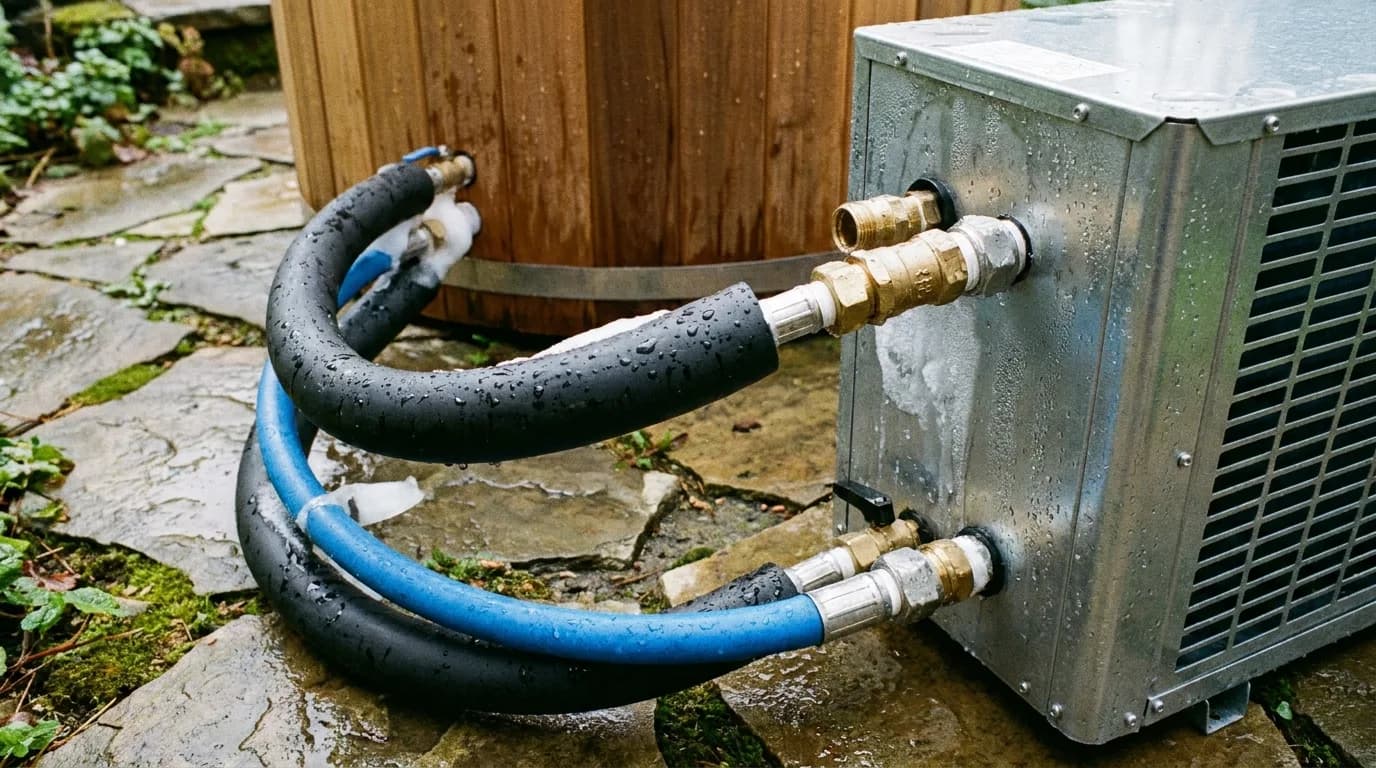
A cold plunge chiller is a small vapor-compression refrigeration unit plumbed into a loop with the tub. Water leaves the tub, passes through a heat exchanger, and returns colder. That loop does three distinct jobs, and buyers usually only price the first.
- Pull-down — getting tap water from wherever it starts to your setpoint. That is the job ice does too, and the one the cost comparison is about.
- Holding — once the water is cold, something has to keep removing the heat leaking in through the walls and lid all day. A chiller cycles on and off to do it; ice does it by melting, continuously, whether or not anyone uses the tub.
- Circulation — almost every chiller pushes water through a filter on its way past the compressor, and most add ozone. That is a hygiene feature, not a cooling one, and hygiene is where manual-ice tubs actually fail, because a still tub has to be drained on a schedule you have to remember. Our cold plunge water guide covers why pool-chemistry advice under-delivers at plunge temperatures.
Reframe the purchase: price the chiller as a filtration system that also makes cold, and it stops looking like an expensive way to avoid a supermarket trip.
The two published numbers that settle the efficiency question
You do not need a wattmeter to know roughly how efficient these units are. Manufacturers publish enough to derive it.
Plunge lists its standalone Pro Chiller as a 0.75 HP unit that cools at 12.5 degrees per hour and requires a dedicated 120V 15A circuit. Its specifications page puts the matching tub at roughly 105 gallons.
Work it through. Water weighs about 8.35 lb per gallon, so 105 gallons is about 876 lb. Dropping that by 12.5°F in an hour means removing about 10,950 BTU per hour, or roughly 3,210 watts of heat. A dedicated 15A/120V circuit tops out near 1,440 watts of continuous draw. So the unit moves at least 2.2 times more heat than it consumes in electricity, and likely closer to 2.5 or 3 in practice.
That ratio is the whole reason a chiller beats ice on running cost. It is also modest — a small air-cooled system working against a large temperature difference, not a miracle.
What a week of cold actually costs
Two prices we looked up rather than remembered: Walmart lists a 10 lb bag of Reddy Ice at 18.8 cents per pound, and the EIA put the average US residential electricity price at 18.34 cents per kilowatt-hour in its June 2026 Electric Power Monthly. Applied to the same 94-gallon insulated tub held at 50°F:
| Usage pattern | Ice needed | Ice cost per week | What a chiller saves |
|---|---|---|---|
| Daily plunge, tub held cold | About 14 lb a day | About $18 | About $16 a week, net of electricity |
| Three sessions a week, tub warms in between | About 73 lb per fill | About $41 | About $38 a week, net of electricity |
Both ice figures are the row's stated quantity at the 18.8 cents per pound above. Three things fall out of it, and two are not what the category tells you.
Holding cold is cheaper than re-chilling from ambient
This is the counterintuitive one. An insulated, lidded tub bleeds heat slowly — on the order of 95 BTU per hour at a 20-degree difference — which works out to roughly 14 lb of ice a day, about one bag, to hold the line. Let that same tub drift back to room temperature and you pay the full pull-down again, and the full pull-down on 94 gallons is around 73 lb of ice.
So the person who plunges three times a week and lets the tub warm up in between spends more than twice as much on ice as the person who plunges every day and never lets it warm up. Per-session ice cost goes down as frequency goes up. That inverts the usual advice to "try it a couple of times a week first and see."
Your tap temperature is the biggest single lever
Municipal cold-water temperature swings hugely by season and region. Filling an 88-gallon tub from a 75°F summer hose and chasing 50°F takes roughly 113 lb of ice. Filling from a 55°F winter tap and chasing the same 50°F takes about 23 lb.
A five-fold swing in operating cost, caused by nothing you control. It is why owner reports of two or three bags a session and of eight bags a session are both honest — they describe different months.
The bather is a rounding error
A three-minute immersion transfers on the order of 250 BTU from a body into the water — under 2 lb of ice. Bather load matters enormously for water hygiene, which is the subject of the water guide, and it barely registers on the cooling bill. What costs you money is the tub's insulation and the ambient temperature around it, not how much you use it.
The payback, stated honestly
A standalone chiller runs roughly $3,490 to $4,000 at the two brands we checked — Plunge's Pro Chiller at $3,490 (list $3,990) and the Ice Barrel Chiller at $3,999.99.
- Against a daily user holding an insulated tub cold with ice: about $16 a week saved, net of electricity. Payback four and a half to five years.
- Against the three-sessions-a-week, let-it-warm-up pattern: closer to $38 a week saved, and payback in about two years.
Neither of those is the "pays for itself" story the category tells, and the four-year number is the honest one for most buyers, because most buyers who own a chiller do hold the tub cold.
The case for a chiller is not the money. It is that ten bags of ice a week is roughly 100 lb you have to buy, carry, and dump — every week, forever — and that friction is what actually ends most cold plunge habits. You are buying the absence of an errand, plus a filtration loop you would otherwise have to run manually.
If your budget will not stretch to a chiller, the honest move is not a cheaper chiller. It is an insulated tub and a commitment to holding it cold, which is the cheapest form of ice plunging there is. Our home cold plunge roundup and the cold plunge category page cover the tubs that do that well.
Sizing: horsepower against volume
Chiller marketing pushes horsepower hard. The sizing question is actually two questions, and they have different answers.
Holding is easy. That same insulated 94-gallon tub needs under 100 BTU per hour to hold 50°F in a 70°F garage — about 30 watts of heat removal. Even outdoors in a 95°F summer holding 39°F, the leak is only a few hundred BTU per hour. Any half-horsepower unit clears that with enormous margin. If a salesperson tells you a 1/2 HP chiller cannot hold temperature in a hot climate with a well-insulated tub, the arithmetic disagrees.
Pull-down is where horsepower shows. A 0.75 HP unit moving 12.5°F per hour needs about two hours to take 105 gallons down 25 degrees. A 1/2 HP unit on the same tub needs roughly three. If you are refilling weekly, that difference is a scheduling annoyance. If you are refilling daily, it decides whether the tub is ready when you are.
So the practical rule is: size for how you refill and how bad your insulation is, not for your climate.
- Under about 100 gallons, insulated tub, weekly-ish refills: 1/2 HP is genuinely enough.
- Over about 120 gallons, or an uninsulated tub, or several people using it across a day, or an outdoor unit in real summer heat: step up to 1 HP. Plunge's All-In uses a 1 HP unit and asks for a 120V 20A circuit rather than 15A, which is the more consequential spec — a 20A circuit is often the part that needs an electrician.
- Any uninsulated inflatable: a chiller will run more or less continuously and still struggle. Fix the insulation first. That trade-off is the whole subject of our portable cold plunge tub guide.
Indoor or outdoor, and the install questions nobody asks first
A chiller is air-cooled, so it dumps the heat it removes from the water into the room it sits in.
Indoors, the constraints are: clearance around the condenser, compressor noise near a wall you care about, and a floor drain for water changes.
Outdoors, they are: direct sun on the condenser, which derates it exactly when you need it most, and a freeze plan, because water in an unheated loop can split it.
Three things to settle before ordering:
- The circuit. Manufacturers are specific about this: Plunge asks for a dedicated 15A circuit for the Pro Chiller and a 20A circuit for the All-In; Ice Barrel lists its chiller at roughly 115V with a 15A maximum overcurrent protection rating. Dedicated means dedicated. A garage circuit shared with a freezer or a compressor will trip.
- The plumbing. Retrofit chillers connect by hose. Ice Barrel's barrels use 3/4-inch NPT ports, which is standard plumbing size and why third-party tubs advertise compatibility. Check the fitting before you assume a chiller will bolt onto the tub you already own.
- The drain. Whatever the filtration, the water gets changed. Plan where 94 gallons goes before it is in the tub.
Maintenance, briefly
Filter cartridges are the routine item; ozone modules are the periodic one. Neither removes the need to test the water.
Filter cartridges are routine, ozone modules periodic. Ozone and UV both treat water as it passes through the plumbing and leave no residual in the tub itself, which is the single most misunderstood point in this category and the reason the water guide exists.
Buying a standalone chiller
We have no verified picks for standalone chillers beyond the two brand-direct units named above, and we will not invent them — the segment is full of rebadged aquarium and hydroponics chillers sold under new names with unverifiable specs. What to check, in order:
- Published cooling rate on a stated volume. A horsepower figure with no degrees-per-hour on a named tub size tells you nothing.
- Circuit requirement, stated in amps, and whether it must be dedicated.
- Whether filtration and sanitation are in the loop or sold separately.
- Fitting size and whether it matches your tub.
- Warranty length on the compressor specifically, not on the enclosure.
For tubs, including the ones with the chiller already integrated, start at the cold plunge category page.
Before you plunge at all
Cold water immersion is a real cardiovascular event, not a wellness accessory. The Cleveland Clinic lists heart disease, high blood pressure, diabetes, pregnancy, peripheral neuropathy, poor circulation, venous stasis and cold agglutinin disease as conditions that warrant talking to a doctor first, and warns that cold water can trigger uncontrolled hyperventilation that becomes dangerous if it causes dizziness or fainting while you are in the water. Harvard Health is blunter about the cardiac case: people with cardiovascular disease, especially heart rhythm abnormalities, should avoid the practice.
Cleveland Clinic also puts numbers on a sane starting dose — 50 to 59°F for beginners, never below 40°F, sessions under five minutes. Our cold plunge protocol guide covers dose and timing around lifting. None of this is medical advice, and if any of those conditions apply to you, the chiller decision is not the first one to make.
Frequently Asked Questions
Is a cold plunge chiller cheaper than buying ice?+
Eventually, but slowly. At 18.8 cents per pound for bagged ice and 18.34 cents per kilowatt-hour for electricity, holding a 94-gallon insulated tub at 50°F costs about $18.57 a week in ice versus roughly $1.60 to $2.90 a week in electricity. A standalone chiller at $3,490 to $4,000 therefore takes four to five years to pay back. The payback drops to about two years only for people who currently let the tub warm to room temperature between sessions, because repeated pull-downs are the expensive pattern.
What size chiller do I need for my cold plunge?+
Half a horsepower is enough to hold temperature in essentially any insulated tub under about 100 gallons, in almost any climate, because an insulated lidded tub only leaks on the order of 100 BTU per hour. Horsepower buys pull-down speed instead: a 0.75 HP unit rated at 12.5 degrees per hour takes about two hours to drop 105 gallons by 25 degrees. Step up to 1 HP for tubs over about 120 gallons, uninsulated tubs, several users across one day, or outdoor units in real summer heat, and check whether that unit needs a 20-amp circuit rather than 15.
Does a chiller keep the water clean?+
It helps, indirectly. Most cold plunge chillers push water through a filter and often an ozone module on the way past the compressor, which is a genuine hygiene advantage over a still tub. But ozone and UV leave no disinfectant residual in the water you are sitting in, so a circulation loop reduces how often you drain rather than removing the need to test. Our water guide covers what to test for and why cold water needs roughly four times the chlorine contact time that 77°F water does.
How much electricity does a cold plunge chiller use?+
Less than most people expect in a well-insulated tub, and the circulation pump rather than the compressor is usually the larger share. Holding a 94-gallon insulated tub at 50°F in a 70°F room requires removing only about 30 watts of heat, which a chiller at a conservative efficiency does for under 15 watts of electrical draw. A pump running continuously at 40 to 80 watts adds far more. The realistic total is roughly 1.3 to 2.2 kilowatt-hours a day, or about $7 to $12 a month at the June 2026 US average rate. Hot ambient temperatures and uninsulated tubs push it up sharply.
Can I add a chiller to a tub I already own?+
Often yes, if the tub has hose ports. Ice Barrel's barrels use 3/4-inch NPT ports, which is a standard plumbing size, and Plunge sells its Pro Chiller as a standalone unit that pairs with several of its own tubs. Check three things before ordering: the fitting size, the circuit the chiller requires and whether it must be dedicated, and whether filtration is in the loop or sold separately. An uninsulated tub is the case where a retrofit disappoints, because the chiller ends up running continuously.
Indoors or outdoors for the chiller?+
Both work, with different costs. A chiller is air-cooled, so indoors it dumps the heat it removes from the water into the room, needs clearance around the condenser, makes compressor noise, and wants a floor drain nearby for water changes. Outdoors it needs shade on the condenser, since direct sun derates it exactly when demand is highest, and a winter plan, because water left in an unheated loop can freeze and split it.
Sources & Research
- US EIA — Electric Power Monthly, Table 5.6.A — average price of electricity to ultimate customers; US residential average 18.34 cents per kilowatthour, June 2026
- Walmart — Reddy Ice 10 lb bag of ice — listed at $1.88, or 18.8 cents per pound, read August 2026
- HyperPhysics, Georgia State University — Heat of fusion — the value of 80 calories per gram used for melting ice, and the worked ice-bath cooling example
- USGS Water Science School — Water density — 62.424 pounds per cubic foot at 39.2°F, the basis for the 8.35 lb per gallon figure
- Plunge — Pro Chiller product page — $3,490 (list $3,990), 0.75 HP, 37°F floor, 12.5 degrees per hour, dedicated 120V 15A circuit, ozone plus 20-micron filter
- Plunge — Model specifications — The Plunge at 1/2 HP, 39°F and 120V/15A; the All-In at 1 HP, 37°F and 120V/20A; both about 105 gallons with a 20-micron filter plus ozone
- Ice Barrel — Ice Barrel Chiller — $3,999.99, true 1/2 HP, maintains 37°F, roughly 115V 60Hz with a 15A maximum overcurrent rating, connects to tubs with 3/4-inch hose ports
- Ice Barrel — Ice Barrel 500 — 94 gallons, R16 polyurethane insulation, 3/4-inch NPT chiller ports, 104 lb empty, limited lifetime warranty, chiller sold separately
- Cleveland Clinic — Are cold plunge ice baths good for you? — conditions warranting medical consultation, the hyperventilation risk, 50 to 59°F for beginners, never below 40°F, and sessions under five minutes
- Harvard Health — Cold plunges: healthy or harmful for your heart? — cold water raises heart rate and blood pressure, and people with cardiovascular disease, especially rhythm abnormalities, should avoid the practice
Related reviews
Best Cold Plunges for Home Use
Plunge wins best home cold plunge on its full stack; Ice Barrel on price, Renu Therapy on premium build. Five tubs scored on cooling, hygiene, footprint.
Cold Plunge Protocol: How Cold, How Long, How Often
A safe cold plunge protocol: what temperature to start at, how long to stay in, weekly frequency, timing around lifting, and what cold does not do.
Cold Plunge Water: How Often to Change It, and Why
Cold water slows chlorine as much as it slows bacteria. What the CDC and EPA numbers mean for a home cold plunge, and the signal that says drain it.
Hilly Shore Labs
Editorial teamThe independent product research team behind GymScored. Every recommendation is researched, never hands-on tested — rankings come from manufacturer specifications, published standards, and aggregated buyer sentiment.
161 products scored across 26 home gym categories, each on the same 5-dimension Gym Score formula.
See the scoring methodology and who we are.
Affiliate disclosure: GymScored is a participant in the Amazon Services LLC Associates Program. We earn from qualifying purchases at no extra cost to you. Full disclosure →