Foam Roller Density and Size: What Actually Matters
Two trials changed one roller spec at a time. Density changed nothing measurable; surface pattern did. How to read length, texture and firmness.
Buy the length and the surface pattern deliberately, and treat density as a comfort setting. In a 2018 randomized trial, 36 adults rolled their quadriceps for two minutes on soft, medium or hard rollers that shared the same surface pattern and 14 cm diameter, and the between-group difference was p = 0.78 for knee range of motion and p = 0.37 for pressure pain threshold — all three densities gained 7 to 8 degrees. When the same group instead held density constant and varied the surface, the groups did separate: the smooth roller gained 3 degrees against 6 for the GRID pattern, and its pressure pain threshold change of 14 kPa did not reach significance while the textured rollers gained around 180 kPa. Length is a format decision — a 36-inch roller is the only one you can lie on lengthwise, and a 12-inch one is the only one that packs.
How GymScored is paid: Amazon Associates commission plus brand-direct affiliate (Rogue / REP / Titan when approved). No sponsored placements, no paid reviews, no pay-to-rank. Picks are ranked by the Gym Score formula and nothing else. Read the full disclosure.
Firmness is the spec foam rollers are marketed on and the one a head-to-head trial could not separate: soft, medium and hard rollers built on the same surface pattern and diameter produced statistically indistinguishable changes in knee range of motion and pressure pain threshold, and a second lab found medium and hard rollers gave similar range-of-motion recovery after hard exercise. Surface pattern is the spec that did separate the groups, with the smooth roller producing the smallest range-of-motion gain and a pressure pain threshold change that did not clear noise. Length is not really a performance question at all — it decides which positions are available to you, which is why one brand sells the same five formats in two different densities. Choose format, then surface, then pick the firmness you will actually tolerate.
What happens when you change one roller spec at a time
Every figure is quoted from the study that measured it, read August 2026. The two head-to-head trials share a lab, a protocol and a sample size, and differ only in which spec was allowed to vary — which is what makes the contrast between them readable.
| Study | Design | What varied | Between-group result | Within-group change |
|---|---|---|---|---|
| Cheatham & Stull, IJSPT 2018 | 36 recreationally active adults, 2-minute quad rolling, randomized | Density only — soft, medium, hard; same surface pattern and 14 cm diameter | No significant difference: ROM p = 0.78, PPT p = 0.37 | 7 to 8 degrees ROM and 151 to 180 kPa PPT, in all three groups |
| Cheatham & Stull, J Bodyw Mov Ther 2019 | 36 participants, same 2-minute protocol, randomized | Surface pattern only — smooth, multilevel, GRID; density held constant | Significant difference: ROM p = 0.04, PPT p < 0.001 | Smooth +3 deg and +14 kPa (p = 0.562); GRID +6 deg and +182 kPa |
| Hotta et al., J Bodyw Mov Ther 2021 | 10 active men, 90-minute intermittent shuttle test, 3-day trials | Density — medium versus hard, on the posterior thigh | No difference in ROM recovery between the two densities | Rolling aided ROM recovery; hardness, soreness and creatine kinase unmoved |
| Curran et al., J Sport Rehabil 2008 | 10 healthy adults, thin-film pressure sensors under the lateral thigh | Roller type — multilevel rigid versus conventional foam | Rigid roller significantly higher pressure (p < 0.001), smaller contact area (p < 0.005) | 51.8 kPa over 47.0 cm² versus 33.4 kPa over 68.4 cm² |
| Cheatham et al., J Can Chiropr Assoc 2018 | 25 subjects rated three densities, repeated blindfolded | Density — as a preference and pain-rating question, not a performance one | Preferred roller identical across sessions, p = 1.00 | Pain-rating reliability ICC 0.60 soft, 0.82 moderate, 0.90 hard |
Which spec decides it, by what you are trying to do
Decide by your situation, not the generic ranking.
| If | You want | Pick |
|---|---|---|
| Upper back, thoracic extension, supported chest openers | Length, not firmness — you have to fit on it lengthwise | A 36-inch round; the half round if you want it to stay put under you |
| Legs after running or lifting, at home | Surface pattern, the one spec with a measured between-group difference | A textured 13 to 18-inch roller; smooth only if texture keeps you from using it |
| First roller, never used one, worried it will hurt | Tolerance, which is stable and repeatable enough to shop on | Softer density in a textured pattern, then progress the density later |
| It lives in a suitcase or a gym bag | Format — 12 to 13 inches is the only length that packs | A short hollow-core roller, accepting that two-legged positions get wobbly |
| Foot arches, balance drills, propping a knee or hip | Shape, not density — a round roller is the wrong tool here | A half round, treated as a positioning device rather than a massage tool |
| You want the deepest possible pressure | Contact area, which texture and diameter change and foam hardness does not | An aggressively textured roller, or a ball when you want a single point |
The natural experiment hiding in the literature
Every foam roller listing sells on two things: how firm it is and how long it is. Firmness gets the marketing — high density, extra firm, deep tissue — and a research group at California State University Dominguez Hills tried to isolate it, twice, with almost the same experiment.
Both trials used 36 recreationally active adults, one two-minute rolling session on the quadriceps, an instructional video instead of a coach, and the same two measurements before and after: prone passive knee flexion and pressure pain threshold. The only difference between the studies was which spec was allowed to vary. One varied density. One varied surface pattern.
They did not come back the same, and the one that came back empty is the one the whole category is priced on.
The short version: when firmness was the only variable, nothing separated the groups. When surface pattern was the only variable, the groups separated on both measures. Buy the shape and the surface; treat firmness as a comfort setting.
Spec 1 — Surface pattern, the variable that actually separated the groups
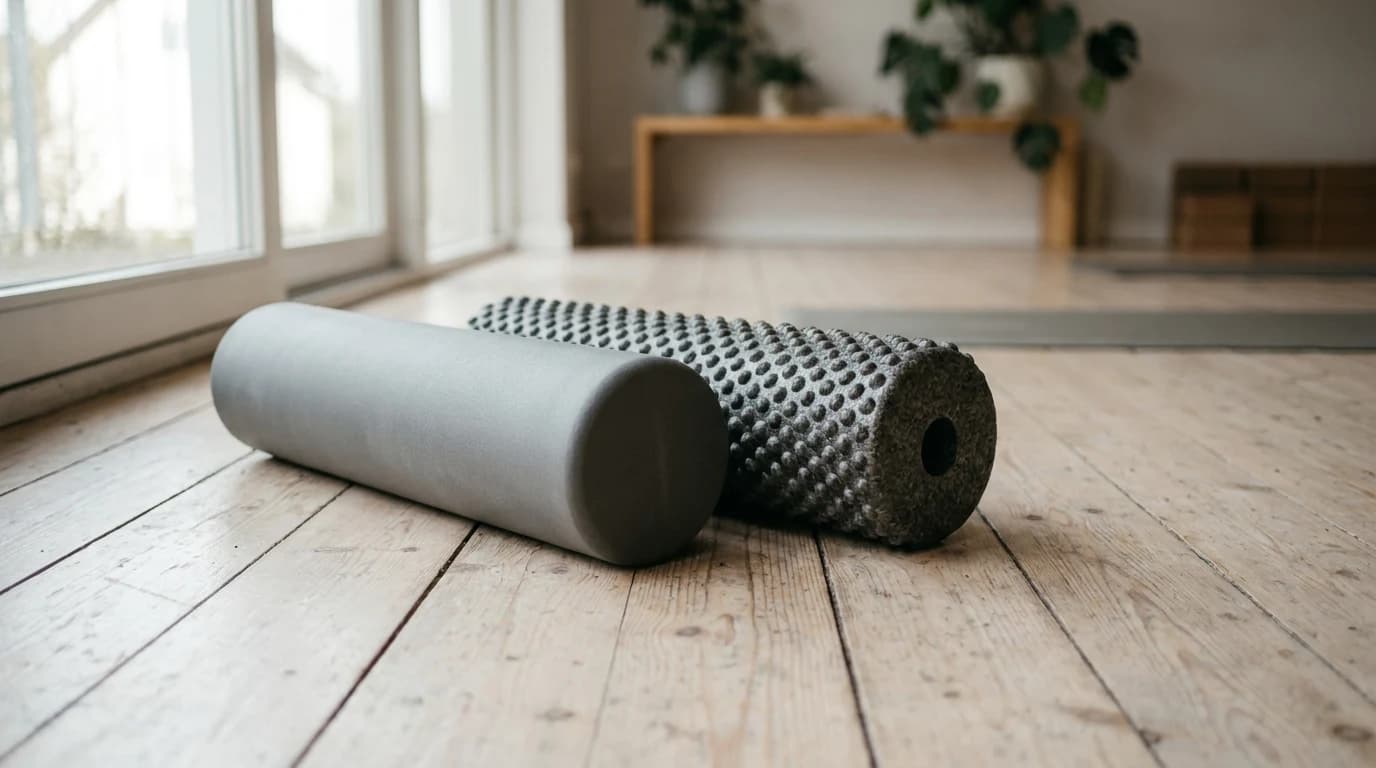
The 2019 trial handed three groups rollers of identical density that differed only in surface: smooth, multilevel, and the GRID pattern. Between-group differences came out significant for range of motion (p = 0.04) and pressure pain threshold (p < 0.001), and the within-group numbers show where the gap opened:
- Smooth surface: +3 degrees of knee flexion, and +14 kPa of pressure pain threshold — which did not clear statistical noise (p = 0.562)
- Multilevel surface: +5 degrees, +179 kPa
- GRID surface: +6 degrees, +182 kPa
The mechanism had been measured eleven years earlier. Researchers put thin-film pressure sensors under the lateral thigh and found a multilevel rigid roller delivered a mean 51.8 kPa against a conventional foam roller's 33.4 kPa, across a contact area of 47.0 cm² versus 68.4 cm². A textured roller is not pushing harder. It is pushing over less of you at a time.
Spec 2 — Density, the variable the trials could not separate
The 2018 study is the cleaner one, because the three rollers were siblings: same GRID surface pattern, same 14 cm diameter, three densities. Soft was a solid EVA roller, medium was a hollow core wrapped in moderately firm EVA — the TriggerPoint Grid Foam Roller build we rank first in the category — and hard was the extra-firm version of the same roller.
Between-group comparison came back at p = 0.78 for range of motion and p = 0.37 for pressure pain threshold. All three worked, and worked alike: 7 to 8 degrees of extra knee flexion and 151 to 180 kPa of pressure pain threshold, whichever one you were handed.
A Japanese lab pushed the question into recovery, running ten active men through a 90-minute intermittent shuttle test and then two minutes of medium- or hard-density rolling on the posterior thigh. Rolling helped range-of-motion recovery; the two densities helped it similarly. Muscle hardness, soreness and creatine kinase were not moved by either.
So what does firmness buy? Three real things, none of them a bigger number:
- Tolerance. A separate study had 25 people rate three densities, then repeat the test blindfolded. Their preferred roller was identical across sessions (p = 1.00), and the pain ratings were most reliable for the medium and hard rollers (ICC 0.82 and 0.90) and least for the soft one (0.60).
- Shape retention. Firmer closed-cell foams and hollow cores hold a circle under repeated loading; cheap open-cell foam goes oval.
- Somewhere to progress to. Starting soft leaves you a step up later. The OPTP PRO-Roller Soft Density exists because clinics need the bottom of that ladder, not because soft rolls better.
Spec 3 — Length and format, the choice nobody markets
The tidiest evidence that firmness and format are independent axes is a catalogue page: OPTP sells its AXIS rollers in five formats — 36 x 6 in, 18 x 6 in, 12 x 6 in, a 36-inch half round and a 12-inch half round — and sells that identical set of five in both a moderate and a firm density. Two separate questions.
| Format | What it unlocks | Where it falls short |
|---|---|---|
| 36 x 6 in | Lying on it lengthwise along the spine for thoracic extension and supported chest openers | Storage, transport, and stability for beginners |
| 18 x 6 in | Quads, hamstrings, calves, lats with less roll-off than a short roller | Cannot support the whole spine |
| 12–13 in | Travel, single-limb work, precise placement | Wobbles under two-legged positions |
| Half round | Foot arches, balance work, propping a joint at an angle | It is a positioning tool, not a rolling tool |
A plain high-density roller sold in several lengths is the honest test of this: one surface at every length, so the only decision left is the one that changes what you can do. The foam roller rankings list the rollers currently in stock.
Where this evidence stops
What these trials do establish:
- One session moved range of motion and pressure pain threshold about equally across soft, medium and hard
- A textured surface beat a smooth one on both measures, same protocol
What they cannot:
- Anything past the immediate post-test — nobody has run soft against firm for eight weeks
- Anything outside quadriceps rolling in ~36 adults per trial, both head-to-head comparisons from one lab
What we would still like to see: a trial that varies diameter rather than firmness. Contact area is the one mechanism with a measured effect, and diameter changes contact area more than foam hardness does — yet no head-to-head we could find has tested it.
Buying it in the order the evidence suggests
- Format first, because it decides what you can do at all. 36 inches if the spine and upper back are the point; 18 inches if it is legs and you want it in a closet.
- Surface second, because it is the spec with a measured difference. Smooth moved range of motion least and left pressure pain threshold statistically unchanged.
- Firmness third, by what you will actually use. Preference turned out to be stable and repeatable even blindfolded — that makes "the one you tolerate" a legitimate criterion, not a cop-out.
- Colour last, and only within one brand. Silver, orange and black meant soft, medium and hard in the 2018 study, and black is the firmest in OPTP's line too — but there is no cross-brand standard we could find, so two black rollers from two makers are not a matched pair.
Aggressive texture at leg length, firm? That is the RumbleRoller Original profile. Textured but civil, short, medium? That is the GRID. Both defensible — neither because of its density number.
Frequently Asked Questions
Does a firmer foam roller work better?+
Not in the trials that tested it directly. A 2018 randomized controlled trial gave 36 adults soft, medium or hard rollers built on the same surface pattern and the same 14 cm diameter, ran a two-minute quadriceps protocol, and found no statistically significant between-group difference for knee range of motion (p = 0.78) or pressure pain threshold (p = 0.37); every group improved by 7 to 8 degrees. A 2021 study comparing medium and hard rollers for recovery after a 90-minute shuttle test reached the same conclusion for range-of-motion recovery. Both are short-window studies, so read them as 'firmness is not the lever' rather than 'firmness is irrelevant forever.'
What size foam roller should I get?+
Pick the length by the positions you want, because length is the spec that decides what is possible. Only a 36-inch roller lets you lie along it lengthwise, which is the position thoracic-extension and supported chest work depend on. An 18-inch roller covers legs, lats and glutes with less roll-off and stores in a closet. A 12 to 13-inch roller is the one that travels, at the cost of stability in two-legged positions. Half rounds are a separate tool again — they are for propping, arches and balance, not for rolling. OPTP sells the same five formats in two different densities, which is a useful reminder that size and firmness are independent decisions.
Is a textured foam roller better than a smooth one?+
It is the one difference the head-to-head research picked up. In a 2019 randomized trial that held density constant and varied only the surface, between-group differences were significant for both range of motion (p = 0.04) and pressure pain threshold (p < 0.001). The smooth roller gained 3 degrees of knee flexion and 14 kPa of pressure pain threshold, the latter not reaching significance, while the multilevel and GRID surfaces gained 5 and 6 degrees and around 180 kPa. Earlier sensor work explains why: a multilevel rigid roller applied 51.8 kPa across 47.0 cm² where a conventional foam roller applied 33.4 kPa across 68.4 cm².
What do foam roller colors mean?+
Inside one brand's line, colour is usually a density code. The 2018 density trial used silver for soft, orange for medium and black for hard within a single manufacturer's range, and OPTP labels its black AXIS roller the firmest, highest-density one in its line with silver as the moderate option. Across brands there is no standard we could find, published or otherwise — a black roller from one maker and a black roller from another are not a matched pair, and neither colour tells you the surface pattern, which is the spec the research actually separated.
What density foam roller should a beginner buy?+
Since the measured outcomes came out the same across densities, comfort is a legitimate way to choose, and it turns out to be a stable preference rather than a mood. In a study of 25 people who rated three densities and then repeated the test blindfolded, the roller each person preferred was identical across sessions (p = 1.00). Start at a density you will use often, in a textured pattern rather than a smooth one, and keep the option of moving up later. A roller you avoid because it hurts produces no range of motion at all.
Sources & Research
- International Journal of Sports Physical Therapy — Cheatham & Stull, Comparison of Three Different Density Type Foam Rollers on Knee Range of Motion and Pressure Pain Threshold, 2018: 36 adults, 2-minute intervention, no significant between-group difference for ROM (p=.78) or PPT (p=.37); rollers shared one surface pattern and a 14 cm diameterresearch
- Journal of Bodywork and Movement Therapies — Cheatham & Stull, Roller massage: comparison of three different surface type pattern foam rollers on passive knee range of motion and pain perception, 2019: significant between-group difference for ROM (p=0.04) and PPT (p<0.001); smooth +3 deg and +14 kPa (p=0.562) versus GRID +6 deg and +182 kParesearch
- Journal of Sport Rehabilitation — Curran, Fiore & Crisco, A comparison of the pressure exerted on soft tissue by 2 myofascial rollers, 2008: multilevel rigid roller 51.8 kPa mean sensel pressure over 47.0 cm² contact area versus 33.4 kPa over 68.4 cm² for a conventional foam rollerresearch
- Journal of Bodywork and Movement Therapies (Waseda University record) — The effect of foam rollers of varying densities on range of motion recovery, 2021, vol 26 pp 64-71: ten active men, medium versus hard density after a 90-minute intermittent shuttle test — foam rolling aided ROM recovery and the two densities provided similar recovery, with hardness, soreness and creatine kinase unaffectedresearch
- Journal of the Canadian Chiropractic Association — Cheatham et al., Roller massage: is the numeric pain rating scale a reliable measurement and can it direct individuals with no experience to a specific roller density?, 2018: 25 subjects, preferred roller unchanged between sighted and blindfolded sessions (p=1.00); NPRS reliability ICC 0.60 soft, 0.82 moderate, 0.90 hardresearch
- OPTP — Silver AXIS Moderate Foam Roller product page: a moderate-density roller sold in five formats — 36 x 6 in, 18 x 6 in, 12 x 6 in, 36-inch half and 12-inch half — the same five formats OPTP lists for its firm-density Black AXIS rollerauthority
- TriggerPoint — GRID 1.0 Foam Roller official product page: EVA foam over a hollow core with the patented GRID surface pattern, the multi-density construction used as the medium-density roller in the 2018 density trialauthority
Your next step
Ready to pick a roller?
Related reviews
Best Foam Rollers for Recovery in 2026: TriggerPoint Grid Wins
The TriggerPoint Grid is the best foam roller of 2026; the Hyperice Vyper 3 is the vibrating pick. Four rollers compared on density and texture.
Foam Roller for Your Back: Where It Helps, Where It Doesn't
The back region people foam roll most is the one certifying bodies say to skip. Where a roller belongs on your back, what to use instead, the evidence.
Best Massage Guns for Recovery in 2026
The Theragun Pro is the best massage gun for recovery in 2026; the Hypervolt 2 Pro runs quieter and Bob and Brad C2 wins value under $150. 9 guns scored.
Hilly Shore Labs
Editorial teamThe independent product research team behind GymScored. Every recommendation is researched, never hands-on tested — rankings come from manufacturer specifications, published standards, and aggregated buyer sentiment.
161 products scored across 26 home gym categories, each on the same 5-dimension Gym Score formula.
See the scoring methodology and who we are.
Affiliate disclosure: GymScored is a participant in the Amazon Services LLC Associates Program. We earn from qualifying purchases at no extra cost to you. Full disclosure →