Foam Roller for Your Back: Where It Helps, Where It Doesn't
The back region people foam roll most is the one certifying bodies say to skip. Where a roller belongs on your back, what to use instead, the evidence.
Roll the upper and mid back, not the lumbar spine. ACE's foam rolling guidance names the lower back as the only place to avoid direct rolling, and Hospital for Special Surgery's own upper-back technique ends the pass just below the shoulder blades. For the low back itself the published substitutes are the roller turned parallel to the spine, the glutes and hips, or a small ball. Foam rolling does not appear anywhere in the American College of Physicians' guideline lists for low back pain, so treat it as comfort rather than treatment, and take persistent or radiating pain to a clinician.
How GymScored is paid: Amazon Associates commission plus brand-direct affiliate (Rogue / REP / Titan when approved). No sponsored placements, no paid reviews, no pay-to-rank. Picks are ranked by the Gym Score formula and nothing else. Read the full disclosure.
Buy the roller for the mid-back, the hips and the limbs, and stop expecting it to reach the lumbar spine. The professional guidance is consistent on the boundary: ACE excludes the lower back by name, Hospital for Special Surgery ends its upper-back pass just below the shoulder blades, and Cleveland Clinic's demonstration never goes lower. The pooled research supports modest range-of-motion gains and a real drop in perceived soreness, both measured on general performance outcomes rather than on backs. A long soft roller plus a small ball covers every position those sources actually publish.
What foam rolling actually moves, in pooled data
Pooled effects from Wiewelhove et al. (2019), A Meta-Analysis of the Effects of Foam Rolling on Performance and Recovery, Frontiers in Physiology. Hedges' g under 0.2 is conventionally a trivial effect. The authors' own summary of the whole set: the effects are “rather minor and partly negligible, but can be relevant in some cases.” These are general performance and soreness outcomes; the analysis does not isolate the back.
| Outcome | When rolled | Pooled change | Effect size (g) |
|---|---|---|---|
| Flexibility | Before exercise | +4.0% | 0.34 |
| Sprint performance | Before exercise | +0.7% | 0.28 |
| Strength | Before exercise | +1.8% | 0.12 |
| Jump | Before exercise | −1.9% | 0.09 |
| Muscle pain perception | After exercise | +6.0% | 0.47 |
| Sprint performance | After exercise | +3.1% | 0.34 |
| Strength | After exercise | +3.9% | 0.21 |
| Jump | After exercise | −0.2% | 0.06 |
Where it hurts, and what actually goes there
Decide by your situation, not the generic ranking.
| If | You want | Pick |
|---|---|---|
| Your upper back and the area between the shoulder blades feels stiff | The technique the clinical sources actually publish | Roller across the spine, elbows drawn together, pass ending just below the shoulder blades |
| Your lower back is what hurts | Something that is not pressing an unbraced spine into the floor | The roller turned parallel to the spine, plus glute and hip work — and a clinician if it persists |
| One deep spot in a glute keeps flaring up | Pressure a six-inch cylinder cannot deliver | A lacrosse-sized ball under one side at a time, not a bigger roller |
| You want the range-of-motion effect before lifting | The use the pooled data actually supports | Short passes on quads, hamstrings and calves before the session |
| You are sore two days after a hard session | The largest measured effect in the meta-analysis | Roll after training and expect reduced soreness, not restored performance |
| You are brand new to rolling | To avoid the first-week overdose | 5 to 10 seconds per area, light pressure, a rest day in between |
The word in the search box is "back." The region usually is not
"Back roller." "Foam roller for back." "Best foam roller for back pain." The roller searches that reach this site cluster hard around one word — and the region people mean is almost always low. The belt line, not the shoulder blades.
The awkward part: the one certifying body that names a region names that one as the exception. ACE's foam rolling primer, by Mollie Martin, an ACE-certified personal trainer and NSCA-certified strength and conditioning specialist, puts it in a single sentence: the only place to avoid direct foam rolling is the lower back, the lumbar spine. The anatomy behind that is not controversial. Each of the twelve thoracic vertebrae carries a rib; the five lumbar vertebrae carry none. Above the line you are pressing a braced structure into the floor. Below it you are not.
The line to remember: stop the pass at the bottom of your shoulder blades. Above that line the rib cage braces your spine against the roller. Below it, nothing does.
Where a roller does belong on a back
Hospital for Special Surgery publishes the boundary as a technique rather than a warning. Polly de Mille, RN, MA, RCEP, CSCS, who directs sports performance there, describes it precisely: hands behind the head, elbows drawn together pointing at the ceiling, then slowly roll down your upper back stopping just below your shoulder blades. Lean onto the right side of the upper back for a few passes, she suggests, then the left.
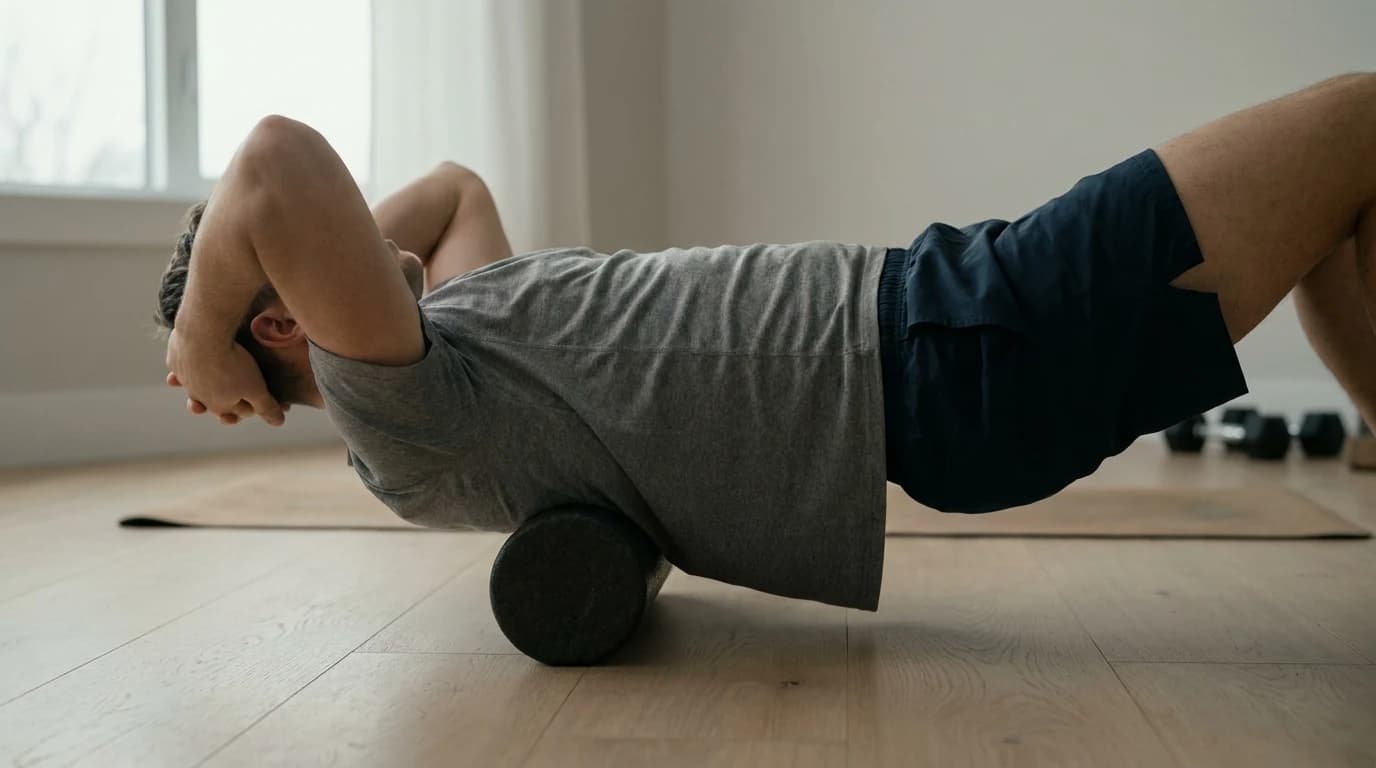
| Where the roller goes | What it is loading | Why this version works |
|---|---|---|
| Across the upper back, roller perpendicular to the spine | Thoracic segments and the muscle either side of them | The rib cage supports the spine against the pressure |
| Lengthwise under the spine, roller parallel | Upper and mid back, glutes and sacrum area | ACE's published substitute for rolling the low back — the load lands beside the spine, not on it |
| Under one glute at a time, ball instead of roller | Glutes and deep hip muscle | A small contact patch reaches tissue a six-inch cylinder skims over |
| Under quads, hamstrings and calves | Long limb muscle | No spine involved, so speed and dwell time are the only variables |
| Side-lying under the lats | Lats and the side of the trunk | Loads muscle rather than vertebrae |
An article promising "your entire back" stops at the shoulder blades
Read three clinical publishers back to back and a pattern shows up that none of them states outright:
- HSS titles its guide "The Right Way to Foam Roll Your Entire Back" — and the instruction ends just below the shoulder blades.
- Cleveland Clinic's explainer, with exercise specialist Ben Kuharik, demonstrates upper-back and between-the-shoulder-blade work and warns about rolling joints such as ankles, knees or elbows because it can hyperextend them. It publishes no low-back roll.
- ACE names the lumbar spine as the one place to skip and hands you a parallel-to-the-spine position instead.
Three organisations, zero published techniques for the region most people are typing into the search box.
If the low back is the part that actually hurts
The American College of Physicians' 2017 clinical practice guideline (Qaseem et al., Annals of Internal Medicine) is worth reading as two lists rather than one.
- What it recommends: for acute or subacute low back pain, superficial heat on moderate-quality evidence, then massage, acupuncture or spinal manipulation on low-quality evidence. For chronic low back pain, exercise, multidisciplinary rehabilitation, acupuncture and mindfulness-based stress reduction on moderate-quality evidence, with tai chi, yoga, motor control exercise and several others behind them.
- What appears in neither list: foam rolling. Not as a first line, not as a qualified maybe, not at all.
Absence from a guideline is not proof that something fails — it means the trials that would place it there have not been run for this region. Treat the roller as comfort rather than treatment, and take persistent, worsening or radiating low-back pain to a clinician.
The honest framing: the roller is missing from the guideline lists, which is not evidence that it fails — only that the trials have not been run. Comfort, not treatment.
What rolling actually buys you
The pooled table above comes from Wiewelhove and colleagues' 2019 meta-analysis in Frontiers in Physiology, and the authors' verdict on their own numbers is blunt: the effects "are rather minor and partly negligible, but can be relevant in some cases." That gives you four honest expectations:
- Flexibility moves a few per cent when you roll beforehand.
- Perceived soreness is the largest single effect, and it shows up when you roll afterwards.
- Jump and strength barely move either direction, before or after.
- All of it is general performance and soreness data. The back is not isolated.
The technique rules the sources agree on
- Roll slowly: ACE's figure for a tender area is 30 to 60 seconds.
- Start shorter if you are new — 5 to 10 seconds per area, rest day between.
- Short passes of two to six inches, core outward, off bones and joints.
- Cleveland Clinic's dosing is one to two minutes per muscle group, session under ten minutes.
- Start light rather than dropping full bodyweight on, and check with a doctor first if you have a broken bone, a torn muscle, or are pregnant.
The gear that matches the map
Four items cover every position those sources publish:
- A long, soft roller for the parallel-to-the-spine position. The OPTP PRO-Roller Soft Density is 36 inches, which is what it takes to support head to sacrum in one line.
- A firm, textured 13-inch roller for limbs. The TriggerPoint Grid Foam Roller is the default for quads, hamstrings and calves.
- A ball for the glutes and hips. A pair of ProsourceFit lacrosse massage balls reaches what the cylinder bridges over.
- A budget full-length option. The Amazon Basics High-Density Foam Roller comes in a 36-inch length if you want the spine-parallel position without a second purchase.
What we cannot tell you
Nobody has run the trial. The meta-analytic evidence was collected on general performance and soreness outcomes rather than on lumbar spines, and the exclusion itself rests on anatomy and professional consensus rather than a randomised comparison of rolling the low back against not rolling it. If that study runs and finds the caution overdone, this page will say so.
Until then the conservative version costs you nothing. ACE's stated rationale for the substitute position is that loosening the muscles around the lower back can decrease pain and increase mobility while protecting the spine — and the glutes, hips and mid-back are all fair game.
Frequently Asked Questions
Can you foam roll your lower back at all?+
ACE's foam rolling guidance names the lower back, the lumbar spine, as the only place to avoid direct foam rolling, and recommends turning the roller parallel to the spine to work the upper and mid back and the glutes and sacrum area instead. Hospital for Special Surgery's upper-back technique stops the pass just below the shoulder blades, and Cleveland Clinic's explainer demonstrates upper-back work without publishing a low-back roll. The consistent professional position is that the region gets worked indirectly, through the muscles around it, rather than by rolling the lumbar spine itself.
What should I use for lower-back tightness instead of a roller?+
The published substitutes are all indirect. ACE positions the roller lengthwise, parallel to the spine, to cover the upper and mid back plus the glutes and sacrum area, with the stated rationale that loosening the muscles surrounding the lower back can decrease pain and increase mobility while protecting the spine. A small ball under one glute at a time reaches deep hip muscle that a six-inch cylinder bridges over. If low-back pain is persistent, worsening or radiating into a leg, that is a clinician's question rather than an equipment question.
Does foam rolling actually help back pain?+
There is no good evidence either way for the back specifically. The largest meta-analysis on foam rolling, Wiewelhove et al. in Frontiers in Physiology, pooled general performance and soreness outcomes and concluded the effects are rather minor and partly negligible, though relevant in some cases. The largest single effect was a 6.0% improvement in muscle pain perception when rolling after exercise. Separately, the American College of Physicians' 2017 guideline for low back pain lists superficial heat, massage, acupuncture, spinal manipulation, exercise and several other options, and does not list foam rolling at all.
How long should I foam roll each area?+
ACE suggests rolling a tender area slowly for 30 to 60 seconds, and starting at just 5 to 10 seconds per area with a rest day between sessions if you are new to it, using short back-and-forth passes of roughly two to six inches while avoiding bones and joints. Cleveland Clinic's exercise specialist gives one to two minutes per muscle group and suggests keeping the whole session under ten minutes. Both advise starting light rather than loading full bodyweight onto the roller immediately.
Sources & Research
- American Council on Exercise — Foam Rolling 101 (Mollie Martin, ACE-CPT, CSCS): “The only place to avoid direct foam rolling is the lower back (lumbar spine),” plus the parallel-to-the-spine substitute and the 30–60 second / 5–10 second dosingauthority
- Hospital for Special Surgery — The Right Way to Foam Roll Your Entire Back (Polly de Mille, RN, MA, RCEP, CSCS, director of sports performance): hands behind the head, elbows together, “slowly roll down your upper back stopping just below your shoulder blades”authority
- Cleveland Clinic — Should You Try Foam Rolling? (Ben Kuharik, exercise specialist): one to two minutes per muscle group, sessions under ten minutes, avoid rolling joints such as ankles, knees or elbows because it can hyperextend themauthority
- Frontiers in Physiology — Wiewelhove et al. (2019), A Meta-Analysis of the Effects of Foam Rolling on Performance and Recovery: pre-rolling flexibility +4.0% (g = 0.34), post-rolling muscle pain perception +6.0% (g = 0.47), effects “rather minor and partly negligible”research
- Annals of Internal Medicine — Qaseem et al. (2017), Noninvasive Treatments for Acute, Subacute, and Chronic Low Back Pain: a Clinical Practice Guideline From the American College of Physicians — recommendation lists that do not include foam rollingresearch
Your next step
Ready to pick a roller?
Related reviews
Best Foam Rollers for Recovery in 2026: TriggerPoint Grid Wins
The TriggerPoint Grid is the best foam roller of 2026; the Hyperice Vyper 3 is the vibrating pick. Six rollers scored on density, texture, and durability.
Best Massage Guns for Recovery in 2026
The Theragun Pro is the best massage gun for recovery in 2026; the Hypervolt 2 Pro runs quieter and Bob and Brad C2 wins value under $150. 9 guns scored.
Should You Warm Up Before Lifting at Home? (And How)
Static stretching before a heavy set costs you strength. The 5-minute dynamic warm-up that works before lifting at home, and what most get wrong.
Hilly Shore Labs
Editorial teamThe independent product research team behind GymScored. Every recommendation is researched, never hands-on tested — rankings come from manufacturer specifications, published standards, and aggregated buyer sentiment.
163 products scored across 26 home gym categories, each on the same 5-dimension Gym Score formula.
See the scoring methodology and who we are.
Affiliate disclosure: GymScored is a participant in the Amazon Services LLC Associates Program. We earn from qualifying purchases at no extra cost to you. Full disclosure →