Weighted Vest Walking Benefits: What Studies Actually Show
Weighted vest walking benefits, claim by claim: what each study measured, in whom, and which of the seven usual claims survive the evidence.
Walking in a weighted vest reliably does one thing: it raises the energy cost of the walk in proportion to the load. In a 2025 trial of 31 young men walking at 5 km/h, a 10 kg vest raised net metabolic rate about 12% over unloaded walking, and a 5% incline in the same vest raised it about three times as much again. Beyond that, the picture divides sharply along one line. Where people trained in a vest, outcomes moved: eight weeks of loaded exercise improved bone density, leg lean mass and physical performance in older women with osteopenia. Where people simply wore a vest through daily life, they did not: a year of daily wear during weight loss produced no hip bone-density or muscle advantage over weight loss alone. Posture improvements are self-reported and did not show up on balance testing, fat loss is not demonstrated, and no study establishes that a vest is easy on knees or backs.
How GymScored is paid: Amazon Associates commission plus brand-direct affiliate (Rogue / REP / Titan when approved). No sponsored placements, no paid reviews, no pay-to-rank. Picks are ranked by the Gym Score formula and nothing else. Read the full disclosure.
Three of the seven benefits people claim for weighted-vest walking survive the evidence: it raises the energy cost of a walk in proportion to load, it raises cardiovascular demand once the walk is hard enough, and it adds a real training stimulus when it is worn during structured exercise. Bone density and strength gains appear only in the studies where people trained in the vest, not in the studies where people merely wore one. Posture is reported rather than measured, fat loss is not shown at all, and joint safety has never been established: the ground-reaction forces a vest adds are the same forces a sore knee already dislikes. Buy one to make a walk you already do harder, in the smallest load increments you can get.
What a vest actually costs you, per step of load
Net metabolic rate and heart rate while walking at 5 km/h on the flat, by vest load, from a 2025 trial of 31 healthy young men (mean body mass 68.5 kg, mean age 20.5). Percent change is computed from the study's own reported means. Because the group averaged 68.5 kg, 10 kg is roughly 15% of body mass for them.
| Vest load | Net metabolic rate (W/kg) | Heart rate (bpm) | Energy cost vs unloaded |
|---|---|---|---|
| None | 3.87 | 111 | baseline |
| 5 kg (11 lb) | 4.09 | 117 | +5.7% |
| 10 kg (22 lb) | 4.35 | 120 | +12.4% |
| 15 kg (33 lb) | 4.80 | 123 | +24.0% |
| 20 kg (44 lb) | 5.07 | 125 | +31.0% |
| 25 kg (55 lb) | 5.54 | 129 | +43.2% |
| 30 kg (66 lb) | 6.29 | 136 | +62.5% |
The short version
- Of the seven benefit claims repeated on nearly every weighted-vest page, three hold up, two hold only under a condition almost nobody states, two are close to unsupported.
- The condition decides everything: wearing a vest is not the intervention — doing something in it is. A 2026 review of 15 studies in adults over 60 found benefits clustered in task-based, progressively loaded programs; low-load wear-only protocols generally showed no measurable musculoskeletal improvement.
- The calorie bump is real and proportional to load, and smaller than expected: 10 kg on the flat cost about 12% more energy. A 5% hill added roughly three times that.
- Nobody has shown a vest is easy on knees or backs. Impact forces rise with the load — the mechanism and the risk in one sentence.
Seven claims, seven verdicts
Every verdict links the study it rests on. Read the third column first: this literature is small, short and drawn mostly from older adults or young men, so each verdict holds in that population.
| Claim | Verdict | Measured in whom |
|---|---|---|
| Burns more calories | Supported | Cost rose at every load step, 31 young men at 5 km/h |
| Raises cardio demand | Past a threshold | In 20 adults, demand rose while running, and while walking only at a 10% gradient |
| Builds bone density | Only alongside exercise | Loaded exercise raised T-score and leg BMD in 31 women with osteopenia; a year of daily wear gave no advantage in 150 older adults |
| Builds leg and core strength | Not from wear alone | INVEST's muscle analysis found every vest-vs-control difference non-significant |
| Improves posture | Felt, not measured | 73% of 34 adults aged 55+ reported better posture; balance tests found no significant effect |
| Burns fat | Not directly | No added fat loss; a pilot of 18 older adults linked wear to preserved resting metabolic rate |
| Easy on the joints | Not established | Both ground-reaction-force peaks and the loading rate rose with load, 10 treadmill walkers |
The line that decides all seven: every positive finding above came from a program with an activity inside it. Every null finding came from wearing one around.
Calories: real, proportional, beaten by a hill
The table at the top is the measured version: 31 healthy young men, mean body mass 68.5 kg, walking at 5 km/h under loads up to 30 kg. Ten kilos — just under 15% of body mass for that group — cost about 12% more energy. Real, and modest.
Here is what the benefit lists leave out. Same vest, same speed, on a grade:
| In a 10 kg vest at 5 km/h | Net metabolic rate (W/kg) | Heart rate (bpm) |
|---|---|---|
| Flat | 3.95 | 130 |
| 5% incline | 5.27 | 146 |
| 10% incline | 6.88 | 162 |
A 5% grade added a third to the cost of the walk; the whole vest, on the flat, added about 12%. Speed did the same — 2.27 W/kg at 3 km/h, 7.42 at 7. These are different sub-groups of the same 31 participants, so read them as conditions rather than a race. The hill is free.
Bone and muscle turn on what you do in the vest
Two verdicts above are conditional rather than yes or no, and this is why.
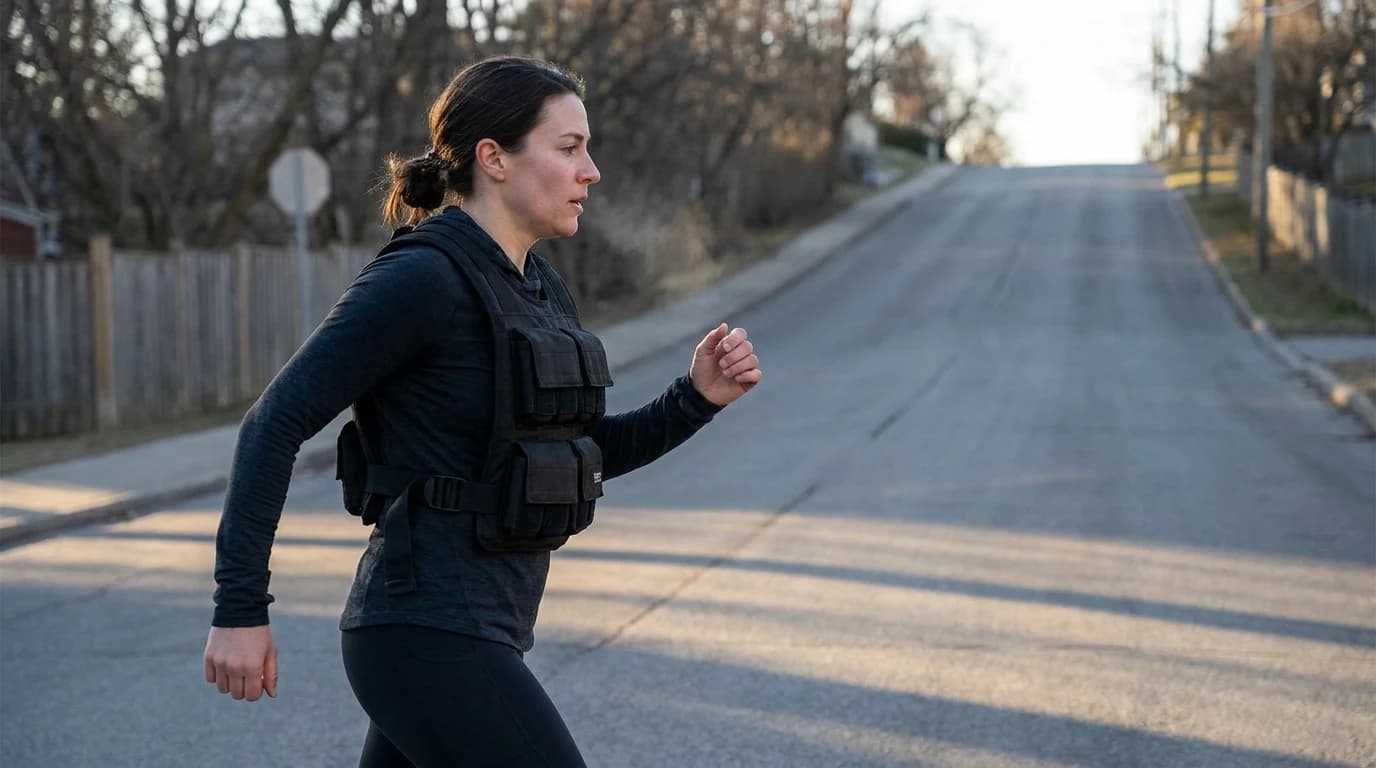
- The positive result is a training study. Thirty-one women aged 60 to 79 with osteopenia did eight weeks of exercise. Those wearing vests gained T-score, leg bone density, leg lean mass and physical-performance scores over those exercising unloaded.
- The null result is a wear study. INVEST randomised 150 older adults to a year of weight loss with or without a vest worn through daily life. Hip bone density did not differ, and neither did muscle — while the resistance-training arm gained mid-thigh muscle area and density.
- A follow-up narrows it. Upright hours tracked with better hip density in the vest arm and the reverse without it — a hypothesis for the next trial, not a plan.
Load selection is a separate question — see how heavy a weighted vest should be, and the fit question in weighted vests and bone density.
The weak claims, and what nobody established
Posture and fat loss are the thinnest entries in the table; joint safety is asserted far more often than sourced. Sorted honestly:
What the data supports:
- It raises the energy cost of a walk in proportion to the load.
- Worn during structured exercise, it adds a measurable training stimulus.
- Through a weight-loss phase it may help hold resting metabolic rate — one pilot, 18 people, so treat it as a lead.
What the data does not support:
- That wearing one around the house corrects posture. The study that asked both got a yes from the participants and a no from the instruments.
- That a vest burns fat as such. Nothing shows it adding fat loss on top of the diet doing the work.
- That any of this generalises from young men on treadmills to a 60-year-old on pavement.
Loading the torso raises both peaks of the vertical ground-reaction force and the rate at which that force arrives — precisely the stimulus a bone study wants, and precisely what an arthritic knee does not.
Ask a clinician first if: you are new to exercise, you have a back or neck injury, or you have arthritis in the hips, knees or ankles. Those are UCLA Health's own caution cases, and its sports-medicine surgeon's line on the bone claim is that the proof is still lacking. The 2026 review separately flags more recorded falls in one trial as a reason for cautious rollout.
A four-week on-ramp
Not research findings — a way to add one variable at a time, so you can tell what is causing what.
- Week 1 — wear it, do not chase it. Two or three walks at normal pace, half your usual distance, a light load. UCLA Health's published starting point is about 5% of body weight.
- Week 2 — restore distance. Same load, normal route, nothing else.
- Week 3 — add the hill, not the plate. Same load, same distance, graded route — the step the data says is worth most.
- Week 4 — then add load. One increment, and only if weeks 1 to 3 left your stride, breathing and knees unchanged.
If your gait changes, the load is wrong for that activity today.
Vests that fit the job
The evidence rewards progressive, task-based use, so the spec that matters is the size of the step you can take, not the ceiling on the box.
| Vest | Price | Load range | Why it suits this use |
|---|---|---|---|
| Sportneer Adjustable Weighted Vest | $53.99 | 2-18 lb, 1-2 lb steps | Small steps, what an on-ramp needs |
| Hyperwear Hyper Vest FIT | $114.95 | To 10 lb, half-pound steps | Finest steps here, cut for a shorter torso |
| RUNmax Pro Weighted Vest | $55.47 | 12-60 lb by model | Headroom for loaded squats and carries |
| WOLF TACTICAL Weighted Vest | $199.47 | Plate carrier, plates included | Rucking-style carries, not daily wear |
Buy for the increment, not the ceiling. A vest whose smallest step is 5 lb forces a jump the research never asked for. The full set is in the weighted vest picks.
A weighted vest is a good way to make a walk you already do harder — and a poor substitute for doing something harder.
Frequently Asked Questions
Is a weighted vest better than just walking faster?+
For raising the effort of a walk, speed and gradient are the stronger levers. In the 2025 vest trial, adding a 10 kg vest on the flat raised net metabolic rate about 12%, while walking the same 10 kg vest up a 5% incline raised it from 3.95 to 5.27 W/kg, and lifting speed from 3 to 7 km/h took it from 2.27 to 7.42 W/kg. The vest is not useless; it is simply the smallest of the three dials, and the only one that costs money.
Can you wear a weighted vest every day?+
In the INVEST trial, participants wore a vest a self-reported mean of 7.1 hours a day for 12 months and 89% of the 150 enrolled completed the study, so all-day wear is tolerable for many older adults. What that trial also showed is that daily wear on its own gave no hip bone-density or muscle advantage over weight loss alone. A 2026 review of the wider literature reports that adverse events across these studies were generally mild, while noting that one trial recorded a higher number of falls. If you do wear it daily, take the training effect from the walks where you add a hill, carry something, squat or step up in it.
Does walking with a weighted vest burn belly fat?+
No study here shows a vest adding fat loss beyond what the diet is already doing. In the INVEST body-composition analysis, every difference between the vest group and weight loss alone was non-significant, while the resistance-training group gained mid-thigh muscle area and density and cut intermuscular fat. One small pilot of 18 older adults found a signal worth watching for a different reason: the vest group's resting metabolic rate fell 16 kcal/day against 238 in the diet-only group, and two years on it had regained about half the lost weight rather than all of it. That difference did not reach statistical significance in 18 people, so treat it as a lead.
Weighted vest or rucking backpack?+
UCLA Health's sports-medicine view is that a vest spreads load evenly across the torso while a pack shifts your centre of gravity backwards, so someone worried about balance or their back is usually better served by a vest. A plate carrier splits the difference. For load numbers rather than fit, our guide to how heavy a weighted vest should be covers what the military foot-march doctrine and the running literature actually used.
Sources & Research
- Bioengineering (EuropePMC) — Effect of Vest Load Carriage on Cardiometabolic Responses with Load Position, Load Mass, and Walking Conditions for Young Adults, 2025: 31 healthy young men, 5 km/h treadmill walking; net metabolic rate 3.87 W/kg unloaded rising to 6.29 W/kg at 30 kg, and 3.95 to 5.27 to 6.88 W/kg across 0, 5 and 10% inclines in a 10 kg vestresearch
- Frontiers in Public Health (EuropePMC) — Weighted vest interventions in older adults: a mini-review of implementation, benefits, and limitations, 2026: 15 studies in adults 60 and over; benefits tended to be observed in task-based, progressively loaded prescriptions, low-load wear-only protocols generally did not demonstrate measurable musculoskeletal improvement, and a higher number of recorded falls in one trial justifies cautious implementationresearch
- Medicine & Science in Sports & Exercise (EuropePMC) — The effect of weighted vest walking on metabolic responses and ground reaction forces, 2006: 10 adults walking at five speeds in vests at 0, 10, 15 and 20% of body mass; both vertical ground-reaction-force peaks and the loading rate rose significantly with vest loadresearch
- Ergonomics (EuropePMC) — Weighted vests in CrossFit increase physiological stress during walking and running without changes in spatiotemporal gait parameters, 2022: 20 adults in a 20 lb (men) / 14 lb (women) vest; walking demand rose at a 10% gradient but not at 0 or 5%, and running raised oxygen uptake, heart rate and energy expenditure with no change in stride length or frequencyresearch
- Life (EuropePMC) — Comparative Effects of Weighted Vest and Whole-Body Vibration Training on Bone and Muscle Health in Osteopenia, 2026: 31 women aged 60-79; after 8 weeks the weighted-vest exercise group improved T-score, leg bone mineral density, leg lean mass and physical performance over exercise aloneresearch
- JAMA Network Open (EuropePMC) — Weighted Vest Use or Resistance Exercise to Offset Weight Loss-Associated Bone Loss in Older Adults (INVEST), 2025: 150 older adults randomized to 12 months of weight loss, weight loss plus resistance training, or weight loss plus weighted-vest use, with no treatment difference in total hip bone mineral densityresearch
- Journals of Gerontology Series A (EuropePMC) — Weighted vest use or resistance exercise to offset muscle loss in older adults: secondary findings from the INVEST in bone health RCT, 2026: differences between the vest group and weight loss alone were all non-significant, while resistance training increased mid-thigh muscle cross-sectional area and density and cut intermuscular adipose tissueresearch
- Frontiers in Aging (EuropePMC) — Does time spent upright moderate the influence of a weighted vest on change in bone mineral density during weight loss among older adults? 2026: upright time was positively associated with change in hip areal BMD in the vest group and negatively in weight loss alone (interaction p = 0.023)research
- International Journal of Obesity (EuropePMC) — Does weighted vest use during weight loss influence long-term weight loss maintenance? A pilot study, 2025: 18 older adults; the vest group regained about half the lost weight by 24 months versus all of it in the diet-only group, and resting metabolic rate fell 16 kcal/day versus 238 kcal/dayresearch
- Health Science Reports (EuropePMC) — Assessing the Impact of Wearing a Weighted Vest on Balance, Stability, and Quality of Life in Older Adults: A Pilot Study, 2025: 34 adults aged 55 and over; 10 lb and 20 lb vest conditions were not significantly correlated with objective balance measures, while 73% of participants responded positively, citing improved posture and feeling more stableresearch
- UCLA Health — Should you walk with a weighted vest? Sports-medicine surgeon Dr Sharon Hame: proof for the bone-density claim is still lacking; start at about 5% of body weight; be very cautious with a back or neck injury or arthritis in the hips, knees or ankles; a vest distributes weight evenly where a rucksack shifts your centre of gravityauthority
Related reviews
Weighted Vest for Walking: How Heavy Should It Be, by Goal
How heavy should a weighted vest be for walking? The 5-10% chart every brand publishes traces to no study. What the research actually loaded, by goal.
Weighted Vest for Women: Fit, Load and the Bone-Density Question
A weighted vest for women is a fit decision before it is a bone decision: what differs on a short torso, how heavy to start, and what the research shows.
Progressive Overload at Home Without Adding Weight
Progressive overload without adding weight: progress with reps, sets, tempo, range, and rest when the next dumbbell jump is too big. The full method.
Hilly Shore Labs
Editorial teamThe independent product research team behind GymScored. Every recommendation is researched, never hands-on tested — recommendations draw on manufacturer specifications and available published research. Category order is editorial; the Gym Score is a separate comparison aid.
161 listed products across 26 home gym categories. Scores use category criteria, value and owner-rating inputs; missing evidence limits what a score can tell you.
See the scoring methodology and who we are.
Affiliate disclosure: GymScored is a participant in the Amazon Services LLC Associates Program. We earn from qualifying purchases at no extra cost to you. Full disclosure →