 Premium Pick
Rank #4 in Weighted Vests
WOLF TACTICAL Weighted Vest and Weight Vest Plates
by WOLF TACTICALOptional
Score
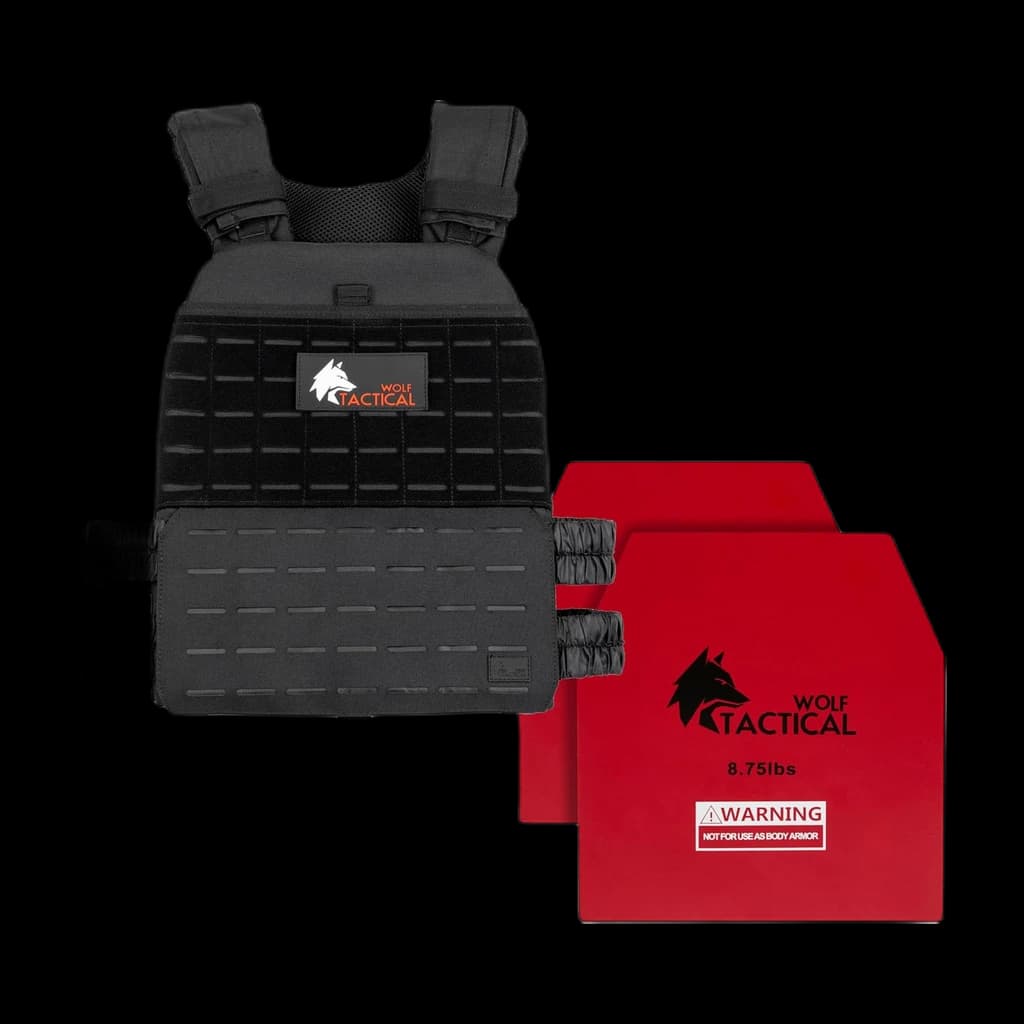
This is the plate-carrier answer rather than the vest answer, sold as a carrier plus a pair of plates so it arrives usable. The distinction is real: a carrier splits the load into two slabs, front and back, sitting high and close, which is much nearer to what a loaded pack does to your posture than a torso-hugging vest is. Ruckers who have tried both describe exactly that difference, and it is why plate carriers keep turning up in rucking discussions rather than in walking ones. WOLF TACTICAL states 600D construction, adjustable shoulder and waist straps, one size fits most from XS to XL, and support for medium and large plates in 14, 20, 31 or 42 lb configurations. It is warm, it is bulky, and it is the right tool if the goal is loaded distance rather than a discreet daily walk.
- Rucking and loaded distance work rather than gym sets
- Anyone who wants the load high and split front-to-back like a pack
- Buyers who already own or plan to buy standard training plates
- Outdoor training in cool weather where bulk is not a problem
- You want a vest to walk in for two hours in warm weather
- You need small progression steps rather than plate jumps
- You train in a tight indoor space where a bulky carrier is awkward
- You want the cheapest way to add ten pounds
None indoors beyond a hook and about 24 x 24 in of wall. The plates themselves want a flat spot on the floor or a shelf that can take the load; do not leave them balanced on a bench.
easy — Slide the plates into the front and back pockets and set the shoulder and waist straps. Budget one session to dial the fit — a carrier that is loose at the waist transfers everything to the shoulders, which is the complaint people mistake for the plates being too heavy.
A carrier is a distance-training tool that happens to live in a gym. It does not replace anything in a home setup, and it is the obvious buy only if loaded walking or rucking is already part of the week.
Strengths
- ↑Carrier plus plates in one purchase, so it is usable out of the box
- ↑Front-and-back plate split loads the traps and posture like a pack does
- ↑Adjustable at both shoulders and waist, one size covering XS to XL
- ↑Takes larger plates later, so the load ladder goes well past the included pair
Weaknesses
- ↓Bulky and hot; a poor choice for gym work in a crowded space
- ↓Plate steps are coarse — this is not a fine-progression tool
- ↓Cummerbund and strap setup takes a session to get right
- ↓Costs more than a simple neoprene vest of similar weight
What owners actually complain about
Synthesized from owner reviews and community threads. Paraphrased, not quoted.
- Bulk and heat are the recurring notes; this is equipment, not clothing
- Getting the shoulder and waist balance right takes a few outings
- Plate jumps mean load progression happens in large steps
- The included pair is a starting load, so most owners buy plates again
- Not the vest for weighted pull-ups in a low-ceiling space — it sits proud front and back
Buyer sentiment
Based on 49 user mentionsBuyers praise build quality and adjustability. Mixed feedback on plate fit. Some flag bulk.
Verdict: A carrier, not a vest. Buy it because you want a pack-like load for distance, not because you want something comfortable to walk to the shops in.
Specs that matter
| Spec | Value |
|---|---|
| Loading | Front and back plate pockets |
| Included | 8.75 lb plate pair |
| Plate support | Medium and large; 14/20/31/42 lb configurations |
| Shell | 600D construction |
| Sizing | One size fits most, XS-XL |
What you get
- Pack-like distribution — high and close, front and back, which is the point of a carrier
- A usable kit — carrier and plates together, so nothing is missing on day one
- Headroom — the pockets take far more than the included pair
What you give up
- Comfort and discretion — bulky, warm, unmistakably equipment
- Fine progression — the load moves in plate-sized steps
Buy it if rucking or loaded distance is the goal. Skip it if the use case is a daily walk.
For a sense of scale rather than a target: Army foot-march doctrine puts a conditioned soldier's approach-march load at up to 72 lb and documents the distance cost of every pound above 40.
Full specs
- Loading
- Front and back plate pockets
- Included Plates
- 8.75 lb pair
- Plate Support
- Medium and large plates, 14/20/31/42 lb configurations
- Shell
- 600D construction
- Sizing
- One size fits most (XS-XL)
- Adjustment
- Shoulder and waist straps
Common questions
Plate carrier or weighted vest for rucking?
They load you differently and that is the whole decision. A carrier puts two slabs high and close, front and back, which trains the traps and posture closer to the way a loaded pack does. A torso vest spreads the same weight around your ribs, which is more comfortable to walk in and less like carrying a pack. Rucking discussion consistently splits on exactly that line, and several people own both and switch mid-route to move the load.
How much weight should I ruck with?
Start low and progress by distance first. For a sense of the ceiling rather than a target, US Army foot-march doctrine caps a conditioned soldier's fighting load at 48 lb and the approach march load at 72 lb, roughly 45% of body weight, and prices every extra pound: six-hour march distance drops about 2 km for every 10 lb carried over 40 lb. That is a job requirement, not a training dose. Nothing about it says a fitness walk should start there.
Will standard gym plates fit?
The maker states support for medium and large plates and lists 14, 20, 31 and 42 lb configurations. Plate dimensions vary between brands more than the labelled weight does, so measure the pocket against the plate you intend to buy rather than assuming a standard.
Can you do pull-ups in a plate carrier?
You can, but a compact vest is better for it — the plates sit proud front and back and swing at the top of the rep. Whatever you wear, the binding limit is the bar: pull-up bar and tower ratings are total system load, body weight plus the added weight as one number, and they assume controlled static reps.
Sources & references
- ManufacturerWeighted Vest Plate Carrier — 600D construction, one size fits most, 14/20/31/42 lb configurations— WOLF TACTICAL
- FM 21-18, Foot Marches, Chapter 5 — Soldier's Load Management— US Army FM 21-18
- CommunityWeight vest vs pack (community discussion)— r/Rucking
- CommunityNormal weighted vest or plate-loaded version? (community discussion)— r/bodyweightfitness
Other weighted vests we rate
Ranked alternatives from the same category, with our score and the current price.
The RUNmax Pro is the vest to buy if you want one shell that grows with you for years. It is a shoulder-padded nylon carrier with removable weight packs, sold from 12 lb up to 60 lb, so the decision you make at checkout is a load ceiling rather than a fixed number. That matters more than it sounds: the single most common regret in weighted-vest threads is buying a fixed 20 lb vest and outgrowing it in a season. The trade is bulk. This is a training vest, not a garment — it sits proud of the chest, it is warm, and it is not the thing you wear to walk the dog in July. For loaded carries, step-ups, push-ups and weighted pull-ups, the padded yoke is the part you will be grateful for.
The Hyper Vest FIT is the only pick here designed around a short torso rather than shrunk from a men's pattern. Hyperwear states the load is carried in half-pound removable containers of steel shot, with no weights over the chest, up to 10 lb total, in a machine-washable Cordura shell with elastic side lacing. Every one of those choices answers a specific complaint women make about unisex vests: the load riding up onto the collarbone, the front panel sitting over the bust, jumps of five pounds when you wanted one, and a vest that cannot be washed after being worn for hours. The ceiling is the catch — 10 lb is a walking and daily-wear load, not a loaded-pull-up load. Buy it for the fit and the increments, and buy something else when you outgrow it.
For walking specifically, this is the most sensible shape in the list. Sportneer supplies eight 2 lb packs and one 1 lb pack, so the vest runs anywhere from 2 to 18 lb and steps in one-pound increments at the bottom of the range — which is exactly where a new walker should be living. It zips at the front rather than pulling over the head, the weights come out for washing, and the shoulders and waist lock independently, which is the single feature that stops a vest sliding side to side on a narrower frame. It is neoprene, so it holds heat and it is not the vest for a July afternoon. But at a walking load, on a body that a one-size unisex vest does not fit well, the independent locks matter more than the fabric.
The cheapest honest way to find out whether you will actually wear a weighted vest. It is a fixed-weight neoprene shell filled with iron sand, sold in 8, 12, 16, 20, 25 and 30 lb versions, with a double buckle strap sized for a 35 to 45 inch bust and reflective strips on both sides. Fixed weight is the whole trade: you cannot start at 5% of body weight and work up, you buy the number and live with it, and if you guess high the vest sits in a cupboard. Iron-sand vests also cannot be emptied, so they cannot be washed and they do eventually smell. As a one-month test of whether weighted walking fits your life, that is a defensible way to spend very little. As the vest you own in two years, it is not.
The Hyper Vest PRO is the one vest here you could wear under a jacket and the one that will not move when you run. Hyperwear states the load is carried in individual 2.25 oz galvanized steel weights only a quarter of an inch thick, distributed across a stretch compression shell with a front zip and side lacing, with maximum loads by size of 20 lb small, 25 lb medium, 30 lb large and 40 lb extra-large. Those tiny increments are the argument: a 2.25 oz step is finer than any progression rule needs, which means you can follow the load rather than jump to the next available number. It is expensive, and it is not a rucking tool — the load hugs your ribs rather than sitting high like a plate carrier. For running, HIIT and daily wear it is the reference.