 Best Budget
Rank #5 in Weighted Vests
Prodigen Weighted Vest
by ProdigenOptional
Score
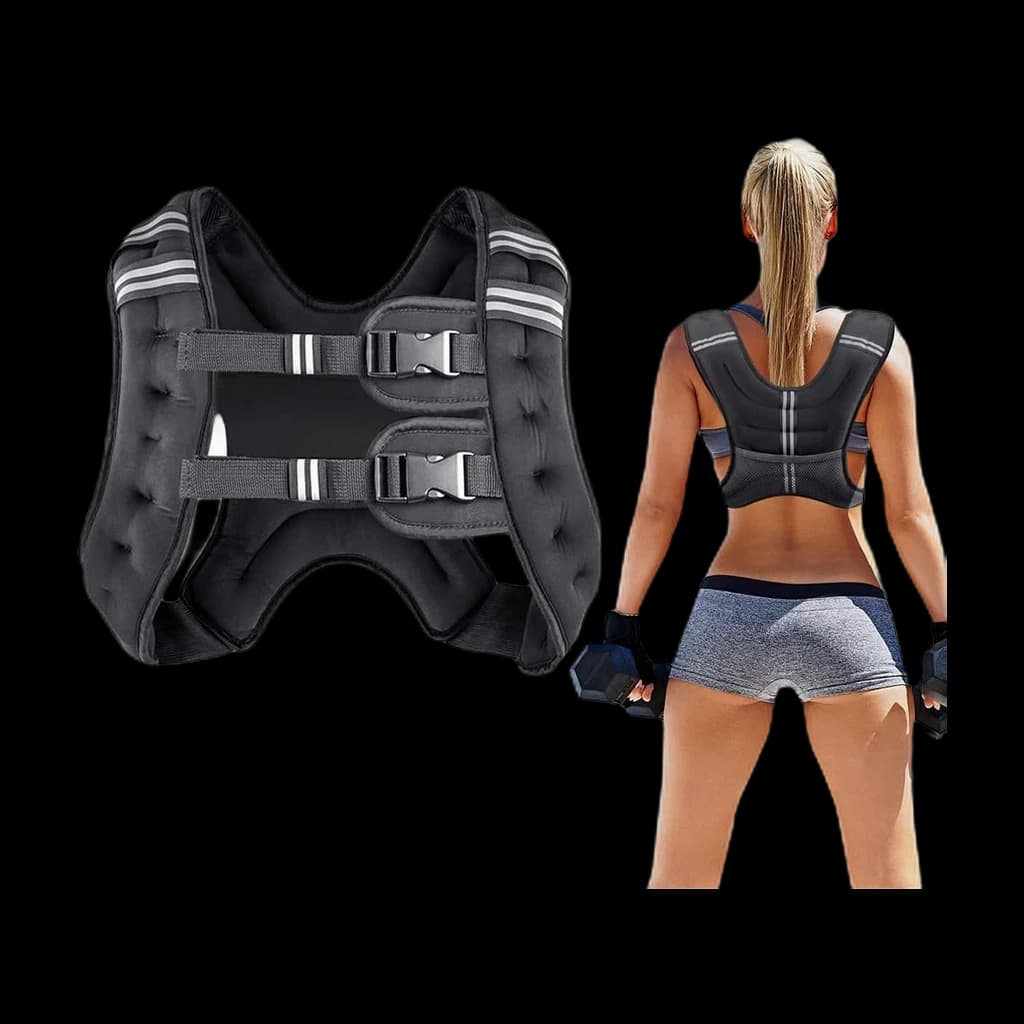
The cheapest honest way to find out whether you will actually wear a weighted vest. It is a fixed-weight neoprene shell filled with iron sand, sold in 8, 12, 16, 20, 25 and 30 lb versions, with a double buckle strap sized for a 35 to 45 inch bust and reflective strips on both sides. Fixed weight is the whole trade: you cannot start at 5% of body weight and work up, you buy the number and live with it, and if you guess high the vest sits in a cupboard. Iron-sand vests also cannot be emptied, so they cannot be washed and they do eventually smell. As a one-month test of whether weighted walking fits your life, that is a defensible way to spend very little. As the vest you own in two years, it is not.
- Finding out whether you will wear a vest before spending properly
- A known, fixed walking load you have already settled on
- Light warm-up and posture work rather than progressive training
- Gifting to someone curious about weighted walking
- You want to progress the load — a fixed vest cannot do it
- You will wear it for hours and want to wash it
- You need a precise starting weight matched to your body weight
- You want it to last several years of daily use
None. A hook or a shelf. Nothing about a fixed vest asks anything of the room.
easy — No assembly. Check the wear direction before the first outing — the elastic edge goes at the waist, and wearing it inverted is the most common early complaint. Then run the three-step jog test to check for bounce.
This is a trial purchase, not a foundation. Buy it to find out whether weighted walking sticks, then buy an adjustable vest when it does.
Strengths
- ↑Lowest cost of entry by a wide margin
- ↑Simple neoprene shell with double-stitched seams to resist sand leaks
- ↑Reflective strips on both sides for early-morning or evening walks
- ↑Sold in six fixed weights, so you can match a known target
Weaknesses
- ↓Fixed weight — no progression without buying another vest
- ↓Iron sand cannot be removed, so the vest cannot be washed
- ↓One strap sizing means a narrow or broad frame gets a coarse fit
- ↓Seams are the failure point; a leak ends the vest
What owners actually complain about
Synthesized from owner reviews and community threads. Paraphrased, not quoted.
- Fixed weight is the complaint that eventually applies to everyone who keeps training
- Iron sand leaks at the seams on a minority of units, and there is no repair
- It cannot be washed, so long-term odour is a matter of when, not if
- The single buckle strap fits a middle range of frames well and the edges poorly
- Labelled weight sits within a loose tolerance rather than a precise one
Buyer sentiment
Based on 4,424 user mentionsBuyers praise value for money, comfort and fit. Mixed feedback on weight accuracy. Some flag durability.
Verdict: The trial vest. Cheap enough to find out whether weighted walking sticks, fixed enough that it will not be the vest you keep.
Specs that matter
| Spec | Value |
|---|---|
| Loading | Sewn-in iron sand, not removable |
| Weights offered | 8, 12, 16, 20, 25, 30 lb |
| Shell | Neoprene (chloroprene rubber) |
| Adjustment | Double buckle strap, 35-45 in bust |
| Washable | No |
What you get
- A very low entry cost — the cheapest honest answer to "will I wear this?"
- Reflective panels — the one safety feature that actually matters on a dawn walk
- Six weight options — you can match a load you have already chosen
What you give up
- Progression — fixed is fixed
- Washability — sewn-in sand cannot come out, and neither can the smell
Buy it if you are testing the habit. Skip it if you already know you will keep going.
Start at roughly 5% of body weight, per UCLA Health's published guidance, and add distance before you consider a heavier vest.
Full specs
- Loading
- Sewn-in iron sand, not removable
- Load Range
- Fixed 8, 12, 16, 20, 25 or 30 lb
- Shell
- Neoprene (chloroprene rubber)
- Adjustment
- Double buckle strap, 35-45 in bust
- Visibility
- Reflective strips both sides
- Washable
- No
Common questions
Which fixed weight should I buy?
Work from your body weight, not from the cheapest option. UCLA Health's published starting point for a new walker is about 5% of body weight — roughly 7 to 8 lb at 150 lb — so the 8 lb version is the honest first buy for most adults, and the 12 lb one if you already walk regularly. Buying heavy to save a second purchase is how a vest ends up unused in a cupboard.
Is a cheap vest safe?
The risk is not the price, it is the load and the fit. A vest that shifts side to side chafes and strains one shoulder, and any vest is a bad idea straight away if you have a back or neck injury or arthritis in the hips, knees or ankles — UCLA Health names all three as reasons to ask a doctor first. Fit it snug, start light, and progress by distance.
Can I run in it?
Short distances, yes, but read the running evidence first. A 2024 study of trained trail runners found an added 5% of body mass produced no noticeable physiological or mechanical change while 10% cut time to exhaustion by 6%. On a fixed vest you cannot tune to 5%, which is a real argument for an adjustable one if running is the plan.
How long do these last?
Longer than the price suggests if it is used for walking, and less long if it is dropped on the floor after weighted push-ups. The failure mode is a seam letting go and iron sand escaping, and because the fill is sewn in there is no repair — which is the structural reason removable-weight vests outlive sewn-in ones.
Sources & references
- Should you walk with a weighted vest?— UCLA Health
- ResearchWeighted vest at 0%, 5% and 10% of body mass in trained trail runners, 2024— Sports (MDPI)
- CommunityNormal weighted vest or plate-loaded version? (community discussion)— r/bodyweightfitness
- CommunityWeighted vest recommendations (community discussion)— r/homegym
Other weighted vests we rate
Ranked alternatives from the same category, with our score and the current price.
The RUNmax Pro is the vest to buy if you want one shell that grows with you for years. It is a shoulder-padded nylon carrier with removable weight packs, sold from 12 lb up to 60 lb, so the decision you make at checkout is a load ceiling rather than a fixed number. That matters more than it sounds: the single most common regret in weighted-vest threads is buying a fixed 20 lb vest and outgrowing it in a season. The trade is bulk. This is a training vest, not a garment — it sits proud of the chest, it is warm, and it is not the thing you wear to walk the dog in July. For loaded carries, step-ups, push-ups and weighted pull-ups, the padded yoke is the part you will be grateful for.
The Hyper Vest FIT is the only pick here designed around a short torso rather than shrunk from a men's pattern. Hyperwear states the load is carried in half-pound removable containers of steel shot, with no weights over the chest, up to 10 lb total, in a machine-washable Cordura shell with elastic side lacing. Every one of those choices answers a specific complaint women make about unisex vests: the load riding up onto the collarbone, the front panel sitting over the bust, jumps of five pounds when you wanted one, and a vest that cannot be washed after being worn for hours. The ceiling is the catch — 10 lb is a walking and daily-wear load, not a loaded-pull-up load. Buy it for the fit and the increments, and buy something else when you outgrow it.
For walking specifically, this is the most sensible shape in the list. Sportneer supplies eight 2 lb packs and one 1 lb pack, so the vest runs anywhere from 2 to 18 lb and steps in one-pound increments at the bottom of the range — which is exactly where a new walker should be living. It zips at the front rather than pulling over the head, the weights come out for washing, and the shoulders and waist lock independently, which is the single feature that stops a vest sliding side to side on a narrower frame. It is neoprene, so it holds heat and it is not the vest for a July afternoon. But at a walking load, on a body that a one-size unisex vest does not fit well, the independent locks matter more than the fabric.
This is the plate-carrier answer rather than the vest answer, sold as a carrier plus a pair of plates so it arrives usable. The distinction is real: a carrier splits the load into two slabs, front and back, sitting high and close, which is much nearer to what a loaded pack does to your posture than a torso-hugging vest is. Ruckers who have tried both describe exactly that difference, and it is why plate carriers keep turning up in rucking discussions rather than in walking ones. WOLF TACTICAL states 600D construction, adjustable shoulder and waist straps, one size fits most from XS to XL, and support for medium and large plates in 14, 20, 31 or 42 lb configurations. It is warm, it is bulky, and it is the right tool if the goal is loaded distance rather than a discreet daily walk.
The Hyper Vest PRO is the one vest here you could wear under a jacket and the one that will not move when you run. Hyperwear states the load is carried in individual 2.25 oz galvanized steel weights only a quarter of an inch thick, distributed across a stretch compression shell with a front zip and side lacing, with maximum loads by size of 20 lb small, 25 lb medium, 30 lb large and 40 lb extra-large. Those tiny increments are the argument: a 2.25 oz step is finer than any progression rule needs, which means you can follow the load rather than jump to the next available number. It is expensive, and it is not a rucking tool — the load hugs your ribs rather than sitting high like a plate carrier. For running, HIIT and daily wear it is the reference.