Vibration Plate Benefits: 9 Claims, Graded by the Evidence
Bone density, circulation, balance, recovery, fat loss: each vibration plate benefit graded strong, mixed or weak, with the trial data behind it.
The evidence splits sharply by claim. Strong: lower-limb strength in adults over 60 (knee extensors SMD 0.53, p < 0.00001 across 34 pooled trials) and a large acute rise in peripheral blood flow, up to 322% above control during 25 Hz exposure. Mixed: bone density at three hip sites but not total hip, functional mobility measured by Timed Up and Go, a 7.01 mmHg systolic blood pressure reduction in overweight adults, and muscle soreness relief from trials the reviewers themselves called poor quality. Weak or unsupported: fat loss and body composition (pooled null, GRADE quality low), upper-body strength, power and endurance (no significant effect), and lymphatic drainage or detox (no randomized trial exists).
How GymScored is paid: Amazon Associates commission plus brand-direct affiliate (Rogue / REP / Titan when approved). No sponsored placements, no paid reviews, no pay-to-rank. Picks are ranked by the Gym Score formula and nothing else. Read the full disclosure.
Of the nine benefits marketed for vibration plates, two are well supported (lower-limb strength in older adults, a large but short-lived rise in peripheral blood flow), three are mixed and worth knowing about (hip-region bone density, functional mobility, blood pressure), one rests on low-quality trials (muscle soreness), and three are not supported by pooled data at all (fat loss, upper-body strength and power, lymphatic drainage).
Nine claims, one grade each
Vibration plate benefits are marketed as one flat list and researched as a very uneven one, and the two lists do not match. The marketing list is bone density, circulation, strength, balance, recovery, weight loss, detox, cellulite, lymphatic drainage — presented flat, as if each were equally established.
They are not. Some of these have pooled randomized-trial evidence with significant effects and tight confidence intervals. Some have meta-analyses that come back null. One has effectively no controlled evidence at all.
Our evidence review of vibration plates answers the top-level question: does the machine do anything. This page is the level below it — every individual claim, graded, with the study behind the grade.
The one we would buy: for the claims that graded well below, the LifePro Waver Vibration Plate at $199.99 — the plate we rank first in best vibration plates for home; Power Plate is the only one that publishes its frequency, at nine times the price.
How we grade
- Strong — pooled randomized trials in a meta-analysis, significant effect, consistent direction, decent study quality.
- Mixed — meta-analytic evidence exists and points somewhere, but the trials are small, unblinded, heterogeneous, or the effect depends heavily on protocol.
- Weak — pooled analysis returns null, evidence quality is rated low, or nothing controlled exists to pool.
We do not test equipment. Every grade below comes from published trials, and every one names its source.
| Claim | Population studied | Evidence | What the pooled data shows |
|---|---|---|---|
| Lower-limb strength | Adults 60+ | Strong | Knee extensors SMD 0.53, p < 0.00001 |
| Hip-region bone density | Women 60-93 | Mixed | Significant at three hip sites, null at total hip |
| Balance and mobility | Adults 60+ | Mixed | Timed Up and Go improves; sit-to-stand does not |
| Acute peripheral circulation | Adults, mixed ages | Strong for the acute effect | Foot skin blood flow up to 322% higher during exposure |
| Blood pressure | Overweight and obese adults | Mixed | Systolic down 7.01 mmHg, called clinically significant |
| Muscle soreness and recovery | Trained and untrained adults | Mixed | Large pain reductions, poor study quality |
| Fat loss and body composition | Adults 60+ | Weak | No significant effect, GRADE quality low |
| Upper-body strength, power, endurance | Adults 60+ | Weak | No significant effect on any of the three |
| Lymphatic drainage and detox | Nobody, in a trial | Weak | No randomized trial with a lymphatic outcome |
Vibration plate benefits at a glance
| Benefit claim | Evidence quality | Source behind the grade |
|---|---|---|
| Lower-limb strength, adults 60+ | Strong | 2023 meta-analysis, 34 randomized trials (Journal of Clinical Medicine) |
| Acute peripheral circulation | Strong for the acute effect | 2020 trial in 30 older adults at 15/20/25 Hz (IJERPH) |
| Hip-region bone density | Mixed, site-specific | 2026 updated meta-analysis, 14 trials, 1,447 adults (BMC Musculoskeletal Disorders) |
| Balance and functional mobility | Mixed | 2023 network meta-analysis, 25 trials (Frontiers in Physiology) |
| Blood pressure, overweight adults | Mixed, one pooled analysis | 2021 meta-analysis, 23 trials, 884 participants (Arch Phys Med Rehabil) |
| Muscle soreness and recovery | Mixed, poor study quality | 2019 meta-analysis, 10 trials, 258 participants (J Int Med Res) |
| Fat loss and body composition | Weak, pooled null | 2023 meta-analysis, 8 trials, 661 adults, GRADE low (Frontiers in Physiology) |
| Upper-body strength, power, endurance | Weak, pooled null | Same 2023 review of 34 trials as the strength row |
| Lymphatic drainage and detox | Weak, no controlled evidence | No randomized trial with a lymphatic outcome exists |
Strong: lower-limb strength in older adults
This is the claim the category actually earns. A 2023 systematic review and meta-analysis pooled 34 randomized trials of whole-body vibration in adults over 60 and found significant improvements across every lower-limb muscle group it examined: knee extensors (SMD 0.53, 95% CI 0.32-0.74, p < 0.00001), knee flexors (0.64, p = 0.0002), leg extensors (0.68, p = 0.009) and ankle plantar flexors (0.65, p = 0.02).
For scale, a standardized mean difference around 0.5 is a moderate effect — the kind of change a person notices in stairs and sit-to-stand, not a physique transformation.
The catch is population. These are trials in older and deconditioned adults. Nothing here says a trained 30-year-old gains leg strength from a plate, and the same review found traditional training outperformed vibration for strength in a later network analysis.
Strong, but brief: acute peripheral circulation
Circulation is the most reliably reproduced short-term effect. In 30 healthy older adults exposed to three one-minute bouts at 4 mm displacement, foot skin blood flow rose 126-150% above control at 15 Hz, 171-206% at 20 Hz and 300-322% at 25 Hz (p < 0.001). An earlier trial of 45 adults aged 18 to 43 found vibration alone roughly doubled mean skin blood flow, holding for at least ten minutes afterwards.
Grade the duration, not just the direction. The effect is large and it is temporary — a post-session flush, not a change in your vascular health. And it is measured in skin blood flow, which is why the lymphatic drainage claim does not follow from it.
Mixed: hip-region bone density
An updated 2026 meta-analysis pooled 14 randomized trials covering 1,447 adults aged 60 to 93, 96% of them women, and found the effect is site-specific rather than systemic:
| Bone site | Studies | WMD | p-value |
|---|---|---|---|
| Ward's triangle | 7 | 0.04 | < 0.00001 |
| Greater trochanter | 7 | 0.03 | 0.0002 |
| Femoral neck | 10 | 0.01 | 0.01 |
| Lumbar spine L2-L4 | 3 | 0.04 | 0.003 |
| Lumbar spine L1-L4 | 5 | 0.00 | 0.79 |
| Total hip | 4 | 0.01 | 0.56 |
Three hip sites and one lumbar segment moved. Total hip and the wider L1-L4 lumbar measure did not. That is a genuinely useful finding for fall-and-fracture risk in older women — and it is not the same sentence as "vibration plates build bone."
Bone density is a medical matter. If you are managing osteopenia or osteoporosis, this belongs in a conversation with your doctor alongside whatever else you are doing, not instead of it.
Mixed: balance and mobility
A 2023 network meta-analysis of 25 randomized trials (1,267 older adults) sorted protocols into low frequency (under 30 Hz), medium (30 to 45 Hz) and high (above 45 Hz). Low-frequency training significantly improved Timed Up and Go scores against both placebo and traditional rehabilitation (WMD -1.37 and -1.84). But five-repetition sit-to-stand improved in every arm without reaching statistical significance in any of them.
A 2026 network meta-analysis of 27 trials (1,608 participants) reached a similar split verdict: high-frequency vibration ranked best for dynamic balance and gait, medium-frequency for static balance — and traditional training ranked best for muscle strength.
The honest read: vibration plausibly helps functional mobility in older adults, the optimal frequency is unsettled, and for raw strength conventional training still wins.
Mixed: recovery and muscle soreness
A 2019 meta-analysis of 10 trials (258 participants) found vibration significantly reduced soreness on visual analogue scales at 24, 48 and 72 hours after exercise, with the largest effect at 48 hours (SMD -2.04), and lowered creatine kinase at 24 and 48 hours but not 72. A 2022 meta-analysis reached broadly the same conclusion on pain, pain threshold, creatine kinase and lactate dehydrogenase.
Those effect sizes look enormous. Treat them with suspicion: the 2019 authors described the existing evidence as "relatively poor," citing small samples, lack of blinding and heterogeneity above 50%. You cannot blind someone to whether a platform is vibrating, so placebo response is baked into every trial in the pool.
Both reviews also mixed whole-body platforms with local vibration devices applied directly to muscle — closer to a massage gun than a plate for some of the included studies.
Mixed, and underrated: blood pressure
The most interesting finding in this whole cluster is one almost nobody markets. A 2021 meta-analysis of 23 trials (884 overweight or obese participants) found whole-body vibration training reduced systolic blood pressure by 7.01 mmHg — which the authors flagged as clinically significant — plus 1.83 mmHg diastolic and 2.23 bpm resting heart rate, and improved lower-extremity strength (SMD 0.63).
It is one meta-analysis in one population, so it is not a strong grade. But a 7 mmHg systolic change would be a more meaningful health outcome than anything else on this page. If you are on blood pressure medication, that is a reason to mention a new plate to your doctor rather than a reason to skip the appointment.
Weak: fat loss and body composition
This is where the category's biggest marketing promise collapses. A 2023 systematic review and meta-analysis of 8 randomized trials in 661 adults over 60 found no significant effect on fat mass (p = 0.19), lean mass (p = 0.67) or skeletal muscle mass (p = 0.91), with GRADE quality of evidence rated low for all three. The authors' conclusion is blunt: whole-body vibration "did not demonstrate improvements in body composition."
The 2021 overweight-and-obese meta-analysis found a fat-mass reduction of 1.07 kg — and explicitly labelled it not clinically significant. It also found no change in weight, BMI, muscle mass, cholesterol, triglycerides or glucose.
Two independent pooled analyses, two different populations, same answer. A vibration plate is not a weight-loss device.
Weak: upper body, power and endurance
The same 2023 meta-analysis that found significant lower-limb strength gains found no significant effect on handgrip strength, on lower-limb power (countermovement jump, five-times sit-to-stand), or on muscular endurance in either the upper or lower body.
There is no mechanism story to rescue here. You stand on the thing; your arms are along for the ride.
Weak: lymphatic drainage, detox and cellulite
No randomized controlled trial has tested a consumer vibration plate against a lymphatic outcome. The circulation data does not transfer, because skin blood flow is blood, not lymph. We walk through the mechanism evidence, the one small tilt-table study that touches lymphatic flow, and the safety cautions in vibration plates and lymphatic drainage.
Cellulite and detox claims have no trial evidence in this category at all.
What the graded evidence implies about protocol
Read across the trials and a consistent shape appears.
Frequency is a real variable. Circulation responses scaled with frequency from 15 to 25 Hz. Balance outcomes split by frequency band. If a plate does not publish hertz — and most consumer plates market a 1-99 speed scale instead — you cannot match a studied protocol.
Active movement, not passive standing. The strength trials had participants doing squats, holds and calf raises on the platform; standing still was not the intervention. Our vibration plate exercise guide lays those positions out with hold times and two sample routines.
Weeks, not sessions. Strength and bone outcomes came from multi-week programmes, typically two or three sessions a week. The only same-day effect on this page is circulation.
Your starting point sets your ceiling. Almost every positive trial studied adults over 60. The less trained you are, the more the evidence applies to you.
If you are buying on this evidence
The vibration plates category carries our full Gym Score ranking. Two notes that follow directly from the research above: the LifePro Waver is the reasonable entry point for seated leg work, and the Power Plate Personal is the only plate we list that publishes its vibration frequency in hertz (a fixed 35 Hz), which is the one spec that lets you compare your session against a published protocol.
If your actual goal is strength or body composition, the honest recommendation is adjustable dumbbells instead. Progressive overload is what the null results on this page keep pointing back to.
Bottom line
Vibration plates have one strong claim (lower-limb strength in older adults), one strong but short-lived one (acute circulation), three mixed ones worth knowing about (hip bone density, functional mobility, blood pressure), one mixed claim built on weak trials (soreness), and three that the pooled data does not support (fat loss, upper-body and power gains, lymphatic drainage). Buy on the first group, be pleasantly surprised by the third, and ignore the last. If you have osteoporosis, high blood pressure or a circulatory condition, run the plan past your doctor first.
Sources
- Impacts of Whole-Body Vibration on Muscle Strength, Power, and Endurance in Older Adults: A Systematic Review and Meta-Analysis (PMC, 2023)
- Whole-body vibration training and bone mineral density in older adults: an updated systematic review and meta-analysis (BMC Musculoskeletal Disorders, 2026)
- Effects of whole-body vibration training with different frequencies on the balance ability of the older adults: a network meta-analysis (Frontiers in Physiology, 2023)
- Does Frequency of the Mechanical Vibration Matter? Evaluating the Impact of Whole-Body Vibration Training on Older Adults Strength, Balance, and Gait Performance (Archives of Physical Medicine and Rehabilitation, 2026)
- Acute Effects of Whole-Body Vibration on Peripheral Blood Flow, Vibrotactile Perception and Balance in Older Adults (PMC, 2020)
- The effect of whole body vibration on lower extremity skin blood flow in normal subjects (Medical Science Monitor, 2007)
- Effects of Whole-Body Vibration Training on Body Composition, Cardiometabolic Risk, and Strength in the Population Who Are Overweight and Obese (Archives of Physical Medicine and Rehabilitation, 2021)
- Evidence of whole-body vibration exercises on body composition changes in older individuals: a systematic review and meta-analysis (Frontiers in Physiology, 2023)
- Does vibration benefit delayed-onset muscle soreness? A meta-analysis and systematic review (Journal of International Medical Research, 2019)
- The effect of vibration training on delayed muscle soreness: A meta-analysis (Medicine, 2022)
Frequently Asked Questions
What are the proven benefits of a vibration plate?+
Two claims have solid pooled evidence. A 2023 meta-analysis of 34 randomized trials found significant lower-limb strength gains in adults over 60, with knee extensors at SMD 0.53 (p < 0.00001). And whole-body vibration produces a large immediate increase in peripheral blood flow — up to 322% above control during 25 Hz exposure in one study of older adults — though that effect fades within minutes of stepping off.
Do vibration plates help you lose weight?+
No. A 2023 meta-analysis of 8 randomized trials in 661 adults over 60 found no significant effect on fat mass, lean mass or skeletal muscle mass, with GRADE evidence quality rated low. A 2021 meta-analysis of 23 trials in overweight and obese adults found a 1.07 kg fat-mass reduction that the authors themselves labelled not clinically significant, and no change in weight, BMI, cholesterol, triglycerides or glucose.
How often should you use a vibration plate to get the studied benefits?+
The strength and bone-density trials ran for weeks, typically two or three sessions per week, with participants doing active movements on the platform such as squats, holds and calf raises. Passive standing was not the intervention studied. Circulation is the only benefit on this list that appears within a single session.
Does vibration training help muscle soreness?+
Probably, but the evidence is weak. A 2019 meta-analysis of 10 trials found significant reductions in soreness at 24, 48 and 72 hours, largest at 48 hours, plus lower creatine kinase at 24 and 48 hours. The same authors described the evidence base as relatively poor, citing small samples, absent blinding and high heterogeneity. You cannot blind a participant to whether a platform is vibrating, so placebo effects are unavoidable in this literature.
Is a vibration plate better than regular strength training?+
No. A 2026 network meta-analysis of 27 trials in older adults ranked traditional training as the best option for muscle strength, with vibration frequency bands ranking higher only for dynamic balance and gait performance. Vibration is a supplement to loaded resistance work, not a replacement for it.
Sources & Research
- PMC — Impacts of Whole-Body Vibration on Muscle Strength, Power, and Endurance in Older Adults: A Systematic Review and Meta-Analysis (2023)research
- BMC Musculoskeletal Disorders — Whole-body vibration training and bone mineral density in older adults: an updated systematic review and meta-analysis (BMC Musculoskeletal Disorders, 2026)research
- Frontiers in Physiology — Effects of whole-body vibration training with different frequencies on the balance ability of the older adults: a network meta-analysisresearch
- Archives of Physical Medicine and Rehabilitation — Does Frequency of the Mechanical Vibration Matter? Whole-Body Vibration Training on Older Adults Strength, Balance, and Gait Performanceresearch
- International Journal of Environmental Research and Public Health — Acute Effects of Whole-Body Vibration on Peripheral Blood Flow, Vibrotactile Perception and Balance in Older Adultsresearch
- Medical Science Monitor — The effect of whole body vibration on lower extremity skin blood flow in normal subjectsresearch
- Archives of Physical Medicine and Rehabilitation — Effects of Whole-Body Vibration Training on Body Composition, Cardiometabolic Risk, and Strength in the Population Who Are Overweight and Obeseresearch
- Frontiers in Physiology — Evidence of whole-body vibration exercises on body composition changes in older individuals: a systematic review and meta-analysisresearch
- Journal of International Medical Research — Does vibration benefit delayed-onset muscle soreness? A meta-analysis and systematic reviewresearch
- Medicine — The effect of vibration training on delayed muscle soreness: A meta-analysisresearch
Related reviews
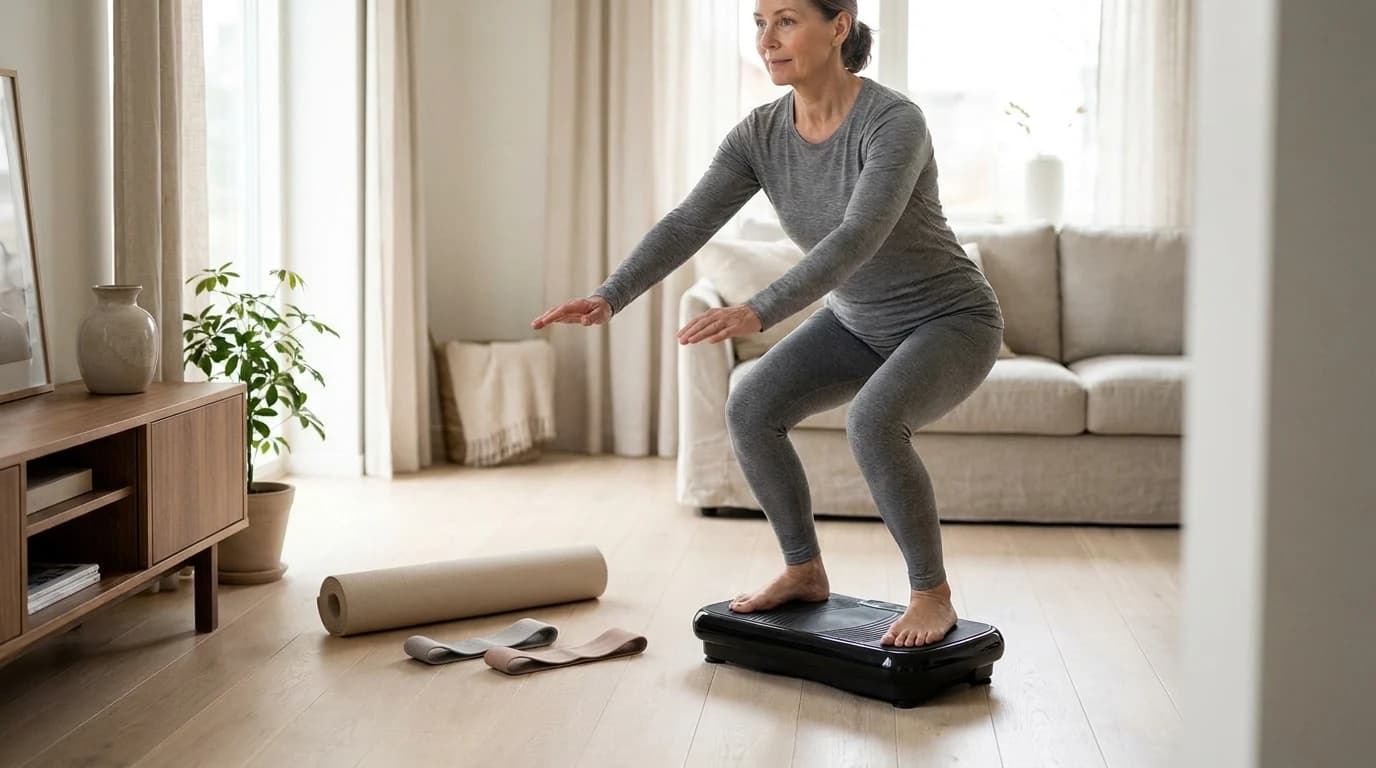
Vibration Plate Exercises: 14 Moves, Grouped by Goal
Fourteen vibration plate exercises grouped by goal, with hold times, weekly frequency, 10- and 20-minute routines, and the safety rules that apply.
Do Vibration Plates Actually Work? What the Science Says
Vibration plates build lower-limb strength and some hip-bone density in older adults - but the research kills the fat-loss claim. What the science shows.
Best Vibration Plates for Home Use in 2026: LifePro Waver Wins
The LifePro Waver is the best value vibration plate; the Power Plate Personal wins the premium tier on published frequency. Four plates ranked.
Hilly Shore Labs
Editorial teamThe independent product research team behind GymScored. Every recommendation is researched, never hands-on tested — rankings come from manufacturer specifications, published standards, and aggregated buyer sentiment.
161 products scored across 26 home gym categories, each on the same 5-dimension Gym Score formula.
See the scoring methodology and who we are.
Affiliate disclosure: GymScored is a participant in the Amazon Services LLC Associates Program. We earn from qualifying purchases at no extra cost to you. Full disclosure →